Yara's NDE: The Journalist Who Died on the Operating Table
A routine procedure became a journey to the edge of existence, where she learned that returning to life requires permission from the other side
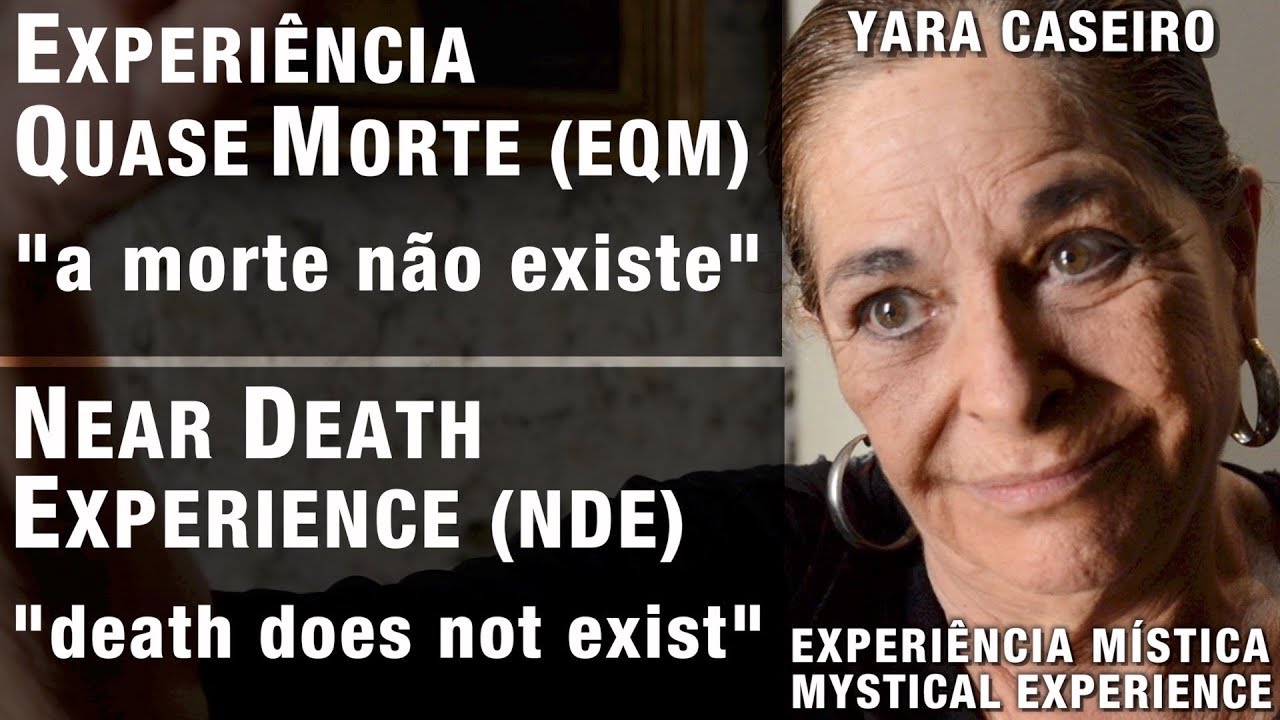
Yara was lying on a stretcher in a gynecologist's office when everything went dark. She'd agreed to a quick anesthesia for a routine IUD insertion, nothing serious, just a favor from a doctor who knew her family. Fifteen minutes, he said. She'd wake up and walk to her mother's hospital room. Instead, she woke up in a white tunnel surrounded by the recently dead, desperate and alone, begging strangers for help that wouldn't come. She knew with absolute certainty that she'd died. She also knew, though no one told her, that she wasn't supposed to be there. And she understood something the doctors working to revive patients never see: the decision to return isn't made in the ICU. It's made on the other side.
The Woman Who Wasn't Supposed to Die
Yara was 34 years old, a working journalist in São Paulo, splitting her time between fashion columns and her mother's deathbed. Her mother was in a hospital in Guarulhos, dying slowly from a final illness. Yara would stay with her through the night, leave when her father arrived in the morning, then head to the newspaper office. It was a grinding routine, emotionally exhausting, the kind of schedule that makes you agree to things you normally wouldn't.
On this particular morning in 1989, before heading to work, she stopped by the gynecologist's office inside the hospital. She wanted an IUD placed. She'd done this procedure several times before, never with anesthesia. But the doctor, who knew her family from his practice in Tucuruvi, insisted. "Because of the emotional process you are going through, you are accompanying your mother," he said. The anesthesiologist appeared and promised her she'd wake up in fifteen minutes, able to walk back to her mother's room on her own.
She agreed. The anesthesiologist administered the drug, and she blacked out. No pain, no transition, just instant darkness.
What happened next would stay vivid in her mind for 34 years, clear as the moment it occurred, more real than any dream she'd ever had.
Inside the White Tunnel
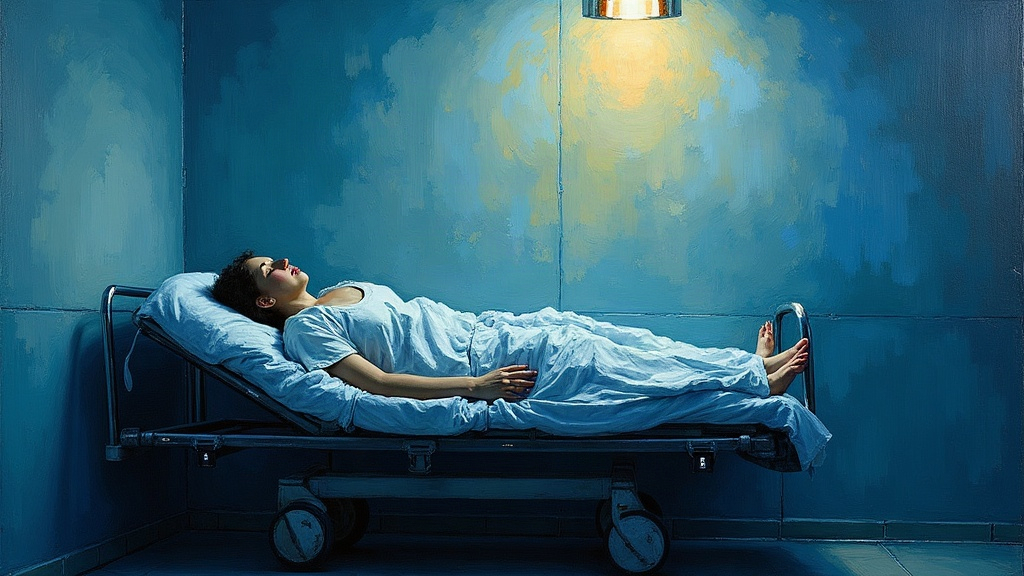
Yara didn't see herself from above, didn't watch doctors working on her body. She simply appeared inside a white tunnel. Not a metaphorical tunnel, not a hazy impression. A real place, physical in its dimensions, "wonderful, harmonious, an agreeable place," she says, though nothing about it felt agreeable to her.
She was terrified.
The tunnel stretched in both directions, and along its walls stood white stretchers, maybe fifteen on each side, thirty in total. Beside each stretcher stood a nurse, their backs turned to her, attending to the person lying there. "I considered it an infirmary," Yara recalls. She walked up and down the central path, frantic, calling out for help.
"Nobody said anything to me, no one saw me, but I knew I was dead," she says. "Just arrived, and those were all dead too, just arrived, and being assisted." She understood, without being told, that everyone on those stretchers had just died. They were being helped. She was not.
"I was absolutely sure that I was not assisted by anyone. I was alone there because I was going to return," she explains. "But an authorization was required."
This is where Yara's account becomes especially striking. She didn't just experience the tunnel. She received knowledge about how it works. "I felt that my decision of willing to return was important, but it was necessary an authorization," she says. She saw part of a hierarchy, something vast and structured, and she knew her place in it: at the base, waiting for someone higher up to grant her passage back.
And she knew something else, something that might trouble the doctors who fight so hard to resuscitate the dying: "When the doctor manages to resurrect here, it is because this has already been authorized there," she says. "This is clear to me."
The Boundary She Couldn't Cross
Desperate for a way out, Yara walked toward the end of the tunnel where it tapered into a funnel shape. "I thought that if I went to the edge of that tunnel funnel, I might find a way out for me," she says. She kept walking, kept pleading. "Help me, please, somebody help me, I need to go back, please, who am I waiting for?"
When she reached the end, something extraordinary happened. A new tunnel opened up, twice the size of the first, "sparkling white, something very lucid, a wonderful thing." It appeared in seconds, massive and empty, and Yara stopped cold.
"I had an impression: 'No. I can not get in here,'" she says. No voice told her this was a boundary. No sign marked the limit. "No one told me there was a limit, but I knew it," she explains. "'No, I can not go in here. I'd better go back. Let me go back because there are people there who will see me.'"
She turned around and walked back to the infirmary area, back to the stretchers and the nurses who wouldn't look at her. She kept asking for help. "Please, someone listen to me," she called out. "And no one was looking at me, nobody saw me, nobody heard me, nobody did anything at all."
Until one did.
The Authorization
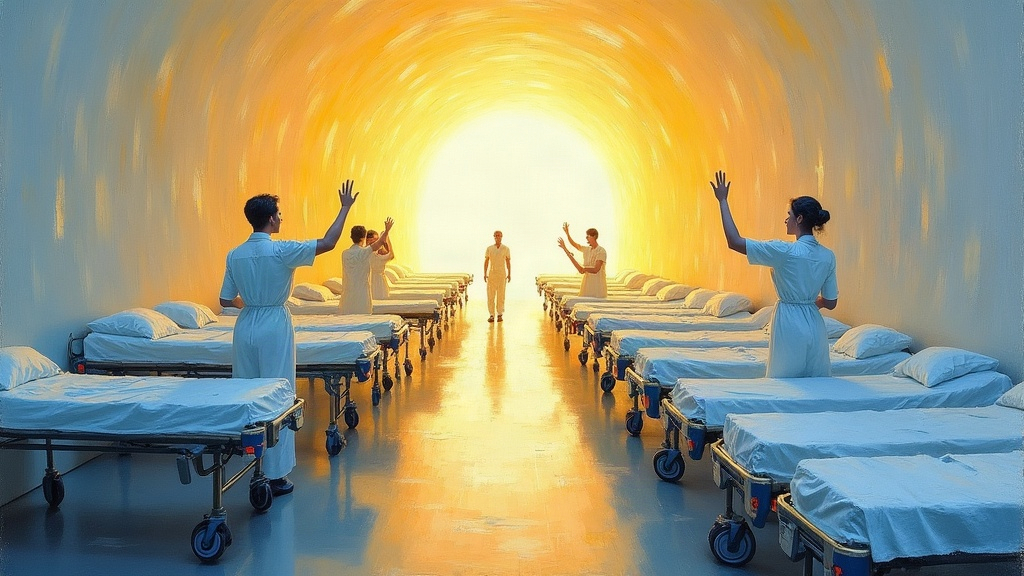
One of the nurses, a woman, looked at Yara and raised her hand, "as if authorizing me," she says. "And at that moment, I felt my body coming into my body."
She was back. Not in the gynecologist's office, but in her mother's hospital room, lying on the companion's bed. A nurse had just placed her there and was leaving. Yara's father stood nearby, confused and worried.
What Yara felt next is one of the most unusual details in her account. "I felt, through my feet, entering a very heavy mass, as if it weighed two tons, entering and fitting into my body," she describes. "It did not hurt, it was no sacrifice at all, that just scared me: 'What's that? What came into me?' That is, my body."
Five minutes later, she was fully awake, standing, talking to her father. She felt no pain, no grogginess beyond normal sleepiness. The body had "fit perfectly," she says.
Her father was bewildered. "My daughter, where were you? What happened?" he asked. Yara hadn't told him about the procedure. He thought she'd gone straight to work. But it was now 11:30 at night. She'd left the room around 9 or 10 that morning.
What Happened in the Observation Room
Yara pieced together the timeline later by asking her father what the nurse had told him. The story that emerged is almost as disturbing as the NDE itself.
After the procedure, both the gynecologist and the anesthesiologist left at the end of their shift. The morning nursing team left too. The afternoon team arrived and found Yara lying unconscious in the observation room with no medical record, no notes, no explanation. They left her there. The night team arrived and found the same thing: an unknown woman, still sleeping, no documentation.
Finally, one of the night nurses recognized her. "I know this woman, she is the daughter of that lady who is hospitalized in that room," the nurse said. They brought her to her mother's room, still unconscious.
Yara woke up the moment the nurse left the room, right after answering her father's questions. The timing feels significant to her. "It was just the exact time for the nurse to put me in bed, leave the room after answering what my father asked her," she notes.
She'd been unconscious for roughly thirteen hours. The doctor had promised fifteen minutes. He'd performed the procedure as a favor, off the books, and then left the hospital with no record of what he'd done. "I really could have died," Yara says. "I died. For me, I died."
She's never pursued the matter legally. "I know I'm going to complicate these professionals," she explains. She suspects she had an anesthetic reaction. In the three surgeries she's undergone since, she always warns the anesthesiologist about her NDE. Their response is always the same: "Do not worry, you're here in a hospital that has all the necessary resources to bring you back," they tell her.
"But they barely know, Carlos, that the resources, I can not guarantee, but I think the resources are not here in the hospital. They are there," she says. "In the moment that according to free will, the person who is going through the experience decides to come back or accepts to come back, and then the person wakes up here, based on resuscitation."
The Nurse Who Knew Her Father
There's one more detail about the woman who authorized Yara's return. When that nurse turned and raised her hand, Yara saw her face clearly. "I saw this woman because the others they were with their backs to me, but this woman when she turned to me I saw her as if it were you, as I see you, clearly," she tells the interviewer.
At the time, Yara thought, "I know this woman, but who is she?" Nothing came to her. For years, she couldn't place the face.
Then, not long ago, it clicked. The woman was Sister Marta, a nun from Santa Casa de Misericordia in São Paulo. Yara had never met her in person, only seen her once on television when her father pointed her out. Her father had been friends with Sister Marta through his work as a real estate broker. He'd driven her and other nuns to São José several times in his Rural Willys.
"This woman coincidentally helped me, or she noticed some connection, that I was the daughter of a man who was her friend," Yara says. Sister Marta was deceased by the time Yara had her NDE.
When Yara saw the nurse raise her hand, she had the impression the woman said something like, "Yara, you were not supposed to be here. Yara, when you're there and you have the opportunity, tell people about it. Disclose it. Tell about here," she recalls. But Yara didn't tell anyone. Not for decades. "I thought that if someone asked me about this subject, I would tell. And did someone ask? Never," she says.
Except for anesthesiologists, who dismiss it as a drug-induced hallucination. "And then, Carlos, I shut up, because if I tell him what I've been through, and that I have absolute certainty about it, he'll laugh, because he believes it's an effect of anesthesia," she says.
The Life That Changed
Yara didn't immediately connect her NDE to the shifts in her personality that followed. She only made the connection recently, after hearing other people's stories and thinking, "Have I changed? And then I understood. I really have changed," she says.
Before the experience, Yara had been engaged for four years to a man she'd met young. They'd both been raised traditionally, attended Catholic schools, planned to wait until marriage. The engagement didn't work out. After it ended, Yara embraced a different life. "I begin to question this rigorous discipline I had, so full of values, and I thought, 'No, this should not be like this,'" she explains.
She became, in her words, "a free being". "For me, when I was with someone and I was feeling good, to go to bed, to sleep with that person, there was no problem. It was a very natural thing for me, very natural," she says. She never felt conflicted about this. "I thought it was super okay to live that. I've never been a promiscuous woman. I always had the respect of my partners, although for me it was like drinking water," she explains. "I never criticized that in me. This behavior for me was natural, and I liked that in myself."
After the NDE, that naturalness vanished. "I became a person who would take care much more," she says. "There were times I thought, 'But why did I lose that naturalness?' I wanted to resume that naturalness. I never got it again," she reflects. "It's been 34 years since I lived this experience and lost my naturalness."
She started wanting things she'd never wanted before: a constant partner, children, a quieter life. "I did not want to go to parties anymore," she says, even though she'd worked as a social columnist. "I wanted to read. I wanted to be quiet, as I am today. I am very happy. I exchange any invitation I receive for a good book that has come into my hands," she says.
At 68, she's comfortable with this version of herself. But at 34, fresh from the tunnel, the shift felt disorienting. She didn't understand why she'd changed. Now she does.
What the Tunnel Revealed
Yara is careful about what she claims to know. But certain things feel unshakable to her. "I was completely conscious that I had died," she says. The tunnel wasn't a dream. "A dream is a very different thing for me. In a dream I have trouble seeing, 'But was it white, was it a house, what was it?' But there, everything is very clear. It is your consciousness. You are fully aware of what is going on there," she explains.
She understood she was at the base of a hierarchy. "That pyramid, hierarchically, is made of minds which are far beyond us, beyond the greatest sages and greatest scientists from here, from our plan. Maybe these will not reach the middle of the pyramid," she says. "The hierarchy goes until the top of the pyramid. Maybe it's God there. But we, God and we are one thing. God and we are the pyramid," she reflects.
When the interviewer asks if she was in another dimension, she doesn't hesitate: "For sure. Certainly. I have never seen in life or in travel or in movies some tunnel like that. That is absolutely another dimension," she says. "In that place I saw things I would never imagine could happen," particularly the moment when the second tunnel opened before her, "immense and beautiful and empty," twice the size of the first.
No one spoke to her directly, but she felt informed the entire time. "They did not talk to me, but I was informed. I knew they were dead people recently arrived on the stretchers. Nobody told me but I was sure. I knew I was dead but I was going to return. I knew I was just waiting for an authorization," she says. "I was informed."
What She Wants Us to Know
At the end of the interview, the host asks Yara what message she'd leave for people hearing her story. Her answer is direct.
"I practically knew death, and death, guys, does not exist," she says. "I was there with my body. I was the Yara I've always been. I've been helped in ways I've been helped on Earth too, but in a very different way, because that help I got in there, inside that tunnel, it was primordial to my return," she explains.
She believes the other places people describe in NDEs, the gardens and flowers and communities, all exist. "I believe everything I've heard in these stories, and I know that these people are not telling a dream they had. They tell the same way I'm telling here," she says. "This is what I lived. I lived and I have not forgotten a single detail. It's completely clear to me."
"And death does not exist," she repeats.
What Makes This Account Matter
Yara's experience sits at an intersection that makes it especially valuable. She wasn't in an ICU surrounded by a medical team fighting to save her. She was alone in an observation room, forgotten, with no one monitoring her vitals or recording what happened. There's no medical drama here, no crash cart, no desperate measures. Just a woman who stopped breathing and found herself somewhere else.
The detail about authorization is striking because it appears across hundreds of NDE accounts, often in similar language. Experiencers report knowing they need permission to return, that the choice isn't entirely theirs, that something or someone higher in a hierarchy must approve their departure from the other side. Yara's description of being at "the base of the pyramid" while understanding that vast intelligences exist above her matches what many others report: a sense of cosmic order, of structure, of being a small part of something immense.
The boundary she encountered, the second tunnel she knew she couldn't enter, is another common feature. Many experiencers describe reaching a point of no return, a threshold they instinctively understand they must not cross. No one tells them. They just know. Yara's account adds weight to this pattern: the boundary is real, and it's recognized not through instruction but through direct knowing.
What's most interesting about Yara's story is what happened after. The personality shift she describes, the loss of her former ease with casual intimacy, the sudden desire for stability and depth, these aren't typical responses to trauma. Trauma tends to make people more guarded or more reckless, not more reflective and value-oriented in this specific way. Yara describes a reorientation of her entire approach to relationships and meaning, one she didn't seek and didn't initially understand. She only connected it to the NDE decades later.
This delayed recognition is common among experiencers. The event is so far outside normal reference points that it takes years to process, to see how it reshaped them. Yara didn't tell anyone for 34 years, not because she doubted what happened, but because she didn't think anyone would believe her. When she finally tried to tell anesthesiologists, they dismissed it as a drug reaction. So she stopped trying.
But the clarity never faded. "All I am going to tell here, answering your questions, it's as if it had happened yesterday. It is vivid," she says. This is the signature of genuine NDEs: they don't blur with time the way memories do. They remain sharp, present, more real than waking life.
Yara's message is simple and optimistic: death is not the end. It's a passage. What we are, the consciousness that makes us who we are, continues. And on the other side, there's structure, care, and a hierarchy of minds far beyond anything we can imagine here. She saw just the entry point, the infirmary where the newly dead are attended to, and even that was more organized and purposeful than anything in our world.
She's not afraid anymore. And she wants us to know we don't need to be either.
Was this article helpful?