Vincent Tolman Died for Over an Hour—Then Came Back
A construction worker's fatal overdose became a window into consciousness beyond the brain
Vincent Tolman was dead for over an hour. His body lay cold and stiff in a body bag while paramedics filled out paperwork. His heart had stopped, his lungs had filled with vomit, and rigor mortis was already setting in. But something extraordinary was happening. While his brain showed no activity and his body had begun the irreversible process of death, Vincent was fully conscious, watching everything unfold from a vantage point that defied every assumption about where consciousness lives.
The day started like any Saturday. Vincent and his friend planned to visit an International Auto Expo, then hit the gym. They were both fitness enthusiasts, Vincent especially. He'd been bodybuilding hard, living what he calls "the ideal single life", traveling the world for construction projects, even working in TV and film for three and a half years. By conventional measures, he was successful. But something was missing.
"I didn't feel happy," Vincent explains. "I felt like happiness was always on the horizon. And I was always chasing it. I didn't feel like I felt I had happy moments, but I didn't feel like I embodied happiness yet."
That Saturday, January 18, 2003, would change everything.
The Supplement That Stopped Two Hearts
Vincent and his friend each took a bottle cap full of what they thought was a performance supplement. Within minutes, driving toward the Dairy Queen two blocks away, both men felt it hit them. "It felt almost like a drunkenness," Vincent remembers. "And I felt cold spreading from around my chest and my thighs. Like literally cold cold, my body was becoming cold."
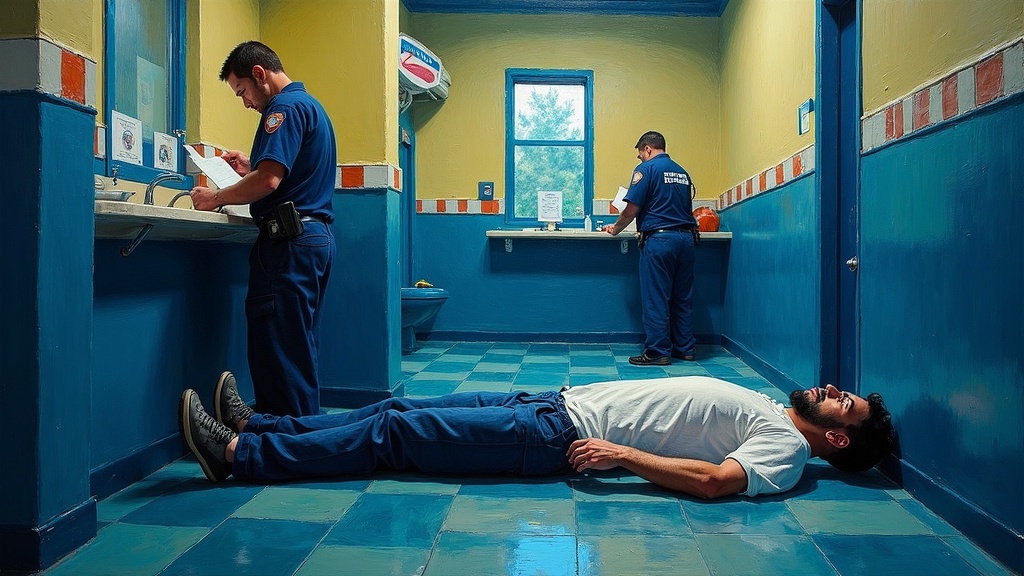
His friend was nearly unconscious by the time they pulled into the parking lot. Vincent had to reach over and help him put the car in park. He stumbled into the restaurant, made it to the single-use bathroom by the door, and out of habit, locked it behind him.
Then he collapsed.
"I proceeded to just pass out passed out right there on the floor on my back," Vincent says. "And I began to aspirate or vomit and breathe in my vomit literally died right there."
Meanwhile, his friend collapsed in a booth, vomiting. The manager called 911. Paramedics arrived, pumped his friend's stomach, treated him with charcoal, and released him the next day without lasting effects.
But nobody knew there was another man in the bathroom.
Vincent lay dead on that floor for at least 45 minutes before anyone discovered him. The time between the first 911 call for his friend and the second call to retrieve what everyone assumed was a corpse establishes the minimum. "We know for at least 45 minutes at the most conservative estimate," Vincent explains. Factoring in the time paramedics spent processing the scene, bagging the body, and collecting statements, "there's some estimates that say it's at least it could easily be an hour and a half to two hours."
More than an hour. Cold, dead, and beginning to stiffen.
Plunged Into Cool Electricity
From Vincent's perspective, the transition was instantaneous and unmistakable.
"The very next moment I felt like I was I was like plunged into cool electricity," he describes. "And it felt very much like a fluid almost a water. But it wasn't water because I didn't feel wet. But I felt electrified literally in a good way. I mean not in the like scary but I felt just full of this. This vitality, this energy."
The relief was immediate and total. His body had been sore from intense bodybuilding. "As soon as I plunged into this cool feeling 100% of pain was completely gone," Vincent says. "And I recognize that instantaneously, but then I recognized also that I was surrounded by just nothingness. Like I couldn't see anything I could just see darkness."
Then the darkness began to clear.
"Out of nowhere I started to see this like fogginess in front of me start to get clearer and clearer and brighter and clearer and brighter," Vincent recalls. "And what it was is it was the scene of this restaurant, but I was looking from above, but I could see everywhere in the restaurant as if there was no roof, like no ceiling, no roof on this restaurant."
This wasn't ordinary vision. Vincent could see through walls, through the building itself. But what stunned him most wasn't the expanded visual field. It was something far more intimate.
Perceiving Everything, Everyone, Everywhere
"I could see and hear the thoughts, feelings, everything that anyone who was dealing in that building," Vincent explains. "I could perceive literally, the feelings of the cook, I could perceive the feelings and the thoughts of the assistant manager, the manager, even the two customers that were eating breakfast, this man and his wife, I could perceive what the man was thinking about what the wife was thinking about."
He watched paramedics arrive for his friend. He watched them load him into the ambulance. And somehow, without being told, without reasoning it through, "I knew, I knew without knowing I don't know how I knew. I knew he was going to be okay," Vincent says. "But I knew that this other guy in the bathroom that he was he was in serious trouble that he was gone."
This direct knowing extended to the paramedics themselves. When a second ambulance arrived for the body in the bathroom, Vincent immediately understood the entire team dynamic. "There's two veteran medics. And there's one rookie Medic and the rookie has kind of a tag alarm. It's his first live week on the job," he describes. "And somehow I know all this, I just know it from from the second they show up. I just know this. It's almost like he carried that as a badge on him that he was a new guy."
The veteran medics processed the scene methodically. They attempted preliminary resuscitation, chest compressions, manual oxygen. Nothing worked. "The body was actually starting to get a little stiff in the legs," Vincent notes. "So they they knew this one was gone. They went ahead and bagged it. They took their time, there was no rush."
They spent 45 minutes to an hour collecting statements, signing paperwork, processing the scene as a straightforward fatality. The body was zipped into a bag, strapped down, loaded into the ambulance.
Case closed.

The Rookie Who Wouldn't Give Up
But the rookie medic sat in the back of the ambulance, staring at the body bag, wrestling with feelings Vincent could perceive as clearly as his own. "Why can't we make a difference for this one," the young medic was thinking.
What happened next violated every protocol.
"He unzips the body bag, he has to undo the straps on the body just to unzip the body back he's trying to find a pole so can't find anything," Vincent describes, watching from his vantage point outside physical space. "He reaches under the arm area can't find a pole. So it's cold, stiff, it's gross. And he's even feeling this like this is a dead body."
The rookie undid three straps. He reached down to the inner thigh area, feeling for the femoral artery near the femur bone.
Then something extraordinary happened.
"When he got on the inside femur area, he made contact with the actual femur bone," Vincent recalls. "I felt a shock and I felt I saw him jump right when I felt the shock. So I think that he felt it too."
That shared shock, that impossible spark of connection between a dead body and a living hand, was enough. "There's gotta be something there, there has to be something there," the rookie thought.
He continued unzipping the bag, undoing more straps. He began forcing oxygen into the lungs. Then he hooked up the defibrillator.
The machine's warning alarm shattered the veterans' conversation about the upcoming NFL playoffs. They turned, saw what was happening, and exploded.
"They started to freak out on this medic. They started yelling at him telling him he's gonna get fired. He's breaking protocol. How do you like to be fired on your first week on the job," Vincent describes. "Just really go into town on him and he just ignored it completely ignored it."
The rookie let the defibrillator charge. The first shock delivered. Nothing. Flatline.
The veterans kept yelling. The rookie charged again.
Second shock. "I did get a single heartbeat, one heartbeat, and then it was flatline again," Vincent says. "And that single heartbeat was enough to like shut up the the veteran medics, they completely stopped talking."
Third shock. "It was a steady but faint heartbeat, continuous continuous," Vincent recalls. "So he was able to get that heart started back up after the third round of shocks."
The body was alive again. But Vincent wasn't in it yet.
Three Days Brain Dead
"I was still brain dead, the body was still brain dead," Vincent explains. "And for three more days, I was brain dead. And that's where I had my experience. I had my experience while the body was brain dead."
Three days. The heart beating, the lungs breathing with mechanical assistance, but no brain activity. No EEG signals. No measurable consciousness by any medical standard.
And yet Vincent was having the most vivid, coherent, transformative experience of his existence.
When he finally returned to his body and regained consciousness, he brought back something that would reshape his entire understanding of what it means to be human, to be alive, to be loved.
The Love That Changes Everything
"The most important takeaway that I took away from this experience," Vincent Tolman
This wasn't philosophical speculation. It wasn't wishful thinking or religious conditioning. Vincent experienced this love directly, the way you experience sunlight on your skin or cold water on your tongue. It was the most real thing he'd ever encountered.
For a man who'd spent years chasing happiness on the horizon, always feeling it was just out of reach, this was revolutionary. The love he encountered didn't require him to be better, stronger, more successful, more spiritual. It met him exactly where he was, in the fullness of his imperfect, striving, confused humanity.
And it loved him completely.
What This Case Actually Shows
Vincent Tolman's account offers several features that appear consistently across thousands of near-death experiences, but his case provides unusually strong evidence for the independence of consciousness from brain function.
First, the timeline. We have documented proof that Vincent's body was without a pulse for at least 45 minutes, likely much longer. His body had begun to exhibit rigor mortis. Multiple medical professionals declared him dead, processed him as dead, and bagged him as dead. When consciousness can be this vivid, this coherent, this rich with sensory detail and emotional content while the brain is receiving zero oxygen and showing zero electrical activity, we have to reconsider our assumptions about where consciousness originates.
Second, the expanded perception. Vincent didn't just see the restaurant from above. He perceived the thoughts and feelings of everyone in the building. He knew the rookie medic's employment status, his emotional state, his internal conflict. He knew his friend would be fine. This kind of direct knowing, unmediated by sensory organs or neural processing, appears in NDE after NDE. It suggests consciousness has access to information through channels we don't yet understand.
Third, the shared shock between Vincent's body and the rookie's hand. This moment, where both the disembodied consciousness and the living medic felt the same jolt simultaneously, hints at something about the relationship between consciousness and physical matter. It wasn't a one-way observation. There was interaction, connection, causation flowing both directions across the boundary we think separates life from death.
I don't know what to make of that moment, honestly. It doesn't fit neatly into any model I've encountered. If consciousness was fully separated from the body, how could Vincent feel a physical sensation? If the body was truly dead, how could it generate a shock strong enough for the medic to feel? The materialist would say Vincent reconstructed this detail later, confabulated it from what he learned afterward. But he describes it with such specificity, such certainty about the simultaneity of the sensation. It sits there in the account like a puzzle piece that doesn't quite fit anywhere.
Fourth, the three days of brain death. Vincent's most transformative experiences happened while his heart was beating again but his brain showed no activity. This extended period of clinical brain death with vivid conscious experience provides a natural experiment that would be impossible to create ethically in a laboratory. The fact that he returned with coherent, detailed memories of this period challenges the materialist assumption that memory formation requires a functioning hippocampus.
But perhaps most significant is what Vincent brought back: not fear, not trauma, not existential dread, but an unshakeable certainty about the nature of love and the continuity of consciousness. This pattern appears again and again in NDE accounts. People return changed not because they nearly died, but because they directly experienced something that recontextualized everything they thought they knew about existence.
Vincent's rookie medic violated protocol because something deeper than training was operating. Call it intuition, call it guidance, call it the same mysterious knowing that Vincent experienced while watching from outside his body. Whatever it was, it saved a life that every medical standard said was already lost.
And that life came back with a message the world desperately needs to hear: You are loved exactly as you are, right now, in this moment. Not who you think you should be. Not who you're trying to become. The person reading these words, with all your doubts and fears and imperfections, is loved with an intensity that makes our human concepts of love look like shadows on a wall.
Vincent spent years chasing happiness on the horizon. What he discovered on the other side of death is that the love we're all seeking isn't something we have to earn or achieve. It's what we are. It's where we come from. And it's what we'll return to when these temporary bodies finally give out for good.