Travis Shreeve's NDE: The Daughter Who Saved His Life From Heaven
An accountant's COVID coma revealed his deceased daughter as a radiant, powerful being watching over his family
Travis Shreeve sat on his bathroom floor at dawn, oxygen tube in his nose, trying to make sense of the woman he couldn't stop thinking about. For weeks since emerging from his coma, her face had haunted him. Her voice, especially her laugh, played on loop in his mind. He'd been trying to figure out who she was, this beautiful stranger who'd appeared to him in that impossible place of pearl-white light. A neighbor? Someone from his past? He'd even considered opening up his basement so she could move in with his family. Then, in that quiet moment on the bathroom floor, the truth hit him with such force he started messaging his wife before she'd even woken up. The woman wasn't a stranger at all. She was his daughter Whitney, who had died at 16 months old. And she'd just saved his life from the other side.
The Crisis Nobody Saw Coming
Travis Shreeve is an accountant, and tax season 2020 nearly killed him. He'd been working extended hours because COVID had pushed the filing deadline into May. He was overweight, sedentary, sitting and eating and working and eating. "I was very overweight at the time and it was an extended tax season because of covid and so it extended into May and I had just been sitting there working eating working eating uh you know no really nothing physical," Travis describes. He had asthma, but it had never been a real problem. He didn't realize how unhealthy he'd become.
When he caught COVID, it got bad fast. His wife took him to the emergency room. They gave him oxygen. He spent a strange weekend watching movies, sleeping more than he ever had in his life, barely remembering any of it. By Sunday evening, he was feeling a bit better. His wife had been caring for him nonstop and was getting frustrated. Travis, feeling guilty, said something he didn't fully mean at the time: "what if you know what if this really is bad what if I don't make it," he told her. What if this gets really bad? She felt terrible. He felt better.
But they still had a doctor's appointment scheduled for Monday morning, May 17th. Travis's mother was coming to watch the kids. When Travis walked downstairs that morning, "it was a lot of effort to get down the stairs and I said to my wife how far away is my mom and she said she just left Sandy which was about 25 minutes away and I said you know just I was really struggling to breathe and I said call call an ambulance," Travis recalls. He positioned himself above the couch in their hallway and just fell into it.
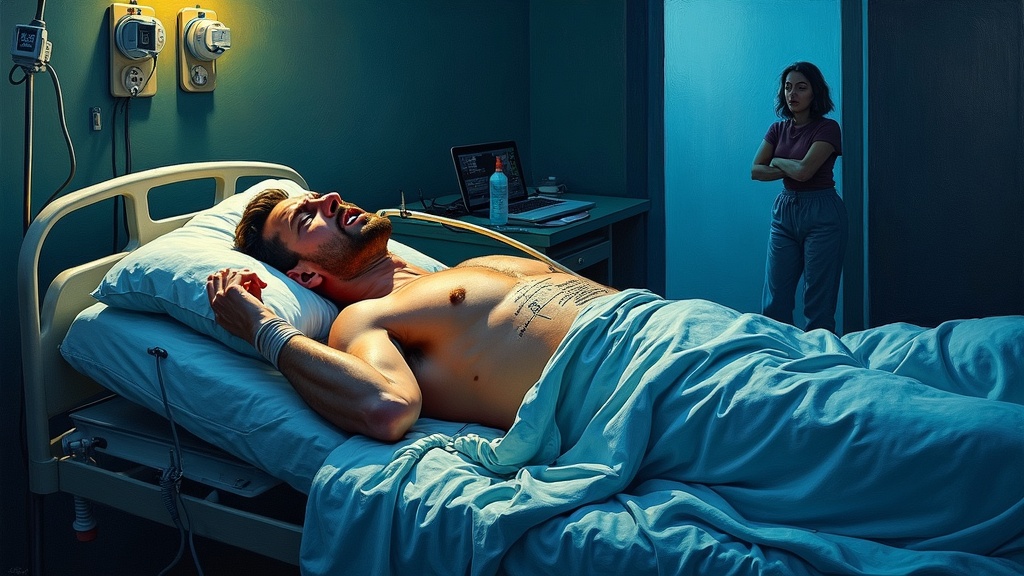
He remembers little bits of the ambulance ride. His mother arrived. His wife left the kids with her and rushed to the hospital. What happened next would become family legend, though Travis has no memory of it. When his wife arrived at the hospital, Travis had sensors all over his bare chest. "I don't remember this but I said I you know I pulled the oxygen off my my mouth and said something and she came closer and she said what was that and I said did you come to see my nipples," Travis recounts. His wife thought those were going to be his last words. She was furious.
Immediately after, they put a tube down into his lungs. Travis violently reacted to the intubation. This was peak COVID, when the word "intubation" was spreading around the world with terrifying speed. The consensus among Travis's friends and neighbors was clear: he's going to die. Not many people were coming out of intubation at that time. Travis's nextdoor neighbor, his bishop, came over and gave him a blessing. "He felt inspired to say um to bless that I would I would survive this if I would fight but he he felt there was a big if there," Travis explains. The bishop went home and told his wife about that "if," deeply worried about what it meant.
Travis's father, who'd just watched him violently react to the tube, pulled his wife aside at the hospital. "You need to tell the kids," he said. Tell them what? "You need to tell the kids he's not going to make it." He was that sure.
The Hell of Awareness
What nobody understood, what Travis himself couldn't articulate until much later, was that he was more aware during his coma than anyone wanted him to be. "I was in this Kos State but they all continued to pray for me while I was in this Kos State I was a little more aware than I would ever want to be," Travis says.
He could see nurses coming into his room. They'd look at him, check his arms, look at equipment, write down numbers. They wouldn't talk to him. Travis thought he was communicating with them, because talking is so second nature, but no words were coming out. They just ignored him. "I just felt that something was dangerous seriously wrong and that that you know basically that week and a half felt like 3 months," he describes. As soon as he could speak again, he told everyone it felt like he'd been there for three months. It was the most terrifying thing of his life, times ten.
He was fighting to breathe. If he'd understood that the machine was breathing for him, he could have relaxed. But he didn't understand. "I fought and I fought and I fought to breathe," Travis says. There came a point where he felt such exhaustion that he thought: this is my last breath, this is my last ounce of energy. "I gave my last bit of effort and I was alive and it was sad it was terrifying to to think that I was still alive still a little bit aware not not able to to communicate or anything like that but I was uh still a little bit aware and I was in such a dark place," he recalls.
He felt like the nurses didn't care about him, like they just wanted him to die. Why were they extending this? Why couldn't they just let him die? "For moments there I thought thought if I could get up out of this chair I would find a way to die," Travis admits. At the last minute, a thought struck him: if I don't fight, I'm going to go to hell. He doesn't believe that way now, but in that crisis, "I felt like I was facing hell like that was the the thing that was in front of me," he says. He felt overwhelming guilt about leaving his children, but also felt there was no way to escape.
Every moment in the hospital was disastrous. He couldn't understand why they were inhibiting his breathing. It was a misunderstanding. The nurses were great, the doctors were great, but Travis didn't know that. Every moment was dark.
Until it wasn't.
The Place Built of Pearl
"Until my body was so weak that I was elsewhere," Travis says simply. And where he went was beautiful.
It was white. It was clean. His first thought? "This must be virtual reality because I've never seen a place that looks this clean and smells this nice and is this well built," Travis describes. He was in a building that looked as if it had been molded, 3D printed out of a pearl element. Light escaped from every surface. There were no light bulbs, but light was everywhere. What told him this wasn't Earth was the cleanliness. "Everything was just flawlessly clean there there wasn't a a single problem a single scratch and anything everything was so perfect," he marvels.
He had a strong feeling that this place had been connected on his behalf, that he was there for a reason. And here's what's remarkable: "At this time I had totally forgotten that crisis that what felt like a month monthl crisis I had totally forgotten about that and I just sat in this place and admired the beauty," Travis says. The hell he'd just endured, the months of terror that were actually a week and a half, had vanished from his mind completely.
He knew there were two people present. He could see one of them, a woman. The other he couldn't see but knew was there. For a time, there seemed to be a separation between him and the woman, but Travis felt no impatience. "For the first time ever time didn't matter I I didn't feel an urgency to do anything to speak to anybody I just was in this place and felt totally calm," he says. This is one of the most striking details of Travis's account. In his ordinary life, he's stressed, rushing, focused on the next thing. But there, time simply dissolved.
Eventually the woman approached. "Our our interactions were beautiful I immediately felt like I knew her," Travis recalls. For a moment he thought about asking her name, and the name of the other person he sensed. But then he felt embarrassed. How can I ask her her name when I know this woman? So he didn't ask. He just adored her. "I just looked at this woman and and just could not get over her beauty um but but I felt this massive feeling of love that I've never felt on this Earth," Travis says.
Even before she approached, he felt overcome with love. He understood this was a special place. They continued to interact. Much of it wasn't spoken, at least not with her mouth moving. "I almost always heard a voice um and and then in some of it was it was like information was downloaded," Travis explains. He immediately understood that this woman was very interested in and very concerned about his children. It meant everything to him. He understood she was a very important person in his life. "I felt that closeness and I felt a love for her and I felt an absolute Adoration of this woman there was a power that that she was she was taking care she was taking care of so much in my life," he says.
At one point, she finally had to tell him: hey, you are in the hospital dying. She had to tell him that because where he was, "that had no meaning that had no importance to me that had all those worries were just gone," Travis says. Think about that. He'd just experienced the most awful thing in his life, fighting to breathe, feeling abandoned, wanting to die. But in this place, he'd forgotten it so completely that someone had to remind him his body was dying.
The Laugh That Changed Everything
They went on interacting. At some point, she laughed at him. But it wasn't offensive, wasn't condescending. Travis compares it to his six-year-old son who says the silliest things. "I just hear those things and I just love him I I laugh and I love him and and it was that same feeling just like I love you you know a little bit of okay you're you don't get it but I love you," Travis says. That's what the laugh felt like. And in that moment, "That's the one moment where I I remember her mouth actually moving as you know as she was vocalizing anything but she laughed and and in that laughter I just felt absolute love coming from her," he recalls.
That laugh is the most singular beautiful memory of his life. It would haunt him for weeks. There's even an old friend, not quite a neighbor, who has a slightly similar voice. Travis says he could go his life without ever seeing her again because her voice is just similar enough to the voice he heard that he doesn't want it to take away from that memory. It sounds silly, he admits, but that's how precious that laugh is to him.
Soon enough, Travis found himself back in the hospital. The crisis returned. They'd started turning TVs on, maybe noticing signs he was slightly aware. They played Transformers: Dark of the Moon, which became a horror movie to Travis in his helpless state. He saw John Malkovich in a different film and wanted to tell everyone he knew him, then realized he couldn't talk. He wanted to send a secret message to John Malkovich. Even in such a silly atmosphere, he was in a state of helplessness. Everything was a chore. He was terrified. The nurses were coming in and leaving, looking at his arms, looking at equipment, writing numbers, not acknowledging him. As far as they were concerned, he was just a vegetable. But Travis misunderstood it to the point that he thought they wanted him dead.
The Intervention
It got really bad again. And once again, Travis found himself elsewhere. This time it was more immediate. "She just said everything's going to be okay uh and this wasn't spoken in words but this was as if it was downloaded to me that she she did say that in words everything's going to be okay but then she had spoken to me almost through downloaded information to say that she somehow intervened in my behalf," Travis describes.
He doesn't know what that intervention was. Did she press something upon a doctor's mind? Did she plead with God on his behalf? He doesn't know. But "I just knew it I knew that everything was going to be okay I knew that she loved me I knew that she had intervened on my behalf," Travis says. And that was enough. That was about it for that interaction.
He found himself back in the hospital. Nothing had changed. It was still a misunderstanding of what was going on. But "I knew the truth of what she said and so even though I still misunderstood what was what was going on in my mind I just knew that she had found a way out for me and that I was going to be okay," Travis recalls. The struggle with the nurses continued, the feeling they didn't care about him, but underneath it all was this confidence: she has come through for me.
He was becoming more aware. They were able to speak with him. He could mouth some things and communicate a little bit. One last time, he was shown an image. "It's it's like I wasn't allowed to fully remember this image but but in that image there was my family uh and there were a couple of other individuals there," Travis says. She spoke to him one more time. This was his only moment of peace in the hospital. "She said everything's going to be okay we'll we will be whole again," Travis recalls.
He felt something special about that. The image had colors that were specific and special to him. But at the same time, he thought: this lady's great, but why "we will be whole again"? In his misunderstanding, he started thinking around it. He actually started worrying. "Okay you know when I get back home once I get out of this we need to we need to open up our basement and we need to let this woman come and live in our basement," Travis admits. This was more real than anything. It felt like he'd been living his whole life to get to that place.
It had been downloaded to him that he would be back there soon enough. Sometimes, Travis unfortunately thinks that "soon enough" isn't as soon as he wants it. Not that he has any desire to speed up this life too much, but "I do sometimes feel like maybe it was soon enough in in their terms meaning that once I go back it will feel like a blip just like that crisis I experienced in the hospital was such an unimportant thing as soon as I was there," he reflects.

The Long Road Home
Travis's hospital stay was tough. He knew the nurses cared now. Everything was improving in that sense. But he was in a lot of pain. They had containers to capture blood if he coughed it up. He filled something that big twice in the next week. If it hadn't been peak COVID, they probably would have kept him another two weeks. But because it was peak COVID, "They were kind of like you're alive throw you on a wheelchair and get you home," Travis says. They made the right decision, he's not criticizing, but he thinks they would have made a different decision if there weren't so many people hospitalized at that time.
He went home and really felt sorry for himself. Part of that feeling sorry for himself was trying to understand what he'd seen. "I tried to through the lens that I had viewed it and I truly think that I was absolutely not allowed to understand where I was," Travis says. Or else it would have been kind of a mindless guess. Of course he was in the spirit world. Of course he was on the other side. It was stereotypical. There was even a cloudy haze in the distance. If he could present that image to somebody, they'd say oh, this guy is presenting an image of heaven. "It was more beautiful than anybody could have ever presented it I think that the that possibility had been taken from me," Travis reflects.
As he tried to understand what had happened, he was mostly confused by this woman. Who is she? Is she a neighbor? He knew she took care of his kids. He knew she loved his kids. Who is this woman? That was such a great concern to him, finding this woman. So he felt confused, in a lot of pain, struggling to breathe.
The next several weeks at home, he'd wake up 40 or 50 times a night in a panic. I can't breathe. I'm dying. I can't breathe. I'm dying. He always had somebody by his bed: his wife, his mom, his sister. They were always there. It always felt like an emergency. "I had a a several weeks that that um I kind of departed from um focusing on what was important," Travis admits.
It wasn't until he began to heal a little bit that things changed. They'd made a bed for him on the main floor, but he was finally able to walk upstairs. He had a really good sleep. By "really good" he means about four hours. But he woke up feeling refreshed, not in tremendous pain. He had his oxygen connected to his nose. "I kind of walked into our master bathroom and I just you know with all my energy went and kind of sat on the floor just cuz I didn't want to wake my wife up but I I felt like there was something I needed to know," Travis says.
The Truth on the Bathroom Floor
He sat there on the floor and thought: okay, what is it? What do I need to know? I nearly died. What are the things I need to know? He started making a list in his mind of all the things he should be better at. I should work less. I should spend more time with the kids. He thought of the best things he does, how he could do them better, and the worst things he does, how he could stop doing them.
The impression came to him: no, that's not it. Travis thought: of course that's it. I almost died. I need to learn something. But again: that's not it.
As he sat there on the floor, the image came back into his mind. Not the individual image that was showed to him, but he basically relived that interaction with this woman. Keep in mind, during these weeks he could never get that woman's image out of his mind, particularly her voice, most particularly her laugh. That laugh is the most singular beautiful memory of his life.
He relived this memory. He heard her voice again. "It hit me this this image This Woman's face who had been on on my mind this whole time it immediately became clear to me that this was family and this was my mom and this was my wife and this was this was our daughter," Travis says. He could see some characteristics from his side and from his wife's side. He knew immediately that this was his daughter.
He didn't want to wake up his wife, but he started messaging her right then. He emailed his mom too. He knew they'd be interested to hear this. He'd talked to his wife about the place before. He'd called it something, "avenly way" or something like that, at least that's what she heard. She'd jotted things down in her journal. But it was at this moment that Travis realized: "Everything that I had seen I had I had seen my daughter my daughter Whitney had passed away at uh 16 months and this beautiful woman that I was speaking to was my daughter," he says.
It all made sense. It made sense why he wasn't allowed to know where he was. It made sense why his nextdoor neighbor was concerned about that "if," why there was even an if that he would fight. It made sense that he wasn't allowed to know her name or who she was.
"For a lot of years uh and and my last my last memory of of Whitney was uh the doctors trying to resuscitate her um we knew we knew she had a shortened life we she had a genetic condition but my last memory was uh it was not a it's not a beautiful memory," Travis explains. So often when he thought of Whitney, that's what he saw. The doctors moving her little body too quickly, the moment where they were so scared, her life ending.
But to be there in this woman's presence, "I felt all those same feelings that a father would feel to his daughter when I looked at her and adored her and stared at her it was all through the lens of a father," Travis says. Even when he was in the hospital, he thought: why was it okay that I just looked at her like that? Why was it okay that I just adored this woman? It all became apparent that all those interactions were the same: a father to his daughter. As if you hadn't seen your daughter in all those years and all of a sudden your adult daughter is there and you just adored her, so happy to see her. "Those feelings were all as if I knew except I didn't," Travis says.
This all came back to him. And he realized why she said what she said. "We will be whole again." It made perfect sense.
There was one other item. Travis and his wife had lost Whitney at 16 months. They lost their son Vincent with the same genetic condition at 8 years old. "It was clear to me just clear as day that there was a reason I was allowed to know this man was there but I was not allowed to see him," Travis says. If he'd seen Vincent, he would have recognized him. Vincent was a little healthier there, looked a little bit more like them. In fact, Travis has a son now who looks a lot like Vincent. Somebody just walked into the house the other day and asked why they had a picture of just Raymond and his sister. That's Vincent, they said. I don't know Vincent, the visitor replied.
The beauty of it is that Travis was able to see things, but even if a little bit was taken from him. "Part of the beauty of that is the importance of sticking around because if I if I had seen what I saw and I knew what I was seeing there may have been significant effort to stay there there may have been effort to stay there," Travis reflects. He feels it's a blessing to have seen and felt what he felt, even if he didn't fully understand where he was.
What Travis Learned About His Children
The interviewer, who has seven kids himself, can't imagine what Travis and his wife have gone through. But what a beautiful reminder, he says, for any parents who've lost their child to know that they're still there. Not only are they still alive, but they're very aware of you. What a beautiful thing to think about, that your children who have passed are just there, just waiting for you and aware of you and what you've gone through.
"I've always been a Believer and I've always felt like they were in good hands but I you know maybe erroneously felt that they had better things to do than to spend time uh worrying about us," Travis admits. But that feeling of love and concern for him, especially for his kids, changed everything. "I've always I've always felt a little ripped off that my my younger kids didn't know Whitney and they didn't know Vincent and yet to have that that overwhelming feeling that more than myself she she has always watched over her her siblings," Travis says.
There's also that bond. As a kid, Travis says, there was probably some movie star like Andie MacDowell who was kind of the epitome of a beautiful, kind person. Somebody who looks like Andie MacDowell could have talked to him. But to have somebody that looks like him, particularly where his daughter was very disabled in this life? Whitney had an enlarged head, was very very skinny, had a lot of veins. She was very disabled in this life. "To see somebody who looks like me and looks like my wife uh I mean it just the gravity of that and the meaning of our decisions in this life just is uh overwhelming to think about," Travis reflects.
Although that place seems so infinite and beautiful compared to this, the decisions and things we do here still have an effect in the long term. But also, as Travis sat there, he adored her but there was also a reverence to her. "In many ways it felt like I was speaking to my for lack of a better word my Superior it felt like I was speaking to somebody who um was an older Soul than myself," Travis says. She looked 30, but in a lot of ways, every word she spoke, every concept downloaded, was just powerful to him. To understand that there was some place where she had intervened, he knew there was a power there. It wasn't just a simple task. There was some enormous power.
The Advice: Just Endure
The interviewer asks: what advice would you have for people who are just struggling with this life? Travis thinks that's a really good question. "I think above all else that's that would just be the advice is to endure," he says.
He doesn't want to compare his situation. He's had some tragedies in his life. That week and a half that felt like months in the hospital felt like a major tragedy. But simply the idea that as he crossed over, that was nothing to him. He had to be reminded that he was dying in the hospital. That's how insignificant it was.
"I hope that that's the the message that could go out there I don't think it's you know for somebody to grow up in in the most horrid of of conditions I have this faith that as they cross over they experience just tremendous Beauty to the point that all of that can be forgotten," Travis says. Now, it doesn't mean we overlook those things. He feels a greater obligation to take care of people, to do the right things. But the big difference is a trust in God that as we fail and as we experience these crises in our lives, once we cross over those things can and will all be solved.
There are failures throughout life. Travis's kids had the best doctors, imports from Italy because they were the best geneticists in the world. Those doctors failed. Great doctors, but they failed. "I just have this overwhelming feeling that um that all can and will be made whole," Travis says. Particularly the idea that his lasting memory with Whitney was that moment of crisis, that moment where they moved her little body too quickly, where they were so scared and then her life ended. To have that last final most meaningful memory replaced with the memory of this just overpoweringly beautiful woman? That memory is totally replaced.
The memory is still there, and yet what Travis thinks of now is very different. "If anything I'm slightly jealous you know slightly jealous of of her but happy that that she's there um and and very much more aware that she's also here sometimes and hope that when when those times come that I need to be spoken to that I'm a little more aware of that," he says.
The interviewer mentions one thing that really stuck out to him that seemed so comforting, something he hasn't personally heard before: the way Travis said he didn't perceive time. The interviewer is in a moment where he's trying to do so many things, take care of his kids, provide, do all the right things. Just that idea of washing away time, feeling no rush? "Man that that alone like that in this exact moment I'm just imagining that I'm just like oh man that sounds so nice," the interviewer says. He's the same way, too stressed out all the time, too focused on the next thing. Travis agrees: it really is something.
What This Story Reveals
Travis Shreeve's experience is one of the most emotionally powerful near-death accounts we've encountered, and it illuminates several profound truths about what awaits us.
First, there's the immediate and total relief from suffering. Travis went from the worst experience of his life, fighting to breathe for what felt like months, to a place so beautiful and peaceful that he completely forgot he was dying. He had to be reminded. This isn't just relief. It's the complete dissolution of earthly trauma. The crisis that felt endless became, in his words, "such an unimportant thing." If this is true for Travis's relatively brief suffering, imagine what it means for those who endure years or lifetimes of pain.
Second, there's the recognition issue. Travis wasn't allowed to immediately recognize Whitney. This is a fascinating detail that appears in other NDE accounts where the experiencer encounters deceased loved ones but doesn't realize who they are until later. It suggests a kind of protective mechanism, a way of preventing the experiencer from wanting to stay. If Travis had known he was with Whitney and Vincent, if he'd fully understood where he was, would he have fought to come back? He doesn't think so. The veil was merciful.
Third, there's the radical transformation of memory. Travis's last memory of Whitney was doctors trying to resuscitate her, moving her body too quickly, the moment of terror and loss. For years, that's what he saw when he thought of her. But now? That memory has been replaced by the image of a radiant, powerful, beautiful woman who loves him and watches over his family. This isn't repression or denial. It's a truer memory, a deeper truth that overwrites the trauma of death.
Fourth, there's the age and power of souls. Whitney was 16 months old when she died. She was severely disabled, with an enlarged head, very skinny, lots of visible veins. Travis saw her as a woman who looked about 30, healthy, beautiful, bearing characteristics from both him and his wife. But more than that, he felt he was speaking to his superior, an older soul, someone with enormous power who had intervened on his behalf. The soul is not the body. The soul is not defined by the limitations or duration of physical life. Whitney is not a baby waiting for her father. She is a powerful being who has been caring for her siblings, watching over the family, intervening when needed.
This connects to the broader pattern we see across thousands of NDE accounts. Children who die young are consistently described by those who encounter them as radiant, wise, fully themselves in a way they never got to be on Earth. The body is a temporary vehicle. The soul is eternal, and it seems to have an intrinsic maturity and identity that transcends physical age. Travis's experience with Whitney confirms this in the most personal and moving way possible.
Finally, there's the message Travis wants people to hear: endure. Just endure. Because no matter how terrible this life gets, no matter how much you suffer, when you cross over, it will feel like nothing. It will be forgotten in the presence of overwhelming beauty and love. This doesn't mean we should ignore suffering or fail to help those in pain. Travis feels a greater obligation now to take care of people. But it does mean we can trust that the story doesn't end with suffering. The story ends with Whitney's laugh, with the promise that we will be whole again, with the knowledge that our loved ones are not gone. They're just on the other side, waiting, watching, sometimes intervening, always loving us.
Travis Shreeve went into that hospital expecting to file some tax returns. He came out knowing that his daughter, who died at 16 months, is a powerful being of light who saved his life from heaven. If that's not proof that this world is not all there is, I don't know what is.
Was this article helpful?