Scott Drummond Dies for 20 Minutes, Returns With a Message About Love
A surgeon's mistake led to death on the operating table and a profound encounter with unconditional love that changed everything
Scott Drummond was standing above his own body, watching a doctor stitch his thumb back together. The heart monitor beside him was flatlined. He'd been dead for several minutes, though time had ceased to mean anything. What struck him most wasn't the sight of his lifeless form on the operating table. It was the presence beside him, an escort who communicated not through words but directly into his mind. And it was the overwhelming realization that everything he'd worked for, every material possession, every calculated career move, every person he'd stepped on to get ahead, none of it mattered now. Only one thing did: how he'd treated people along the way.
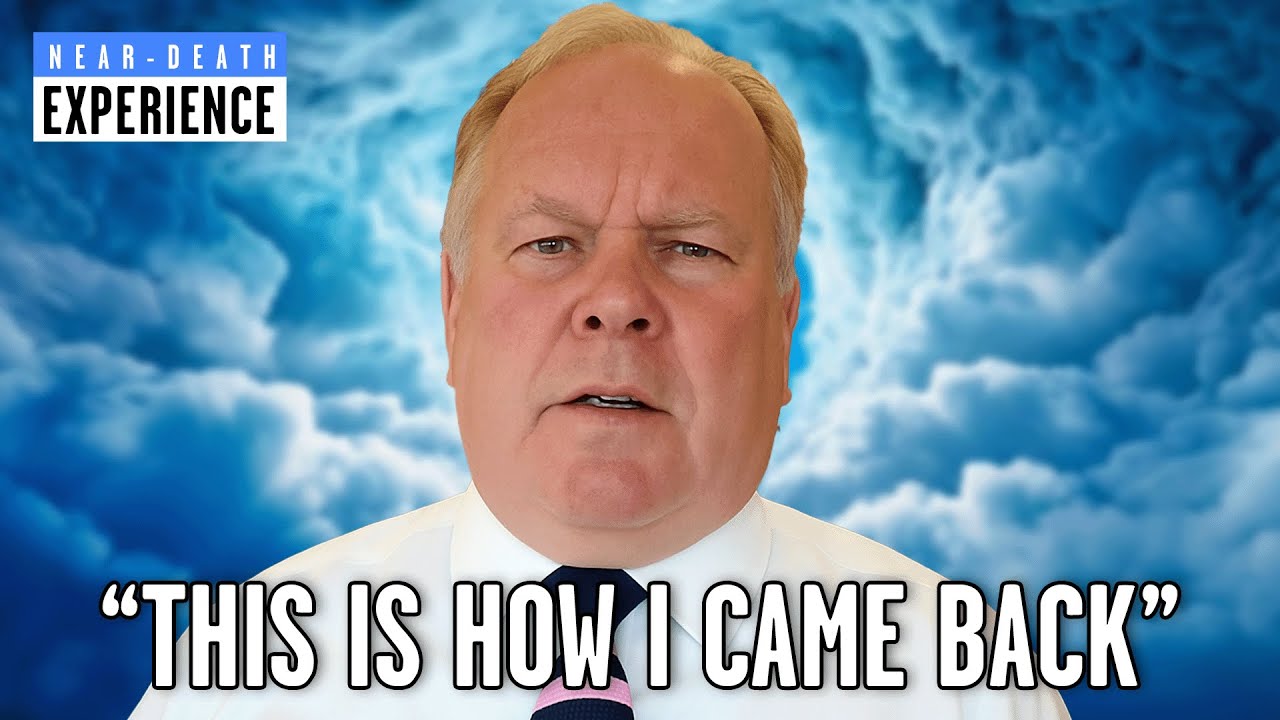
He'd learned self-reliance early. His parents divorced when he was young. At 18, he was drafted during the Vietnam era and served three years in the US Army, playing basketball and baseball, which kept him stateside. After his service, he went to college, played four more years of baseball, and met his wife in Germany while completing military assignments. They married in 1974 and would eventually celebrate nearly 50 years together.
But in those early years, Scott was rarely home. "I started losing track of my family and I really had a rough time because I was gone three out of four weeks with the job because I was making money," he admits. He stepped on people. He knew it then, though he didn't let himself feel it. The only way up, he told himself, was sometimes over others.
The Day Everything Changed
Christmas 1982 was different. Scott came home for the holidays and spent a rare, uninterrupted stretch with his family. It was wonderful. Then, on one of those winter days, he made a selfish decision. He went skiing.
"I decided I was going to go skiing while I was home. And I went up to Park City, Utah, and skied the whole day. One of the best skiing days I think I've ever had in my life," Scott remembers. When he came down from the mountain and started removing his gloves, he noticed something wrong. His thumb was hanging down to his wrist. His fingers pointed up. His friend, an EMT, took one look and said he couldn't fix this with a band-aid.
Scott called his wife. She arranged for a surgeon at a hospital about an hour away. They wheeled him into the operating room. And here's what Scott remembers with painful clarity: "I didn't even tell my wife thank you. I didn't tell her I loved her. I didn't tell her that I loved my kids, which we had three at the time."
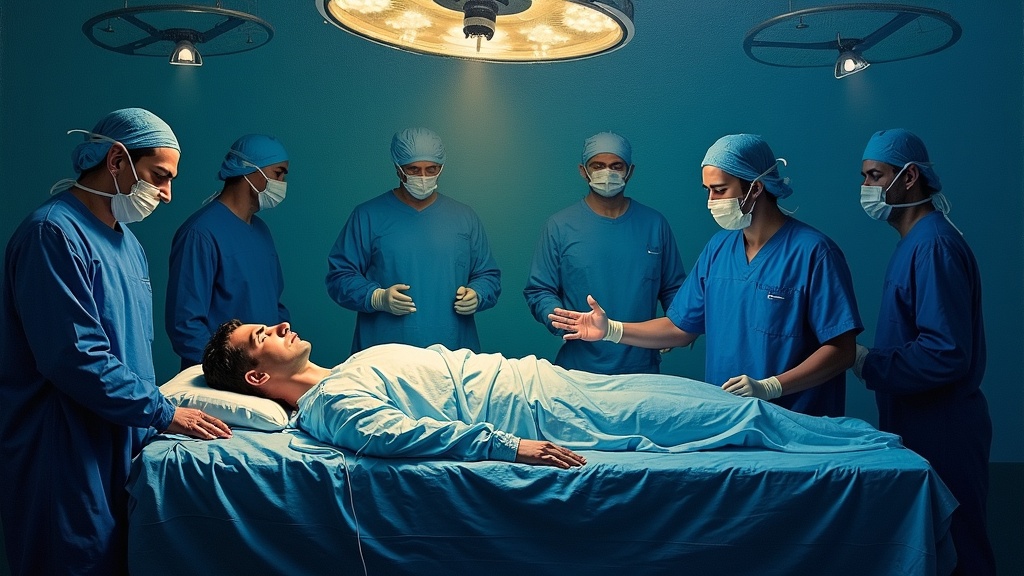
He lay on the operating table. The anesthesiologist was called away to another emergency. The surgeon said he knew another way to operate, something called a Bier block. They lifted Scott's arm, drained the blood, applied an air tourniquet with two valves, then injected lidocaine into his hand as a local anesthetic. A sheet went up between Scott and the surgical site so he couldn't see the work being done.
The pressure in his arm began to hurt. The doctor instructed the nurse to loosen the top valve on the tourniquet. She did. The pressure eased. A while later, it returned. Standard procedure was to tighten the first valve, then loosen the second. But the nurse had never performed this procedure before. She loosened the second valve and forgot to tighten the first.
Standing Above Death
He looked down. A body lay on the table. He wondered why that person was lying there, motionless. He didn't recognize himself. But across the sheet, he could see the doctor still working, cutting into the wrist, pulling out a tendon, wrapping it around the thumb. The heart monitor flatlined. The nurse ran from the room, saying she'd killed him.
"Something that today I do not blame her for. And I wish someday that she might watch this video and see that I would like to talk to her and tell her it wasn't her fault," Scott reflects now, four decades later.
He was standing there, observing, when he felt someone beside him. An escort. They watched together as the doctor worked with remarkable skill. Scott remembers the pin being just slightly too long, protruding through the skin, the doctor removing it, trimming it, reinserting it. "The escort that was with me and I both were very impressed with what the doctor was doing," he says.
Staff rushed in, trying to revive him. Scott watched them work. He was impressed by their urgency, their competence. But the monitor stayed flat. He was dead.
The escort communicated not through sound but directly into Scott's mind. "The person that was standing next to me was talking to me through my mind," Scott explains. As the medical team began stitching the body back together, the escort said it was time to go.
A Place Beyond Description
What happened next defies the vocabulary we use for earthly experience. Scott found himself standing in a field. Tall grass stretched in front of him and to the right. Wildflowers bloomed to his left. Far to the left stood trees that looked like pillars. And in front of him, three clouds: two pure white on the sides, one pearl-colored in the center.
The trees were unlike anything on earth. "Those trees had great big tree trunks. The only thing I can compare it to in this day and age is a sequoia tree," he says. The leaves at the top were bright reds, burgundies, two shades of green, yellows. No branches descended the trunk. The colors were more vivid than any he'd seen in life. And underneath each leaf was gold.
The trunks themselves were pristine. "The trunks that I saw were the most brilliant brown with gold edging on it which was something that I had never seen before because everything that I seen as far as trunks were very dirty but these were not," Scott describes.
The wildflowers displayed colors that don't exist in our spectrum. Every flower faced toward him. Every leaf leaned in his direction. The grass, tipped in gold, flowed toward him as though moved by an invisible current. "It was as if there was energy that I had never felt before. And each one of those flowers and trees and grass showed me love that I had never felt before," he says.
There was no wind. Yet everything moved, drawn toward him, radiating an energy he'd never encountered. Love, but not the conditional, transactional love he knew from life. Something else entirely.
The Life Review
The escort was no longer behind him. Suddenly, Scott was watching his life unfold. Not on a screen. He was living it again, from the moment of birth, lying on his mother's stomach, all the way to age 28.
"It was the most detailed thing that I have ever seen in my life. Watching my parents and how they raised me and how they taught me and gave up a lot for me when I was growing up," Scott says. He saw his athletic career, the sacrifices his parents and siblings made so he could play. He saw his military service, his college years, his business dealings.
And he saw how he'd treated people. "Some things were good and some things were not good and some of the things I was not very proud of because of the way that I treated people," he admits.
Here's what struck him: "I noticed that none of my boats were there. None of the motor homes were there. None of the houses or the many cars that I had were there with me. What I was being judged on was how I treated people. And I wasn't very good to people," Scott reflects.
Even in sports, where he'd excelled, he'd bent rules, taken shortcuts, prioritized winning over integrity. He could have done better. He knew it then. He knows it now. But what's remarkable is this: "The other thing that I noticed when I was going through this experience was it was all done with love. I did things wrong. And I experienced the feelings that people had that I hurt along the way," he says.
This wasn't judgment in the punitive sense. It was recognition, understanding, an invitation to see clearly. "I lived this in my mind. I did not watch it in a video form. I lived it," Scott emphasizes. He felt the pain he'd caused others. Not as accusation, but as information. As truth.
When it ended, he felt calm. "I realized that whatever was going to happen was because I did it. I didn't have anybody to argue with. Nobody to talk over the situation that I was in. It was what it was," he says.

The Voice From the Cloud
He stood there, at peace. Then he heard a voice from the pearl cloud: "Come."
Rays of light emerged from behind the clouds. The grass turned toward him. The flowers followed. Everything pushed him forward, as though the landscape itself was guiding him toward that voice. "It was if those rays were pulling me towards the cloud and the person that was calling my name," Scott recalls.
As he approached, an arm extended through the cloud. Just the forearm and hand. Scott had time to study it. "I had the opportunity to study that arm. And I have to remind you that time was not an issue. Like I said, I had no idea how long I was gone. I just knew that time was not even an issue," he explains.
The hand was positioned as if to grasp his own, fingers pointed, thumb extended. "I could tell that he was a strong person," Scott says. The hand angled downward, suggesting someone taller than Scott, who stands 6'3" and weighs 270 pounds. The hands were larger than his own, calloused and powerful, like those of a farmer, construction worker, or carpenter.
"I was instructed through my mind to take his hand and I knew I was dead. I knew that I was not going back because I was told not to look back," Scott says. He reached for the hand. It began to withdraw. He grabbed for it again. "I had felt something that I had never felt in my life before. I felt love that I had never felt before. And I realized that I needed that. I did not want to go back," he says with unmistakable longing.
The hand retreated into the cloud. Then the voice spoke again: "It is not yet your time. You have more things yet to do."
The Return
The next moment, he was back in his body. They were wheeling him out of the operating room. A sheet covered his head. A certificate lay on his chest: dead for 20 minutes. "I flipped the sheet off and scared the doctor and the nurse half to death," Scott recalls.
The doctor ran to Scott's wife in the waiting room: "He's okay. Everything's okay. We brought him back." She'd known nothing of what happened during surgery. Her experience was fear, the prospect of raising three children alone. His experience was color, beauty, love.
For three days after returning, Scott felt total peace. "I don't know if anybody has ever felt total peace in their lives. There is nothing like total peace. It's the most calming, loving feeling that you'll ever go through in your life," he says.
The doctor visited, asking why Scott had been thrashing on the table. "I told him that there was a war going on on my body because I did not want to come back. I wanted to stay there because I had felt something that I'd never felt in my life before, and I did everything possible to stay there," Scott explains.
He also returned with an inexplicable gift: he could taste colors. "I was blessed with coming back with a gift that I could taste colors. I could see colors different. I know that it's something that it's hard to explain. How do you taste colors? But it's something that I experience and that I feel very gifted that I have that gift," he says.
Forty Years of Silence
On the third day, a reporter came to interview him for a story on near-death studies. Scott declined. "The time it happened, it was so sacred to me that I didn't know even how to express it or how to tell people what I had seen," he explains.
He tried telling a few people. They didn't want to hear it. So he stopped. His wife knew a little. His children knew virtually nothing. For 40 years, Scott carried this experience in silence, planning to take it to his grave.
Then, three years ago, a friend with a podcast asked him to share his story. Scott said no. The friend persisted: "With COVID-19, there's a lot of people dying and I think maybe you might be able to give people hope and give them some idea about what death is like." Scott walked away.
He went home and told his wife. She said, "Maybe it's about time you tell your story." Scott went to the back room and prayed. "This is a prayer that I've never really faced before. And even though I see it every single day in my life, it was something that I wanted to keep inside of me because I had planned to take it to my grave," he says.
The answer came: it was all about the one. Scott didn't understand at first. Then he remembered the parable of the shepherd who leaves 99 sheep to find the one that's lost, and celebrates when he brings it back to the flock. "It was like somebody had slapped me across the face and said, 'Did you get that?' And I said, 'Yeah, I got it,'" Scott recalls.
He called his friend. They recorded the podcast. Scott showed up in an old golf shirt, sweaty from the course, not taking it seriously. "But here it is three years later and that podcast has almost 23 million views," he says with wonder.
"I never expected in my lifetime to be able to talk to so many people around the world and what a blessing it has been to me to be able to share with people my story," Scott reflects. He's been surprised by how many people have had similar experiences but don't talk about them. They don't know how to express what they've seen.
His message now, after four decades of integration, is simple: "Life is precious and how we treat people that we're around is even more precious. Be good to people. If anything that I've learned over the last 40 years is it's not about money. You know, money can take care of your needs, but what's more important is how you use your money," he says.
What Scott's Experience Tells Us
Scott's account carries several of the most consistently reported features of deep near-death experiences. The out-of-body observation of medical procedures, later verified by staff, appears in hundreds of documented cases. The escort or guide who communicates telepathically is nearly universal in NDEs that progress beyond the initial separation from the body. The life review, experienced not as a passive viewing but as a reliving that includes feeling the emotional impact of one's actions on others, is one of the most transformative elements reported by experiencers.
What's striking in Scott's case is the clarity of the judgment mechanism. He wasn't condemned by an external authority. He saw, with perfect clarity, the gap between who he was and who he could have been. And this recognition came wrapped in love, not punishment. This pattern, what researchers call "the judgment of love," appears again and again in NDE accounts: the realization that we are our own harshest judges, and that the divine response to our failures isn't condemnation but an invitation to do better.
The sensory richness of Scott's description (the colors beyond our spectrum, the gold-edged leaves, the flowers radiating love) matches accounts from cultures around the world. Experiencers consistently struggle to describe what they've seen because our language evolved to describe this reality, not that one. When Scott says he can now taste colors, he's describing a form of synesthesia that several other NDErs have reported upon return.
But the most significant element of Scott's experience is the voice from the cloud: "It is not yet your time. You have more things yet to do." This is the moment that changed everything. Scott came back with a mission, even if it took him 40 years to understand what it was. His story has now reached millions. How many of those millions needed to hear, from someone who's been there, that death isn't the end? That we're judged by love, not by law? That what matters most is how we treat each other?
Scott went into that operating room as a man obsessed with money and status. He came back as a man who understands that love is the only currency that crosses the threshold between worlds. He spent 28 years climbing. He's spent the last 40-plus learning to serve. And in sharing his story, he's given us a gift: the knowledge, from someone who's stood on the other side, that we're going home to love, and that the life we're living now is our chance to practice being the kind of people who can receive it.