Nadia McCaffrey's Three Near-Death Experiences: A Lifetime of Messages from the Light
From a viper bite in a French wheat field to visions of Earth's future, one woman's encounters with the being she calls 'little mother of the sky'
Nadia McCaffrey was seven years old, running downhill through a French meadow on July 7, 1952, her arms full of bachelor's buttons and coquelicots, when she saw the white sweet peas rising from the wheat field. They were glorious, she had to have them. The wheat towered over her. She didn't look down. She was focused on the flowers when she disturbed the asp. The viper struck her left ankle with enormous pain, then wandered away. She turned and ran uphill, screaming, already knowing she was going to die. She wasn't scared. The pain was atrocious.
The Wheat Field and the Viper
Nadia's first brush with death came in the most innocent of circumstances. She was spending vacation at her grandparents' estate, a joyful place for a child. Her grandmother, a village healer who used both hands and herbs, was the person she wanted most to please that day. The bouquet was meant for her.
But the sweet peas were in the wheat field, and the wheat was taller than Nadia. "I had to hunt into this forest of wheat to grab the sweet peas," she recalls. "I was not looking down, I was looking at the flowers."
The asp stared at her for a frozen moment before it struck. "I felt that huge, enormous pain coming from my ankle," Nadia describes. The viper disappeared quickly. She was alone in the wheat with the knowledge, certain and calm, that she was going to die.
She screamed loud enough for the whole village to hear. Her grandmother ran down the hill, applied a tourniquet, tried to cut open the bite to extract venom. It was already too late. "I went into unconscious," Nadia says. Her grandmother carried her to the house, laid her on a chaise lounge, sent her grandfather for help.
Two doctors arrived two hours later. One injected antivenom into her abdomen. The other said it was too late anyway. "Then I went into a coma for 10 days," Nadia recalls.

Leaving the Body Behind
She has no idea how long she was in the coma before it happened. Time meant nothing. "I just left my body," she says simply.
She wasn't interested in the body. She didn't even realize at first that it was hers. But she noticed the leg. "This leg was three times the regular size, it had turned brownish, greenish, yellowish color, basically the color of the snake," she describes. She left it in a hurry.
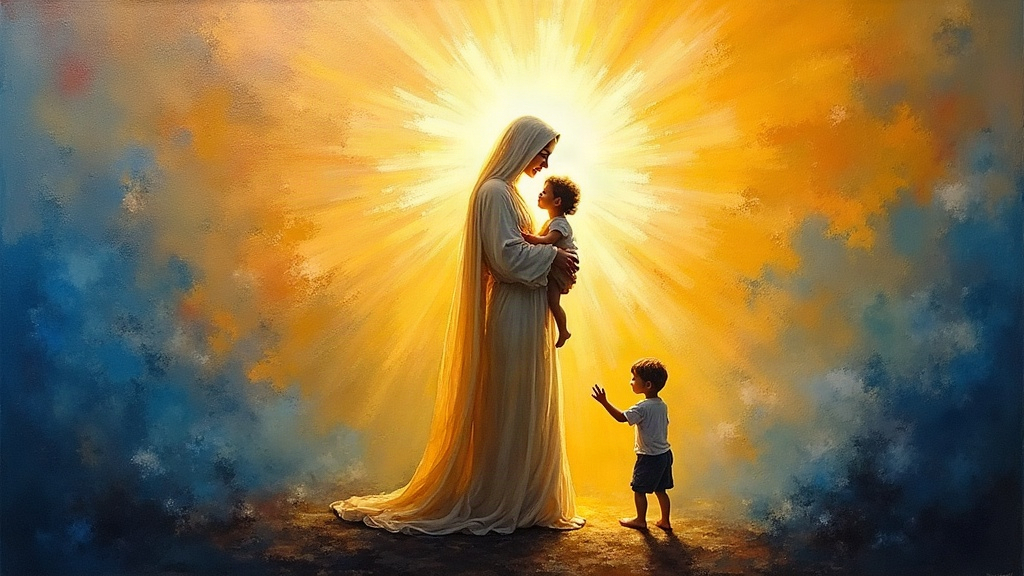
She floated in midair, attracted by a strong light above her. "I just let myself go to it," Nadia says. When she reached the light, she found the most beautiful being she had ever seen.
"She was the most beautiful being I have ever seen," Nadia recalls. "All she was giving out was enormous love, compassion, understanding. This is it. This is what people want. This is what we all want. This is the place to be."
The light itself defied description. "The light was so powerful, but yet not blinding. It was not hurting my eyes or anything of the sort. It was, I was part of it," she explains. This wasn't illumination in any ordinary sense. It was presence, belonging, home.
The Little Mother of the Sky
The being of light communicated without words. She held Nadia close, then told her to stop. "She said that she had a message for me," Nadia recalls.
The first part was direct: Nadia was not going to die. She would heal and live quite a long time. She had a lot of things to do. "Basically what I had to remember was that I was on this Earth to help people," Nadia says.
Then came the introduction that Nadia would spend decades trying to understand. The being said, in French, "Je suis ta petite maman du ciel, which means 'I am your little mother of the sky,' literally word by word," Nadia explains. "And I was seven years old."
To Nadia, raised in a Catholic boarding school, the being appeared as Mary. "She was very familiar to me, she was something that I understood, that I know," she says. The form was recognizable. The message was not.
"The message was long, but all in metaphor, which took me a lot of years to realize and understand," Nadia admits. "Even now I don't have all the answers."
But one promise was unambiguous: "I always will be with you." When you're seven, Nadia notes, you think that means the being will appear every time you turn around. "Well, that's not what she meant," she says now, with the wisdom of decades.
The Miracle Child
Ten days later, Nadia came back to life. Gangrene had started in her left ankle where the viper struck. "Apparently there was talk about amputation," she recalls.
But she told her grandmother with absolute certainty: "I'm not going to die and you're not going to cut my leg." Her grandmother said they hoped not, but it was a possibility. Nadia was unmoved. "I said no, come on, I'm not, I'm going to learn to walk again, you'll see."
Two months later, she was back on her feet with a cane. It took a long time to walk normally again. "But I was called miracle child," she says.
She told only her grandmother what had happened. Her grandmother, the village healer, understood immediately. "She said don't ever talk to anyone about it, people will think you're crazy, so let's keep it quiet," Nadia recalls. "And I did."
But keeping quiet didn't make life easier. "Life became very difficult for me," Nadia says. She couldn't handle the sisters at her Catholic boarding school anymore. "I also know what was true and not true, so I was very difficult to handle," she explains. "I felt like I was living in a fake world."
She was looking everywhere for the little mother of the sky who never came back. "I wanted so desperately to go, to be back in her arms and be close to her," Nadia says.
The Suicide Attempt at Seventeen
That desperation grew for ten years. At seventeen, Nadia decided the only way to return to that magnificent space, that light, was to die. "I decided to swallow all the pills that I could find in the house, my grandparents' house," she says.
She waited until nobody was around and swallowed bottles of pills until she passed out. She would be dead now except for a friend from the village who came to pick up a borrowed book. The friend found Nadia unconscious, dragged her down the stairs by her feet with her boyfriend's help, got her to the hospital.
Nadia's heart stopped. They tried to pump her stomach. "I left my body again," she recalls.
This time was completely different. Again she saw her body on a gurney, again she wasn't interested. "I was looking for a light, I was attracted to the light," she says. She floated to a spot where she couldn't see the light but was strongly pulled into a space, "practically swallowed and spit out," she describes. "I found out later that it's called the tunnel today."
It dropped her on the other side where the light was, but "it was a different light, a different dimension, it was not the same place I was in the first time," Nadia explains.
This time there was no being of light. Only a voice. "A very loud, very strong voice telling me, 'You can't stay, you have not even begun your work yet,'" she recalls.
"I was a very... you don't discuss with that voice, you don't argue," Nadia says. "I argue with everybody or everyone, but I could not think of arguing with that voice."
She had to get back into her body and back to life. She didn't want to. "It was very painful to get back into this body and I didn't want it, so I was kind of fighting myself," she explains. "It's not another skin, it's something different, something strange. We don't belong in this."
When she finally opened her eyes, the nurse sitting beside her gurney was in tears, certain Nadia was dead. The nurse saw her eyes open, stood up, and started to scream, running to find the doctor.
Nadia was back. "I had to go on, I had to accept myself, I had to accept why I was here and wait for, you know, whatever I was here to be doing, things would come to me and unfold," she says.
The Third Journey: December 1999
By 1999, Nadia was working with hospice, helping people at the end of life and their families. On a December day, she was sitting at the bedside of a woman in a coma at a nursing home, holding the woman's hand, relaxing and meditating.
"Suddenly I felt, I let her go, over her hand, and I felt this fever that hit me," Nadia recalls. "I started to get soaked, I mean literally having water dripping, my from my hair to my face, everything started to stick."
She couldn't get up. She felt very bad. Then she looked at herself. "I was in a golden light," she says. She did this (gestures) to make sure she wasn't dreaming. "I was in the light and I said, 'Oh, here we go again,' so I just let go, I just let go."
She found herself in another dimension, never a place she'd been before, no being of light. "Instead there was a voice again that asked me, 'Do you want to come home?'" Nadia recalls.
At the same time, there was a flashing. "It showed me the past, the present, and the future, but that was not me, it was not my life, it was the planet, was the Earth," she explains.
She recognized the past and present. The future had two possibilities. One was different and easier. "The other one was where we are now," she says. She knew she was going to suffer a loss. "It wouldn't be easy, but things were going to shift completely after this."
The vision of the difficult future was stark. "Everything was gray, there was a lot of emptiness, not desert-like but almost," Nadia describes. "People were not well-dressed, hungry, angry both, and there was no balance, there was war in the background." The survivors were in line, waiting to be fed and helped. "The sky was blood red, like I never seen a color like this before," she says.
Years later, after her son Patrick's death in Iraq in 2004, Nadia traveled to the Middle East. "I recognized the sky to a point where I could not get up from my seat, I was so shook up," she recalls. "The same sky, the red color, the indescribable colors were there." After traveling through Jordan to the border, "everything is gray, there is a gray powder that sticks on everything, is everywhere," she says. "So I know where I was, I know where we were, and that's where all of this was shown to me very vividly."
Coming back to her body this third time was the hardest. The fever was 105.9 degrees when she arrived at the emergency room. "I didn't understand why I was still here, you're dead at this, you just don't survive that," Nadia says.
"This time was much harder to come back," she admits. "I know that I was reaching the topic, you know, the main core of the reason why I was here, and I know that loss that I was told a long time ago was really coming too."
The Green Light and Patrick's Death
The experience happened in 1999. In 2004, Patrick was shot and killed in Iraq. "After his death, that's where everything shifted," Nadia says.
She was in Twenty-Nine Palms, the Mojave Desert, because a dying friend had asked her to come. She arrived at the friend's house late at night with the wrong key, couldn't get in the front door, walked around back. There was a storm fence 10 or 15 feet tall. "What am I going to do? It's like midnight or 11:00," she recalls. "So I climbed the fence, I mean, we're going, yeah, climb the fence."
She was sitting on top of that fence in pitch darkness when "here comes this green light in the sky, just beautiful green light," Nadia describes. "And I felt the pressure in my chest. Something happened. I know that. I said, 'Okay, something, you know, somebody's either gone and healed,' but I couldn't breathe."
She sat there, closed her eyes, got down from the fence, got into the house. The neighbor's cat was going completely crazy. She couldn't sleep because of the light, because of the pressure in her chest.
The next morning at the hospital with her friend, her cell phone rang. Her daughter-in-law was on the phone, sobbing, crying, incomprehensible. "She tells me, 'Mom, Patrick was killed,'" Nadia recalls. "I say, 'Okay, let me talk to somebody, sweetheart.'"
The military was there, explained. "What I did, I dropped my phone and I dropped on the floor, I curled up like a fetus and I just stood there and I screamed," Nadia says.
Later she learned the timing. "The moment or the time, the exact time I was on that fence, was the green light, Patrick's moment, Patrick was shot, the exact moment," she explains.
The Visitations
What happened next, in the days after Patrick's death, defies easy categorization. His two-and-a-half-year-old daughter Janessa ran into the house one day, dragging Nadia by the sleeve. "'Grandma, grandma, come and see, come and see Daddy, come and see Daddy, Daddy's here, Daddy is here,'" Nadia recalls.
Janessa dragged her outside to the lemon tree. "In front of the lemon tree, I saw this exact place where Patrick was standing," Nadia says. "I couldn't see him physically like I see you, but Janessa did."
Janessa described him, said he was happy. "What happened to me, I saw where his head was, where his shoulders were, and where he was standing, and even movements," Nadia explains. "What it appeared like is in a very hot day, like in Santa Fe or, you know, where the heat is really bad, you see this steaming spot. That's exactly where Patrick was standing."
"He just wanted his daughter to know, and me, that he was all right," Nadia says.
The next day, or the day before, about 20 people gathered around a computer to see the first pictures from Iraq, from Patrick's unit. "We just became silent, there was not one sound in that room, nothing," Nadia recalls. "There was something very, very strong. It's an energy, but it was also a scent, a scent of roses, to a point where people stopped and I watched people's faces and they were all crying."
Even Sylvia, Patrick's sister, who talks all the time, was frozen. "She tapped me on the shoulder and said, 'Mom, that's Patrick, is here.' We all know that. It's not something that you can explain and make a lot of sense out of, but it definitely was real," Nadia says.
The outside light turned itself on constantly for two days. The neighbor came to tell Nadia to turn it off. She did. She went to the store and came back. "The light was on again," she says. "All the time, pictures of Patrick and Sylvia both just would fall in front of us face down. The television would turn on itself."
What the Being of Light Meant
Before Patrick deployed, he knew he wasn't coming back. He sat with Nadia doing animal medicine cards, picked the Raven. "He started to laugh and he said, 'Mom, look at my shoulder.' His unit was the Raven, the Raven of War," Nadia recalls. They sat outside watching the ravens and crows that were always around the house. "He said, 'Mom, I'll come and visit you with them every time, you know, you're around, I'll be around with the crows and the ravens,'" she says.
That same night, Janessa was watching The Lion King for the tenth time that day. Every time the movie reached the passage where the lion king is ambushed and killed, "Janessa would grab her dad and not let go. 'Daddy, that you? Daddy, that you?'" Nadia recalls. It got so intense that Patrick ran into the kitchen where Nadia was fixing dinner with Sylvia. "He said, 'Mom, I'm not coming back, am I?'" Nadia remembers. "I just said, you know, 'She's a baby, she doesn't know,' but, you know..."
After Patrick left the next day, Janessa kept doing the same thing with the movie. "Every time, the same place, she got my hand, I said, 'Come on, that's my daddy, you know,'" Nadia says.
Patrick loved angels, especially the Archangel Michael, the defender, standing for right and wrong. "He said, 'Well, I'll be working with him,'" Nadia recalls.
After Patrick's death, things shifted completely. Because of him, "we changed so many things in legislature," Nadia says. After General Norman came to the house, "they reopened 2,000 cases of deaths who were just pushed aside so the family could get a closure, but also benefit or whatever needed to be done with it," she explains. There was the ban over the coffin, the freedom for one of the first veterans Nadia took to national television to explain about PTSD. "I was one of the first crusaders for that," she says.
The work the little mother of the sky said Nadia was here to do was finally becoming clear.
The Nature of the Experience
"There is no question about the near-death experience being a dream. It's not," Nadia says with absolute certainty. "I remember the details. I remember the shoes I wore that day. I remember the clothes I wore that day. I remember everything so clearly, and it's not a dream."
"It's something that, it's another dimension, I think it's the best way to try to explain this," she continues. "I had dreams where visions and premonitions came to me, things came to me, but it's not at all, not at all comparable to any other. This experience, this is an event that will change your life forever."
"I wasn't the same. I was only seven, but I was not the same after this happened to me," Nadia says. "Again, I could see things that I couldn't before. I could see through people. I understood without knowing the right and wrong. I know the answers to so many things."
The transformation wasn't easy. "As a child, who is going to listen to a seven-year-old or an eight-year-old? You know, nobody, except stories maybe," she notes.
She talks to the little mother of the sky still. "One thing that she said to me was 'Je t'aime,' and I never forgot that," Nadia says. "So it's kind of a way of prayer, and I do this system is through meditation, but yes, I totally do that."
Patrick comes and goes. "Whenever, you know, you may drop a glass or break a light or, you know, trip me or pinch me, sometimes there is even physical contact," Nadia says. "But we don't have to use our voice. That was never word exchange in any of my experiences. Everything was felt. It's not just physical words. It's in depths. It's very powerful."
The Message for All of Us
"No matter how difficult life seems to be, we need to remember one thing: that if we are immersed in compassion and love for others, we can make it through anything," Nadia says. "It takes time to master, but we really can do it, and it makes you powerful because nobody can take it down."
The experiences changed everything about how she lives. "The first 10 years were kind of a trial time where, like a rehabilitation to life, which I didn't do very well, I guess," she admits. "But after this, from this time until now, and the last experience, was acceptance."
"I am never afraid of death or dying. I am not afraid of anything," Nadia says. "Well, there might be a couple of things, like snakes, but I'm talking about really, I wouldn't run away for anything, you know. It's just, it's part of this dimension."
"And I don't see death as the end. There is no end," she continues. That conviction led her to start sitting with dying people, first in her own street, then in nursing homes, then founding the nonprofit AngelStories.org to train others. "I just know. I would kind of walk the family through it," she explains. "And I thought, well, this is right, you know, why don't I just do it on a larger scale?"
She worked with the concepts of Elisabeth Kübler-Ross. "That became the passion of my life, and I really thought for a long time, until Patrick died, that this was my mission: to help people transition from one life, from this life to the next," Nadia says. "And, you know, explain that we are born, we come from a place, we are born here, we die, and we go back to where we are from. It's a circle. There is no death."
"One thing that has become extremely clear to me is compassion and love, and I'm talking about unconditional love," she emphasizes. "If you can master these two elements in your life, no matter what, even people that you think you can hate, if you walk over that and see the situation with compassion, you will see things on the inside, on your soul."
"This is kind of a mastery of life, in a sense, that I wish I could share everything I have learned with people so, you know, they would understand really why we all have a mission," Nadia says. "I believe that we have a purpose. We all do. And it's up to us to find that mission and purpose, or not. We don't have to if we don't want to."
A Lifetime of Learning
It took Nadia until 1995 to realize she wasn't alone. She was standing in a store reading Dannion Brinkley's "Saved by the Light," describing his near-death experience with Dr. Raymond Moody's research. "I read the book, I couldn't put it down. I stood at the store. I think I sat on the floor and had read the book through, bought the book, and then went home, read it again," Nadia recalls. "And I said, 'Okay, I need to meet Dannion.'"
When Brinkley came to San Jose to speak to 2,000 people, Nadia walked to the front of the stage and sat down. "I just closed my eyes and I communicated with him through my mind," she says. "Oh boy, did that work."
Brinkley stopped, stared at her, looked back two or three times. After the talk, "he just kind of dragged me along and he said, 'We need to talk,'" Nadia recalls. "I was talking to him the whole time, you know. He didn't listen a word I said. He was reading me." He hugged her and said, "'We're going to work together.'"
Sure enough, Nadia started working with hospice. Brinkley was working with veterans. "Hospice is actually, I'm involved in the beginning of the organization. We created, my chapter created the first chapter for him, Compassion in Action," Nadia explains. "So I did work with Dannion and we're still good friends."
Nadia sees her role now as planting seeds. When asked about shifting consciousness on the planet, raising the collective awareness to a different level, she's honest about the limits. "I don't know. I don't know. I only can, I'm the seed. Like, that's all I can do. I plant that seed. People do what they want after, for the harvest, you know. It's not up to me anymore," she says.
"I am at peace. I know what I am about. I pretty much know what's going to be accomplished in this lifetime," Nadia reflects. "So, and I can see now much clearer than I did before what the being of light, you know, was telling me in my first near-death experience. It makes a lot of sense."
"One of the most important things in all of this is to never think that we are better than the next person to us," she emphasizes. "We are not. We are different, but we are not better. And because an experience happened to us doesn't mean that we know everything."
"Why do we forget? There is a reason for that too," Nadia notes. "And why I talk so much about love and compassion? Because precisely there is so much misunderstanding among us today on this planet that we are destroying it, you know, not just each other, but we are destroying the planet because we don't love and respect the planet too. We should."
"It's all about consciousness," she says. "When we do this, where we're able to feel first and share next, we are elevating the consciousness. So by talking about it, again, not convincing, that's not my purpose, but people who find some truths or can reflect on some of the things that I say will bring another person to work with consciousness on plan."
What This Tells Us
Nadia McCaffrey's three near-death experiences, spanning from childhood to middle age, offer something rare in NDE literature: a longitudinal view of how these encounters shape an entire life. The seven-year-old who met the being of light in 1952 spent decades learning what that being meant. The metaphors unfolded slowly, sometimes painfully. The promise that "I always will be with you" didn't mean constant visible presence. It meant something deeper, more subtle, more enduring.
The consistency across her three experiences is striking. Each time, she left her body without interest in it. Each time, she was drawn to light. Each time, she received information not in words but in direct knowing, in what she calls "depths." The communication bypassed language entirely. When the being of light held her, when the voice commanded her return, when she was shown Earth's possible futures, the transmission was immediate, complete, undeniable.
What makes Nadia's account particularly significant is her willingness to live with uncertainty. She doesn't claim to have all the answers. She admits the metaphors from her first experience took years to understand, and even now, some remain opaque. This humility, this acknowledgment of ongoing learning, runs counter to the stereotype of the NDE experiencer who returns with absolute certainty about everything. Nadia returned with absolute certainty about some things (consciousness survives death, love is the core reality, we're here to help each other) and ongoing questions about others.
The vision she received in 1999, showing Earth's two possible futures, one easier and one devastated by war and environmental collapse, connects her personal experience to the collective human journey. She saw where we might go. She recognized it years later in the Middle East, the blood-red sky, the gray powder covering everything, the people in line waiting to be fed. The being of light told her at age seven that she was here to help people. The voice at seventeen said she hadn't even begun her work yet. By 1999, she was being shown what was at stake.
Patrick's death in 2004 was the loss she'd been told about. It was also the catalyst that shifted everything. His death led to legislative changes, reopened cases, advocacy for veterans with PTSD, public conversations about the cost of war. The work Nadia was meant to do became visible, concrete, measurable. The little mother of the sky's message from 1952 was still unfolding in 2004, still unfolding now.
The visitations after Patrick's death, Janessa seeing her father by the lemon tree, the scent of roses filling a room of 20 people, the green light in the sky at the exact moment of Patrick's death, these aren't separate phenomena from Nadia's NDEs. They're part of the same reality, the same permeability between dimensions that she experienced three times herself. If consciousness survives death, if we're eternal beings temporarily inhabiting bodies, then of course a father would find a way to let his daughter and mother know he's all right. Of course the barrier would be thin enough for a two-and-a-half-year-old to see through.
Nadia's insistence on compassion and unconditional love isn't abstract philosophy. It's the direct report of what she encountered in the light. The being radiated love, compassion, understanding. That was the reality on the other side. Everything else, our divisions and hatreds and fears, those are the constructs of this dimension, this classroom. We're here to learn. Love is both the curriculum and the teacher.
What Nadia offers us is not a map but a testimony. She can't make us believe. She can only share what she knows. She plants seeds. She walks families through the dying process. She tells her story. The rest is up to us. But for anyone wrestling with the fear of death, with the question of whether this brief physical existence is all there is, Nadia's three journeys across 47 years offer something precious: the consistent, clear, firsthand report that there is no end, only transformation. The little mother of the sky is still with her. Patrick is still with her. We are, all of us, held in something larger than we can imagine, and it is made of love.
Was this article helpful?