Mellen-Thomas Benedict: The Man Who Died for 90 Minutes and Escaped Hell
A terminal cancer patient's journey through hell consciousness and back reveals the power of forgiveness to transform death itself
The shadows came first. Dense, tangled, sticky. They grabbed at Mellen-Thomas Benedict as he pulled away from his dying body, wrapping around him like cold black fire. Fear, abandonment, betrayal, unworthiness, loneliness, pain, hopelessness poured out of the darkness from all sides, trying to consume him. He was falling into what he could only describe as hell, sinking into a suffocating black hole where millions of others suffered in their own private torments, each cut off by their own pain. And he had no idea how to get out.
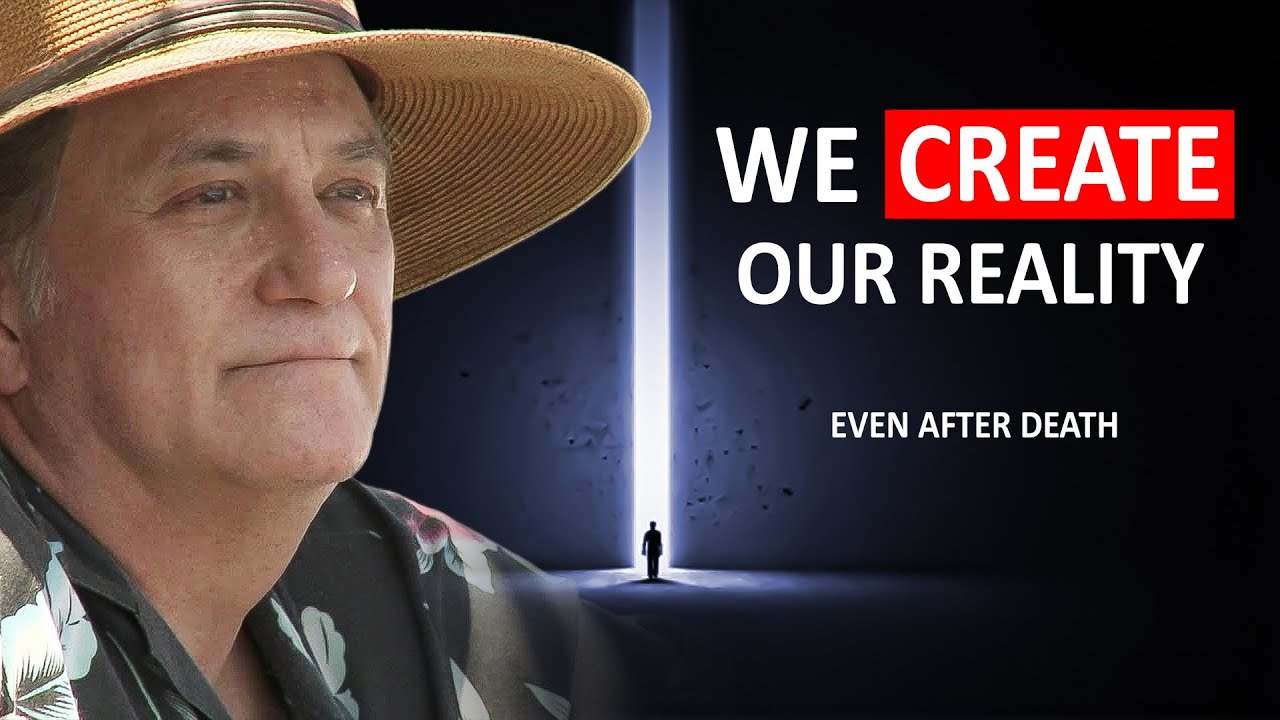
The Dying Artist
In 1982, Mellen-Thomas Benedict was dying of terminal brain cancer. He'd been a casualty of something else first: the Cold War, the ecology movement's apocalyptic warnings, the media's relentless doom. He'd seen a satellite picture comparing Los Angeles to cancer cells, and after that, he began to see all human beings as a cancer ravaging the planet. He lost all hope for humanity. "I believed humans were a Cancer," he recalls, "and I manifested what I believed. I was diagnosed with terminal brain cancer."
His worldview was killing him. Literally.
What Benedict didn't know yet was that his death would become one of the most extensively documented and analyzed near-death experiences in the research literature. Kenneth Ring, one of the founding figures of NDE research, would later describe it as one of the most remarkable accounts ever recorded. But on that day in 1982, Benedict was just a man watching his life drain away, unaware that he was about to spend what felt like an eternity trapped in a hell of his own making.
Into the Shadows
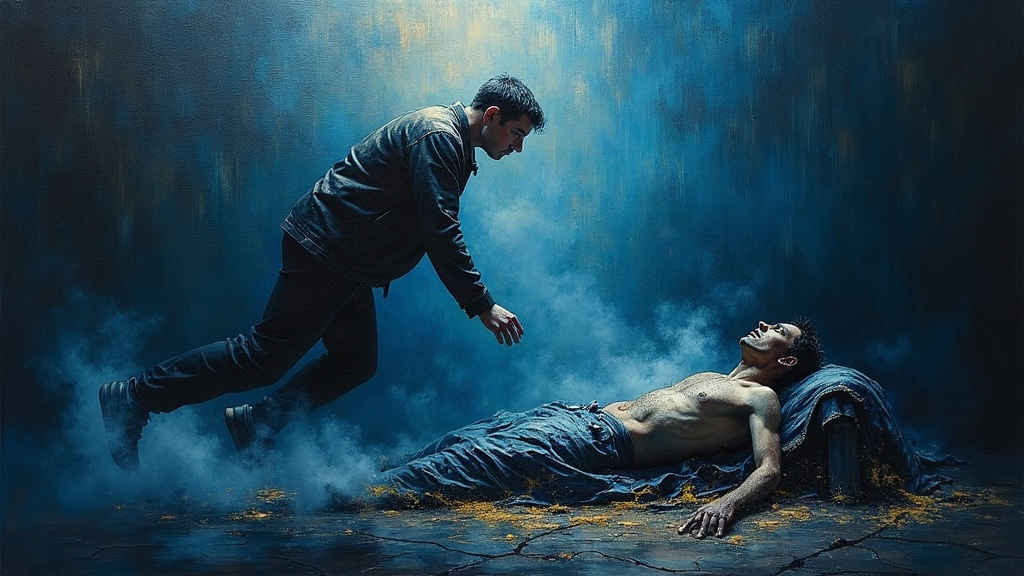
Somehow, Benedict found himself back in his room, hovering over his body. He watched himself dying. All of the life was leaving it rapidly now, and he felt pulled away from it in vapors. What came next wasn't the peaceful tunnel of light that dominates popular NDE narratives.
"I was being drawn into a dense Darkness," Benedict describes. "It was a deep forest of Tangled Shadows that were grabbing and trying to hold me. These dark shadows felt very sticky and somehow abrasive." The sensation was bizarre: like one of his arms was holding on to the other and wouldn't let go. The more he tried to pull away, the tighter the shadows held him.
Although he didn't consider himself a believer, Benedict cried deeply within his soul: "God please help."
The Life Review in Darkness
Then the scenes began. Little cameo movies from his life appeared all around him, each story or event fully playing out. He was put back in touch with so many things about his life that he'd forgotten or repressed. Things he didn't want to remember or was too young to comprehend.
He saw how much his mother wanted him, how she prayed for a child to come into her life before she became pregnant with him. He was amazed. She had been praying for him.
Then came the harder truths. While in her womb, he saw that because his body was made out of her body, he was a part of her love, fears, and life issues. His mother divorced his biological father before he started school, and now Benedict saw things about him he'd never seen before, things his mother never told him.
"The many times my father beat my mother while she was carrying me," Benedict recalls. "When he punched her especially in the belly, I sensed it as a fetus inside her. It sounded and felt like thunder." He became very angry with his father. In those fights, he was programmed to mistrust men, that the world was a dangerous place, and that love was painful.
The realization hit him with devastating clarity: "I didn't realize it at the time, but my world view was killing me."
He'd been a casualty of the Cold War, a casualty of fear. He'd bought into the doom and gloom messages. After seeing that satellite image comparing Los Angeles to cancer cells, he began to see all humans as a cancer. And his body listened.
"I saw that everything we do and think affects so many around us, like ripples on a pond reaching and touching others far more than we might imagine," Benedict explains. Years of his life played away as his body lay there dying.
At some point he cried out: "Enough, enough, where am I?"
The Fall
Everything stopped. The shadows began to close in tighter. He felt all alone and very cold. He saw that the vapor waves were no longer coming from his body. This made him feel sad and afraid. He realized that he must be dying, already dead.
Then he saw a tiny light far off in the distance. He didn't know why, but he wanted to go there. It felt very alluring, like the arms of your ideal mother or father. He tried to reach the light but couldn't move.
What happened next is one of the most vivid descriptions of hell consciousness in the NDE literature.
But there were millions of others all around him in their own Hells, suffering and grieving in every way imaginable. His pain and fear was Amplified millions of times. He cannot and does not want to describe this any further than to say it was each individual's version of Eternal misery.
Here's what makes Benedict's account so significant: he saw that every other hell around him had a speck of light, but no one was paying attention to it. They were also consumed in their own fear, grief, loss, hopelessness, anger. The darkest part of this hell for him was feeling cut off by his own pain, and yet all around him were millions of others each caught up in their own private hell.
For what seemed like an eternity, Benedict was trapped there.
The Call
In the midst of all his suffering, Benedict remembered that the light became brighter when he called to it. He cried out with all his soul: "Please help me, please help me."
The more he summoned his will to focus on the light, the brighter and more intense it became. It occurred to him that if there was any way out of this place, it was the light.
Suddenly everything stopped.
The Angel
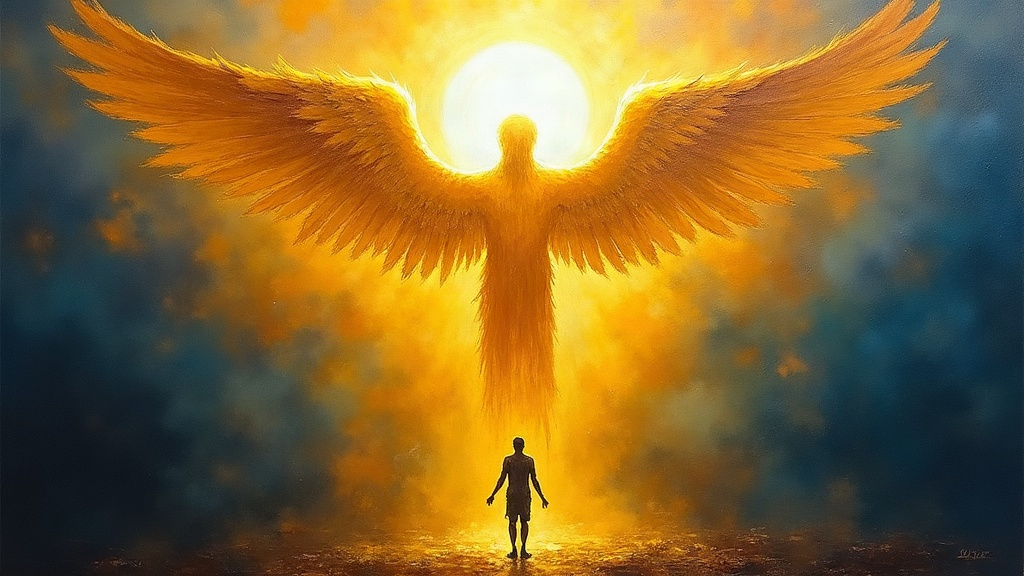
Then out of the light a golden beam shaped like a Halo came towards him. As it moved closer, he could see that it was a towering golden angel. He'd always believed angels to exist only in fairy tales. But there before him was the most beautiful angel. He felt so much love emulating from this being.
He didn't know what to do. So he asked: "Are you the angel of death?"
"There Is No Death. There is only eternal life," the angel answered.
"Who are you then? Can you save me please?" Benedict begged.
Upon hearing these words, Benedict became aware of another part of himself, a larger, higher part that he'd only glimpsed as a child and in rare dreams throughout his life. He hadn't understood that this was the larger part of him: the oversoul, the source of inspiration, his connection to the light.
The Truth About Hell
"Look again at your life," the angel said.
Benedict began to slowly spiral inside the angel's skirt, seeing again his life's demons, the shadows, the cold sticky fire clawing at the skirt all around him. This time, however, he was protected in the skirt of the angel and could see the shadows without fear.
Then Benedict realized something profound: "Hell is a state of consciousness, very real and existing in both life and what we call death. But Consciousness survives death and the individual takes their issues, positive and negative, with them to the other side."
"So why then have I suffered?" Benedict asked.
"Ignorance and fear. Fear of survival," the angel answered.
Benedict was shown more aspects of his life in exquisite detail. He realized how ignorant he'd been because he did not know how the pieces of Life create a tapestry that can be woven, unwoven, and re-woven by everything that we do, how every thread has a reason and a purpose.
He'd come into this world full of fear and anger. He saw his biological father's life and experienced his rage, allowing him to understand why he was the way he was. He could see his mother's fear of survival in her adopted Mother's Hands and later in his father's hands. This was her program or life pattern.
The Way Out
"Can I leave this place? I don't want to be here anymore," Benedict asked.
Suddenly everything stopped.
"This is your life," the angel whispered into his right ear. "What do you really want?"
"I want to leave here, please," Benedict replied.
"Then let go of your negative life issues," the angel said.
"What do you mean? How do I do it? I'll do anything," Benedict said.
At that very moment, Benedict came face to face with his life. Trusting in life as never before, he said and meant: "I love my life. All of it."
He surrendered. And what an incredible release that was.
"Loving my life freed me from my hell," Benedict explains.
The Exodus
Benedict reached out emotionally for the angel. He could see millions of souls still trapped in their private Hells. Most of them were totally consumed by the traumas they had suffered or created in their lives. He asked why these souls were unable to be free.
Protected by the angel, they moved at light speed through this realm of Hell consciousness. Benedict shouted to the others: "Call to the light, call to the light, you can leave this place anytime."
He kept yelling: "Call to the light, call to the light, you can leave, you can leave."
And you know, many did call to the light. Many Souls did leave hell together.
This is one of the most hopeful moments in any NDE account I've encountered. Benedict wasn't just saved. He became a savior, showing others the way out by his example. The implications are staggering: hell is not a sentence. It's a choice we can unmake at any moment.
Beyond Hell
Benedict sailed with the angel out of hell and through several other Realms like varying degrees of light and dark, finally leaving the darkness behind. The angel changed back into a golden Halo which transformed into a beautiful tunnel of multi-colored rings of light. He'd never seen such colors before.
Although he was feeling wonderful, it occurred to him: what's going to happen to me in that light?
So he asked: "Please wait a minute, wait a minute."
And to his surprise, he stopped. Just stopped. Everything just stopped.
All at once he heard a resounding "yes," as if to say "yes, what is your desire?"
"I want to think about all this for a minute," Benedict said.
"All right," was the simple response.
Benedict paused for what seemed like a split second. What's going on here, he thought. And as soon as he thought the question it was answered: "This is your life and rebirth and you are totally interactive," said the angel.
He understood in an instant what that meant. "Life is an interactive experience. And what we call death is just as interactive as life. It's not just a passive experience," Benedict explains.
This was an awesome realization. Imagine that. John Lennon was right.
"What you desire most," was the reply.
"Take me to God," Benedict wished without hesitation.
The Light
Instantly he was before an awesome light that was brighter than a Million Suns. It was like an all-encompassing vast sea of Endless Love Light. It was the light at the end of the tunnel and it penetrated to the essence of his soul. He felt illuminated, fully conscious, totally present in every moment of everything. He was lit up with love light.
In absolute awe, Benedict asked the light: "Are you God?"
The transcript ends there, but we know from other accounts of Benedict's experience that he continued on to explore multiple dimensions of reality, to understand the nature of the universe itself, and to receive information about the future of humanity. His body was monitored for an hour and a half after he died and showed no vital signs. When he returned, his terminal brain cancer was completely gone.
What This Means
Benedict's account is one of the most detailed descriptions of hell consciousness in the NDE literature, and it contains a message that challenges everything our culture teaches about suffering, punishment, and redemption.
Hell, in Benedict's experience, is not a place. It's a state of consciousness created by our own negative patterns, our unresolved traumas, our fears and prejudices. It's real. It's terrifying. It can feel eternal. But it's not permanent, and it's not imposed by any external judge.
The way out is always available. The light is always there, even if it's just a tiny speck in the distance. What keeps souls trapped is not divine punishment but their own inability to look away from their pain long enough to see the exit.
This is consistent with hundreds of other NDE accounts that describe hellish realms. Raymond Moody documented cases where experiencers found themselves in dark, frightening spaces. Howard Storm's famous account describes being rescued from a hellish mob by calling out to Jesus. Nancy Evans Bush has written extensively about distressing NDEs and the theological questions they raise.
What makes Benedict's account unique is the explicit instruction he received: forgive everything, love your life, and fear no more. That's the key. Not repentance in the traditional sense. Not begging for mercy. Just surrender to love.
The angel told him he always had the power to leave. He just didn't know it. How many of us are living in our own private hells right now, unaware that we hold the key?
Benedict's experience also reveals something about the nature of consciousness that neuroscience still can't explain. His brain was dying. Blood flow was stopping. Neurons were shutting down. Yet he was having the most vivid, coherent, meaningful experience of his life. He was thinking, reasoning, making choices, learning profound truths. His consciousness wasn't dimming as his brain failed. It was expanding.
When he returned to his body after 90 minutes of measurable death, his terminal cancer was gone. Completely. This is documented. It's not a story. It's a medical fact that materialist science has no framework to explain.
Benedict spent the rest of his life studying consciousness, collecting NDE accounts, and sharing what he learned on the other side. He gave numerous interviews about his experience, each one revealing new layers of insight. His detailed life review has helped countless people understand the profound interconnection of all our choices.
What he brought back is a message of hope: we are not victims of a cosmic lottery. We are not biological accidents stumbling toward oblivion. We are eternal beings having a temporary physical experience, and death is not an ending but a transition. The love we cultivate here doesn't vanish. The connections we make don't dissolve. The person we become is the person we take with us.
And if we find ourselves in hell, whether in this life or the next, the way out is always the same: call to the light, forgive everything, love your life, and fear no more.
Benedict proved it's possible. He fell into hell and climbed back out. He was dead for 90 minutes and returned with a message: no soul was ever created to suffer. We are already free. We just have to remember it.
Was this article helpful?