Lewis Brown's Near-Death Experience: The Motorcycle Wreck That Revealed His Life's Work
A young engineer's journey through death taught him that consciousness makes the brain, not the other way around
Lewis Brown was 26 years old in 1970 when a motorcycle wreck in Eugene, Oregon destroyed his body. Steel now holds his femur together. His right kneecap is gone. Part of his wrist was pushed up under the skin near his elbow. Three hours after the ambulance picked him up in front of their station, Lewis went into a coma in the ICU. And then he left. Not just the room or the hospital, but his body entirely. What happened next would reshape everything he thought he knew about physics, consciousness, and why we're here.
The Wreck
Lewis describes the accident: "I was killed in a motorcycle wreck in Eugene, Oregon and I happened to have this wreck in front of an ambulance location and they just came around, picked me up and took me to the hospital."
The injuries were catastrophic. He lifts his wrist to show the scars decades later. "I have steel in my femur here, I lost the kneecap on my right leg, I had part of my wrist was up here by my elbow pushed up under the skin," he explains. "I was pretty well destroyed."
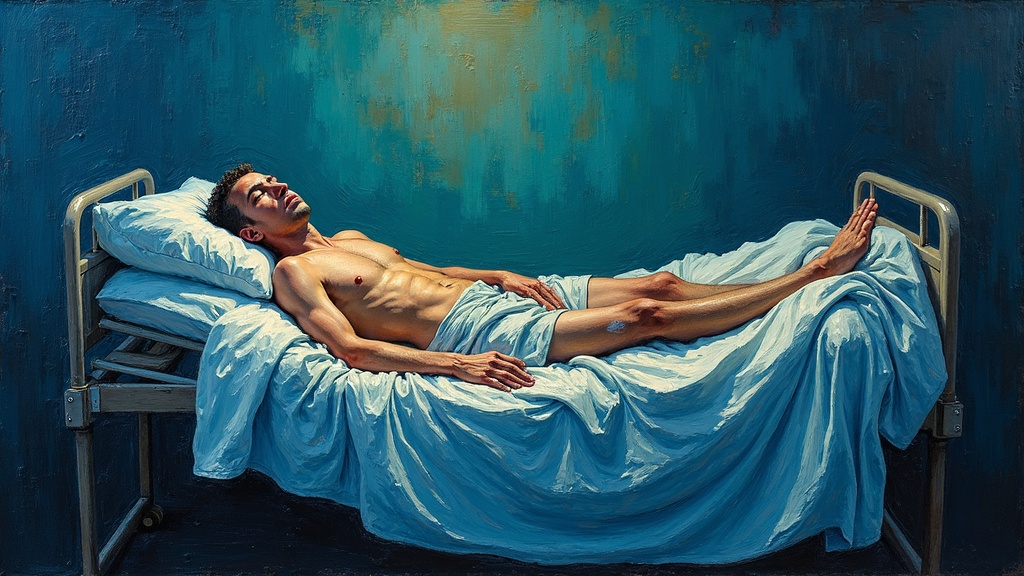
They put him in the Intensive Care Unit. Three hours later, his body gave up the fight. Lewis went into a coma. And that's when the real experience began.
Out of Body
"I went out of body," Lewis says simply. This wasn't his first time. When he was five years old, during a tonsillectomy that turned out to be unnecessary, he'd had a preview of what consciousness could do when freed from flesh. "The next thing I knew I just shot up out of my body and for a while I looked down and saw myself you know being operated on and stuff and I thought, hm, that's interesting," he remembers. A child's curiosity about his own body on the table below.
But this time, in 1970, with his broken body in the ICU, Lewis didn't just hover above the bed. He went further.
The Tunnel and the Light
"My spirit and soul immediately left my body in the car and went through the tunnel we hear people talk about, quickly, all the way through to the other end and out to the other end into pure white light," Lewis describes. Not a gradual drift. Immediate. Fast. Through.
And then he was there. In what he can only describe as the source of everything.
"The being of light is definitely a being but not with a face, a figure, anything else, it's more of an energy center, it's a white light that's described as having gold around the edges if you wish, it's the brightest, prettiest, most loving light I've ever seen," he says. His voice carries the weight of someone trying to fit the infinite into words. "I've never been so in love or at home or with my family or with, it's where I'm from."
This wasn't meeting something new. This was reunion. "I felt that this being and I had known each other for, I use the term thousands of years or eons, we'd always known each other, there was no beginning, no end to how long we've known each other," Lewis explains. He reaches for an image to convey the scale: "If you think of each of our consciousnesses as one little grain of sand and infinite intelligence as the whole beach of sand, I was plugged back in, my little grain of sand was back on the beach where I belonged, where I came from."
The Conversation
"I also was spoken to with a voice, what some people call a conversation with god," Lewis says. The voice was male, though he's quick to add that "we all hear whatever voice we need to hear and whatever language in which we need to hear it."
The message was direct: "Lewis, you were called here to have this conversation and to be sent back because you are not doing your work."
Lewis's first response was surrender. "I said, well I surrender, take me, I'm yours, I will do your work," he recalls. But the voice corrected him immediately: "No, it's not my work you need to do Lewis, it's your work."
So Lewis asked what his work was. He was in a place where "all knowledge is known," after all. He assumed he'd be told. Instead, he was asked a question: "Well, what is it that keeps you from being all you are capable of being?"
Lewis didn't know. He thought everything was fine. But then something surfaced. "I felt something about difference that prevented my soul from connecting with the soul of another, I did not know how to bridge the gap," he says. When he spoke this realization aloud in the light, the voice responded with what Lewis describes as the perfect note in a Mozart composition: "There it is, Lewis, there is your work."
That was the conversation. His work wasn't about God's agenda. It was about learning to bridge the gap between souls, to connect across difference. To see the divine in others.
The Visit with Gaga
Before returning, Lewis had another encounter. "I saw somebody come up to me in a black dress and it was my great-grandmother whom I had actually known until I was about, well she died when I was I think two and a half or something like that, I called her Gaga, everybody called her that," he remembers. He reached out his hand. She took it. "She said, well you're just here for a little visit," and led him into what looked like a building with a long corridor.
They opened a door to a classroom. People were at keyboards. But this was 1951 during his childhood tonsillectomy experience, not the 1970 motorcycle wreck. "There were no such things as computers, especially personal computers, they were big huge room-size things then," Lewis points out. "These were not keyboards like that, they had little squares and they also lit up, I could see the light underneath them, like some were blue and some were red and some were green."
The man showing him the classroom said something Lewis would remember for decades: "You will see these later in your life."
And he did. Personal computers. Lit keyboards. Technology that didn't exist when he was five, shown to him on the other side of death.
The Return
"I was then sent back down the entire same tunnel and white light until I remember coming into the body, until like those tight rubber gloves, I'm not fully in until I am, and then this white light disappeared," Lewis describes. The contrast was immediate and jarring. "I was sitting in my automobile, a totaled automobile, badly damaged, with no physical damage and I walked out of the car into the ambulance to tell them there's no problem."
Another experiencer in the documentary describes the sensation of return more viscerally: "It was like slamming back into the pain of this existence." Lewis remembers "squeezing down, getting smaller and coming into my body."
He came to consciousness about 90 seconds after being thrust back. The body that had been destroyed was still destroyed. The steel, the missing kneecap, the scars. All still there. But Lewis wasn't the same.

The Aftermath: A Physicist Who Knew Better
Lewis returned to his life as a college student studying mechanical engineering and physics. But now he had a problem. "They're teaching me Newtonian physics, they're teaching me that this is 3D, is it, and I'm always from the beginning, from then on, I'm on the other side, no no, there's all the rest of this energy, there's all the rest of this out here," he says.
He tried to tell people what happened. The chief psychiatrist on the head injury floor wanted to commit him to the psychiatric ward. "This isn't true, what do you think you're Jesus, you died and you came back, what is that, you're crazy, so he wants to throw me in the nut house," Lewis recalls. The nurses knew better. They'd heard too many stories. "They're hugging me and say, shh, co, yeah, but it's true, I got to tell him."
The psychiatrist pressed him: "So you think you're Jesus?" Lewis's response cuts to the heart of the problem: "Look, I went there, I did it, you got a degree, you're a doctor and all that, but you've never been there and you're telling me it doesn't exist because you have a degree."
He tried his pastor next. The response was similar: "Well, it can't possibly be true because it doesn't agree with scripture." Lewis corrected him: "Wait a minute, it doesn't agree with your interpretation of the scripture. It's true. I went there."
What Lewis Knows Now
More than four decades later, Lewis speaks with the authority of someone who has seen both sides and refuses to be gaslit about what he knows. "I was lucky to be killed, think about what I'm saying, I was lucky to be killed and then to come back so that I could say all of this and know all of this," he says without irony.
On the question of whether this was real or a drug-induced hallucination, Lewis is unequivocal: "I believe they may have given my body painkillers but I was out of the body, so people say, well it's a drug effect in your mind, no, I'm out of the body, I remember coming back into the room and coming back into the body and seeing myself and coming into it."
"There was no confusion, this was not a dream, this was my real experience of my soul outside of my body, outside of my personality, outside of my ego, and outside of my human form, having a real experience at what I call the source of all energy and all spirit from which we all come," Lewis states. The precision matters to him. This was "more real than this reality."
"We all remember that experience better than anything else in our life, it is embedded in us, it is burning into our mind because it was more real," he explains. The clarity hasn't faded. The details haven't blurred. If anything, they've grown sharper over time.
The Physics Problem
Lewis went on to become a naval architect, designing ships using classical physics. But he never forgot what he learned on the other side. And now, decades later, physics is finally catching up to what Lewis has known since 1970.
"The truth is, and they're coming, physics is coming up against this one big time now, the truth is that the consciousness makes the brain and not the other way around," Lewis says. "The brain is just like a television set, it's a receiving station, the consciousness exists outside the body."
He points to string theory, quantum mechanics, the discovery that 96% of the universe is dark energy and dark matter we can't yet detect. "There's a lot of room for a lot of afterlife and a lot of different levels out there," he notes. But "the materialist scientists who only want 3D, they won't look at it, they won't even, no, it's a bunch of baloney, they don't even look, they just say no, good, impossible, I'm not even going to look at it."
Lewis finds this absurd: "How do they know it's impossible? They see 4% of the universe and the rest of it's impossible? But that's ridiculous."
He's particularly interested in what string theory suggests about the fundamental nature of reality. "The quarks and the gluons which make up our atoms, string theory is that they're made up of a vibration, and you think about a vibration without a string vibrating, now you have what quarks and gluons are made out of: a thought, a vibratory thought, and that's consciousness, and that's what makes the whole universe," Lewis explains. "Well, if consciousness comes first, then this whole idea that the neurosurgeons are using, that the brain, the wet brain creates the thought, is backwards."
The Shift That's Coming
Lewis believes we're at a turning point. "There's a huge change in human consciousness now compared to the past and it continues to change," he observes. More people are talking openly about these experiences. More scientists are willing to look at the data without dismissing it out of hand. "Now that we are beginning to talk more openly about it, then we are better able to hear and understand and believe other people's experiences and talk more ourselves about it, and that change is happening very quickly," Lewis says.
He sees it in the children being born today: "They're being born much more perceptive, much more psychic, much more clairvoyant, much more empathic than they've ever been before."
And he sees it in the growing willingness of people to question the materialist paradigm that says consciousness is just neurons firing, that death is the end, that there's nothing more than what we can measure with our current instruments. "We have to remember that it's not in our 4%, we can't know it all yet, but we're now at a point where we are making beachheads on a new territory, those other dimensions," Lewis says.
His Message
Lewis's advice to others who've had these experiences is simple: "Believe in what you have seen and what you've experienced, you know, if you did experience this, it's a good thing." Don't let others talk you out of what you know. "Just believe in yourself and what you see and what you know, and if you're doing something good and trying to be beneficial to the world, then the things people say are not, they're not real, they don't matter."
On the nature of what awaits us, Lewis is clear: "Just when I say I've been in the light and experienced all knowledge where there's nothing but love and light and truth and peace and grace, are still not enough, when you add all the words together, to fully describe what I experienced."
And on the question of proof, Lewis is honest about the limits: "For me to share with you that I have perfect memory of every experience I had in the tunnel and in the light and in my conversation with god, and that I remembered as clearly as I'm talking to you now, is not able to be proven scientifically, because our understanding of the word memory is that it is in the brain, and the brain was in the body, and the body was in the car, so no, I cannot prove to you scientifically how I can have perfect memory of this experience."
But the lack of scientific proof doesn't diminish the reality of what happened. Lewis knows what he knows. And he's spent the last 44 years living with the certainty that consciousness is primary, that we are eternal, that love is the point, and that the work we're here to do is about bridging the gaps between souls.
What This Tells Us
Lewis's account carries several features that appear consistently across thousands of near-death experiences. The immediate separation from the body at the moment of crisis. The tunnel. The being of light that radiates unconditional love. The life review or, in Lewis's case, the conversation about his life's purpose. The reunion with deceased loved ones. The return against his will because the work isn't finished.
But what makes Lewis's story particularly valuable is his background in physics and engineering. He's not someone predisposed to mystical thinking. He was trained to trust measurement, mathematics, empirical data. And yet his experience forced him to recognize that the materialist framework he'd been taught was incomplete. Not wrong about what it describes, but blind to most of what exists.
The detail about seeing computer keyboards in 1951, decades before personal computers existed, is the kind of specific, verifiable precognitive element that appears in many NDEs. These aren't vague predictions. They're concrete observations of future technology or events that the experiencer couldn't have known about through normal means.
Lewis's description of consciousness as primary, not produced by the brain, aligns with what many physicists and consciousness researchers are beginning to suspect: that the brain is a receiver or transducer of consciousness, not its generator. The television set metaphor Lewis uses has been employed by many others, including neurosurgeon Eben Alexander after his own NDE.
And Lewis's observation that we're at a turning point, that consciousness is shifting, that more people are waking up to these realities, isn't wishful thinking. It's a pattern we can observe. Near-death experience research has grown from a fringe topic to a legitimate field of study. Consciousness studies are now respectable in academia. Quantum physics has made the observer effect and non-locality part of mainstream science. The materialist paradigm is cracking.
What Lewis learned in 1970 is what many are discovering now: we are not bodies that have consciousness. We are consciousness that has bodies. We don't die. We can't die. We are eternal beings having a temporary physical experience. And the purpose of that experience is to learn to bridge the gaps between souls, to see past difference, to recognize the divine in each other.
Love isn't a nice idea. It's the fundamental structure of reality. It's where we come from. It's where we return. It's what we're made of.
Lewis was lucky to be killed. Because he came back with the message we all need to hear: there's nothing to fear. The light is real. The love is real. We're going home. And the work we're here to do matters more than we can possibly imagine.
Was this article helpful?