Jeff Tolley's Near-Death Experience: The Life Review That Changed Everything
After an overdose nearly killed him, Jeff discovered that we judge ourselves, not God, and that life's challenges are opportunities we chose before birth.
The darkness trickled in slowly, then the white light appeared. Jeff Tolley was hovering above his body in an ambulance, watching paramedics work frantically below. He'd swallowed a bottle of narcotic painkillers minutes earlier, certain it would end his pain. It did end something: the version of Jeff who believed death was the only escape. What happened next, in those twenty minutes between clinical death and resuscitation, gave him a blueprint he'd been carrying his whole life without knowing it, and a second chance to get it right.
The Breaking Point
Jeff Tolley wasn't always the man who wanted to die. But when his younger brother passed away at age 21, something fundamental shattered. "My younger brother at the age of 21 passed away," Jeff recalls. "When he died that really for me was the end because we weren't just brothers we were best friends."
Jeff was already struggling with drug addiction before his brother died. The loss didn't just deepen his pain, it multiplied it exponentially. "My best friend slash brother dies and then it totally ruins me," he says. "As bad as I was on drugs it made it way worse now I'm you know drugs on steroids it's just like so horrible."
The spiral accelerated. The drugs that once numbed the pain stopped working. Nothing worked. "It just got worse and worse and eventually it led up to me not wanting to be here anymore," Jeff explains. For him, the logic became brutally simple: "leaving the body was the only thing that made sense to alleviate the pain."
On July 17, 2010, Jeff made his decision. "I had a whole bottle of narcotic painkillers because I know for a fact this is gonna end me," he says. He wasn't seeking help. He wasn't crying out. He was certain this was the end.
The Crossing
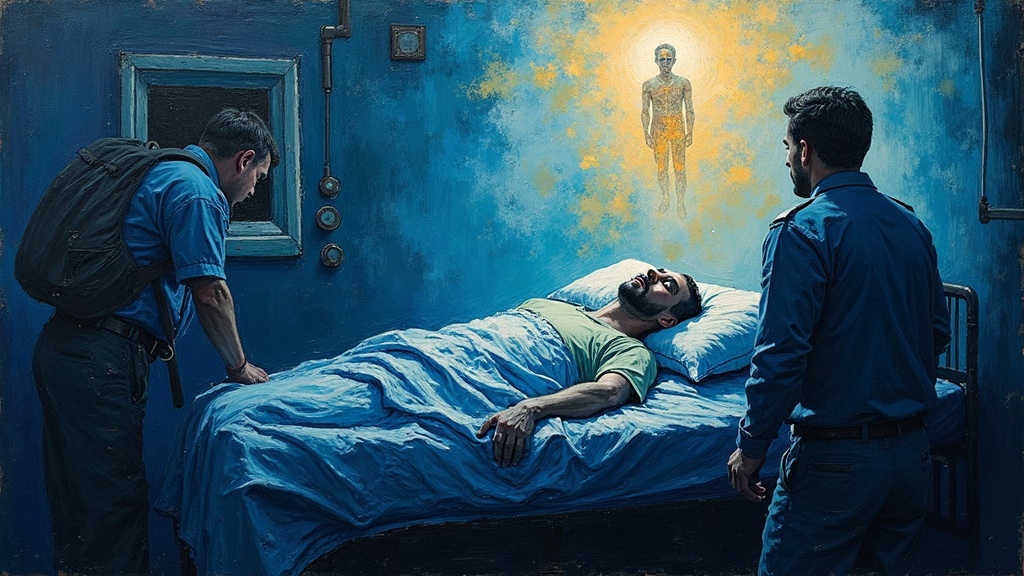
The transition happened faster than he expected. "It was like I don't know only a couple minutes really it was very very quick that everything started to come and just go dark," Jeff remembers. The darkness didn't slam down like a curtain. It trickled in, creeping at the edges of his vision. "So it was like trickling in this darkness was starting to trickle in and I knew that this is it for me."
Then something unexpected happened. "And then white now started trickling up," Jeff says. The perspective shifted completely. He was no longer in his body. He was above it, "hovering looking down on my body."
Paramedics were working on him. Someone had called 911. There was a time frame Jeff can't account for, about twenty minutes between the overdose and this moment of hovering consciousness. "There is a period of about 20 minutes I feel like because the paramedics had to come they had to be called there was a time frame that is being blocked for me," he explains. "For me it was instantaneous it was black and then white and now I'm just there."
The realization hit him with strange clarity: "Holy shit I'm dead like I'm I I died I did it like I died but then I was like holy shit I'm not dead at all." And then came the feeling he'd been chasing through every drug, every escape attempt, every desperate moment of his life: "I am so much better than I ever was."
Jeff describes the sensation as feeling "secure and that nothing could ever go wrong there was no anxiety no depression no heartache no guilt no shame all the stuff that I carried in my body was completely removed and gone I was home."
He was looking down at his body in the ambulance, watching the paramedics work. And that's when the life review began.
The Review: Feeling What You've Done
What Jeff experienced next wasn't a movie of his life playing on a screen. It was something far more visceral, far more complete. "This is when this kind of review started happening," Jeff says. "Everyone that I encountered every single other person I could feel what I had done to them I'm feeling their pain I'm feeling their sorrow I'm feeling their anger god there's a lot of that I'm feeling that from their point of view."
This is one of the most commonly reported features of the life review: the experiencer doesn't just see their actions, they feel the emotional impact of those actions from the other person's perspective. Jeff felt every moment of pain he'd caused. Every careless word. Every selfish act. Every time he'd chosen drugs over the people who loved him.
But the review wasn't only negative. "And then I'm also feeling those that I did do good with as well I'm feeling that joy or excitement or things in that nature more on the positive side," Jeff explains. The problem was the balance: "but like I said way more negative."
What strikes me most about Jeff's account is what he says next: "There was no judgment I was the judge jury the prosecutor I was everything about the judge in my own life it was me judging myself on what I could have done better or could have changed."
No angry God. No cosmic tribunal. Just Jeff, facing the truth of what he'd done with his life. This self-judgment is reported across thousands of NDE accounts, and it reveals something profound about the nature of accountability. We are not punished by some external force. We are confronted with the reality of our choices, and we judge ourselves far more harshly than any deity ever would.
The Blueprint
Then Jeff saw something that reframed his entire understanding of existence. "There was this blueprint of my life and there was challenges put in place for me to overcome," he says. These weren't random hardships. They were specific tests, chosen before birth, designed to help him grow.
And he'd failed them. "It was obvious that I didn't pass any it was obvious that nothing I did actually accomplished anything and all these challenges were still there they were you know unfinished," Jeff recalls. The realization was crushing: "For me it was just like it's not a disappointment but for me it was like oh man I couldn't even get one thing right in this on this list."
"It was obvious that I totally failed," Jeff says, "and I could have done a little better than this like if life was the game I very much failed."
This concept of a pre-life blueprint appears in many NDE accounts. The idea that we choose our challenges, that our hardships aren't cosmic punishment but opportunities for growth, is one of the most transformative insights reported by experiencers. Jeff would later describe this dynamic between destiny and free will: "Our destiny is like the theme we chose to play out in life but the free will is how in which way we go about that," he explains. "So we can go about it rich or poor right or we can go about it happy or sad so that's the free will but the theme is like you're going to overall experience this adventure and you can't get away from the destiny of it."
The Brother and the Guides
Then his brother appeared. The same brother whose death had sent Jeff spiraling into the overdose. "My younger brother died a year before he came up to me," Jeff recalls. His brother's energy was exactly as Jeff remembered him in life: "he and his bubbly self was like wow that was quite the experience quite the journey in a very jokingly manner."
His brother invited him to follow. "And then he's like I want you to come over here I want you to follow me," Jeff says. "Then he brought me into this lightroom and this is where there was three beings there was two women and there was one male guide."
These weren't human forms exactly. "So the two women they had like Victorian clothing and then a guy who had tribal clothing," Jeff describes. He believes "these people were part of the soul family or guides." They had a glow to them, brighter than his brother, who appeared more dimmed down by comparison. "They did have a glow to them kind of light energy but everything out there is light energy it's just it's just degrees of how bright and how not right so they were fair they were brighter than my brother they kind of lit up more and my brother was more kind of dimmed down."
The guides delivered a message: "These beings told me that you have a job to do you're not done you have to complete things you have a better life that could be waiting for you." But here's what's crucial: "you don't have to go back we're not forcing you to go back but we highly highly recommend you go back."
Free will remained intact, even on the other side. Jeff could stay if he chose. But "from that level the soul level there was no choice it was obvious I'm going back because I just saw how badly I screwed everything up and um I'm gonna I want to go fix it."

The Bodies
Before returning, Jeff was shown something most experiencers never report: the structure of the human energy system. "We have these different bodies one being emotional one being mental spiritual and physical," Jeff explains.
The emotional body appeared as "a blanket and it was a heavy blanket a heavy dark blanket." Memories lived there, "flashes of memories it was like a storm it really is like the weather system of a body it was dark and gloomy and there was flashes of light and memory was held in the emotional body not just the mind."
The mental body looked "like a donut like a halo if you will but just like a halo that saints have but mine was dark it was a dark halo." It was "a spinning field of energy around the mind."
The physical body was "very dense of course because you know the physical body takes on toxicity and it was heavy and it just looks sick."
And the spirit body, Jeff learned, "is the electrical system that operates the whole thing so without the spirit body you can't even function."
"These bodies were very heavy and very dense for me and they just got heavier and heavier," Jeff says. The message was clear: "and then I needed to do something about these bodies I needed to change them I needed to lighten the load."
The Future
Then came the vision that Jeff still struggles to fully explain. "After that there was this amazing kind of holographic image that completely surrounded me in this room and it was my future," he recalls. But it wasn't just his personal future. "And it was like basically the future of earth it was very different it was changed so much that it didn't make sense."
Jeff saw himself at about 50 years old. "Say I was about 50 years old and you can tell that things were not what they are now," he says. "Something big changes the earth."
He's spoken more about this vision in other interviews, including details about extraterrestrial disclosure and major shifts in human consciousness. But in this moment, hovering between life and death, the specifics mattered less than the realization: he had a future. There was more to do.
The Return and Transformation
Jeff came back. And the man who returned was not the man who'd swallowed those pills. "Like all I wanted to do was die but now after the nde all I want to do now is live all I want to do now is do my best like it changed me to my core."
The shift wasn't just emotional. It was existential. "For me what really helped me was finding something finding a purpose finding something more to live for finding that meaning," Jeff explains
Jeff now sees the world differently than his neighbors. "I look at the world in this way that I know my neighbors don't look at it that way I know the people I'm around they just don't see it like that," he says. "When you understand where you are why you're here and what you're here to do and you start living that out and really live that out you are on that true north path you're on that purpose road."
And when you're on that path, "that's when that magic happens that's when synchronicities flow that's when things start to happen for you that's when more things show up to expand the level of excitement and life becomes this exciting synchronistic journey and more like an adventure."
Before his NDE, Jeff says, "it was like just a life I was just living or surviving I wouldn't call it I called survival now my life is a great adventure." His advice to others: "try to find adventure because when you start living your life from that point of view of an adventure or something to to you know to overcome and when challenges come you can really you can you can look at them as I'm gonna I'm gonna get through this I'm gonna defeat this not oh god I don't want to do this again right then life it just expands on you and you can be so much happier."
The final words of his account carry the weight of genuine transformation: "I'm being who I am now is so much better than what I was my god."
What This Reveals
Jeff Tolley's experience offers several insights that appear consistently across the broader NDE literature. First, the life review as a process of self-judgment rather than divine punishment. This pattern appears in thousands of accounts. We are not judged by God. We judge ourselves, and we do so with far more severity than any external force would impose. The review isn't about shame. It's about understanding the ripple effects of our choices, feeling what we made others feel, and recognizing where we fell short of our own potential.
Second, the concept of a pre-life blueprint. Jeff saw clearly that his life's challenges weren't random. They were chosen, designed to help him grow. This idea appears across cultures and throughout history, from Plato's myth of Er to modern regression therapy. The implication is staggering: our hardships aren't punishments. They're opportunities. We chose them. We designed this curriculum.
Third, the reunion with deceased loved ones. Jeff's brother appeared exactly as he'd been in life, personality intact, joking about the journey. This detail, the continuity of personality after death, is one of the most comforting and consistent features of NDE reunions. Our loved ones don't become unrecognizable angels. They remain themselves, recognizable, relatable, still connected to us.
Fourth, the choice to return. The guides didn't force Jeff back. They recommended it strongly, but the choice was his. This preservation of free will, even in the afterlife, suggests something profound about the nature of consciousness and autonomy. We are not puppets. We are active participants in our own journey, both here and there.
And finally, the transformation. Jeff went from wanting to die to wanting to live with every fiber of his being. This isn't unusual. It's the norm among NDE survivors. They return with a sense of purpose, a recognition that life is precious, that challenges are opportunities, that we're here to learn and grow and love.
Jeff's story also includes elements less commonly reported, like the detailed vision of the emotional, mental, physical, and spiritual bodies. His description of the emotional body as a storm system, dark and heavy with unprocessed trauma, rings true for anyone who's done deep inner work. The idea that memories live in the emotional body, not just the mind, aligns with modern somatic therapy and trauma research. We carry our experiences in our tissues, our energy fields, our entire being.
The vision of Earth's future is harder to parse. Jeff is careful not to claim certainty about what he saw. He describes it as different, changed, the result of something big. In other interviews, he's elaborated on this vision, discussing shifts in consciousness and the role of extraterrestrial contact. Whether these visions are literal prophecy or symbolic representations of potential futures remains an open question. What's clear is that Jeff came back with a sense that humanity is moving toward something, that change is coming, and that we each have a role to play in how that unfolds.
What I find most compelling about Jeff's account is the emotional honesty. He doesn't present himself as a hero. He admits he failed his life's challenges. He felt the pain he caused others. He judged himself harshly. And yet, he was given a second chance. Not because he earned it, but because the universe, or God, or whatever we call the source of all being, wants us to succeed. The guides didn't say, "You failed, you're done." They said, "You have a job to do. You're not done. You have a better life waiting for you."
That's the message at the heart of so many NDEs. We're not here to be perfect. We're here to learn. And when we fail, when we fall short, when we screw up so badly that we think we're beyond redemption, we're offered another chance. Not always in this life, but always in the larger journey of the soul.
Jeff's story is a reminder that our darkest moments can become our greatest teachers. The overdose that nearly killed him became the catalyst for his transformation. The brother whose death sent him spiraling became his guide on the other side. The challenges he failed became the blueprint for his return. Nothing was wasted. Nothing was random. It was all part of the journey.
And that journey, as Jeff discovered, is so much bigger and more beautiful than we can imagine from inside these heavy, dense, traumatized bodies. On the other side, there's no anxiety, no depression, no guilt, no shame. There's only love, clarity, purpose, and the recognition that we are so much better than we ever knew. We are eternal beings, having a temporary human experience, learning lessons we chose before we arrived, supported by guides and loved ones who never truly left us.
Jeff came back to finish what he started. To lighten the load of those heavy bodies. To face the challenges he'd avoided. To live with purpose and meaning and joy. And in sharing his story, he's offering the rest of us a glimpse of what awaits: not judgment, but understanding. Not punishment, but opportunity. Not an end, but a continuation of the greatest adventure we'll ever know.
Was this article helpful?