Howard Storm: The Atheist Professor Who Died, Went to Hell, and Met Jesus
A materialist academic's harrowing descent into darkness and his rescue by the light he never believed in
Howard Storm, an atheist art professor, experienced a life-altering near-death event in June 1985 when he faced a critical medical crisis in Paris. As his body deteriorated from a severe abdominal condition, he found himself in a situation where he had to confront his disbelief in the divine. Ultimately, this harrowing experience led him to a profound encounter that transformed his understanding of faith and existence.
The Man Who Believed in Nothing
Before June 1985, ["My faith was materialism," Howard explains](/video/diPhrDPH8U8?t=1" class="text-blue-600 dark:text-blue-400 hover:underline">Howard Storm. "What I believed in, all of my PhD friends and all of my friends believed: that if you can't measure it, see it, weigh it, count it, it simply doesn't exist."
He was, by his own admission, a selfish man driven by a singular ambition. "I thought my life was about being the most famous, wealthiest, important, powerful person that I could possibly be," he recalls. "I wanted it all."
Prayer? The very idea was absurd. "The last thing in the world I would have done was pray," Howard says. "I would have sooner jumped off the Eiffel Tower than pray. An absolutely silly notion."
This was the man who would soon find himself begging for divine intervention in the darkest place imaginable.
A Body Eating Itself
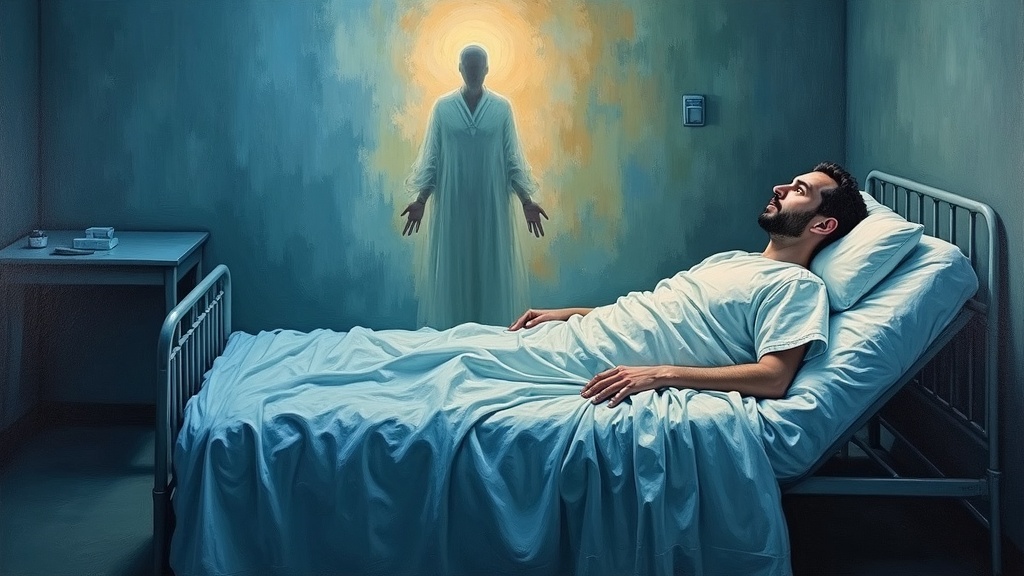
The crisis began in Paris, where Howard was leading a student art tour. The pain started as a burning sensation in his abdomen, then escalated into something far worse. A hole had opened in his duodenum, and digestive acids were spilling into his abdominal cavity.
"The pain of the hole in my duodenum, which was leaking hydrochloric acid and other delightful digestive juices... I was dissolving myself, I was digesting myself," Howard describes. "And if you wonder what that feels like, get a red-hot coal out of a fire and stick it inside your gut."
Two emergency room doctors examined him and delivered a stark verdict: he had one hour to live. Surgery would happen immediately. But in the chaos of a French hospital, something went wrong. No surgeon came. No pain medication arrived. For ten excruciating hours, Howard lay in that room, his body destroying itself, begging for relief that never came.
"People tell me, 'Well, the reason why you had your near-death experience was because of all the narcotics you've been given,'" Howard says with bitter irony. "And I'm like, I begged for anything and I was given nothing for ten hours. Nothing. What about nothing don't you understand?"
When a nurse finally entered to tell him they couldn't locate a doctor, Howard knew what it meant. "That's when I told my wife, I said, 'Tell my parents that I love them,' and I said goodbye to all my kids," he recalls. His wife began crying in a way he'd never witnessed before, "crying from the soles of her feet all the way up, just shaking and throbbing."
Howard looked at her and said simply: "Time for me to go."
Standing Outside Himself
Dying, it turned out, was easy. "I found it the easiest thing in the world to die," Howard reflects. "I was having a lot of trouble breathing for the last several hours. All I was doing was trying to breathe. I had enough sense to know that if you stop breathing, that would be a bad thing. I just... all I had to do was just stop doing that. And I went unconscious."
Then he woke up. But not in the way he expected.
"I awoke. I was standing there. I felt absolutely, physically more real, more alive, and completely healed than I'd ever known," Howard says. "So the first thing I did was I did a reality check, which consisted of taking my hands and I felt myself from the top of my head, felt myself all the way down, right down to my feet. And it's like, feeling good. Matter of fact, feeling really good."
Ever the rational professor, Howard began conducting sensory tests. He could hear the fluorescent lights humming in the ceiling. His vision had changed dramatically. "In art, we see 180 degrees with two eyes," he explains. "Well, I was seeing way more than 180 degrees, and I'm going, 'Oh, that's so weird.' And then I checked my depth of field... I was going like, I have complete depth of field. I am focused on everything."
Even his sense of touch had transformed. "I'm doing the bottoms of my feet, and I could read the texture of linoleum," he marvels. "I'm going like, 'Wow, this linoleum's so cool.'"
Then he noticed something that didn't make sense. His wife sat on the other side of the bed, crying. And in the bed, mostly covered by a sheet, lay a body that looked remarkably like him.
"I looked at the person who was facing my wife, away from me, and to my horror, it bore a remarkable resemblance to me," Howard recalls. "Now, I knew rationally that that wasn't me, because I was standing there. And rational people know you can't bifurcate. I mean, that's crazy stuff, that's schizophrenia, to say that you were standing over yourself looking at yourself. I'm not crazy, I'm not nuts. That's not me."
But the resemblance was too perfect to be coincidence. His mind, still operating in professor mode, tried to construct a logical explanation. "What I came up with, which I realized was absolutely ludicrous, was that the French hospital personnel had made a wax replica of me," he admits. "I realized: one, they didn't have the time to do that. Two, that takes a lot of skill because it was a very good replica. And three, what would be their motive?"
He tried to communicate with his wife, but she couldn't hear him. He tried his roommate. No response. "I started yelling and screaming at him, and no response," Howard says. "And now I'm really agitated. Very, very agitated."
The Voices in the Hallway
That's when he heard them: voices outside the room, calling his name in English. In a French hospital. "I was in France, and surprisingly, the people in France speak French," Howard notes. "And Howard is not a French name. They're speaking English: 'Howard, come with us.'"
He went to the door and saw people in the hallway. But something was wrong with the image. "The hallway was gray and like a really, really bad black-and-white TV picture, very fuzzy," he describes. "Which was weird, because the room was so ultra-clear, and the hallway was very indistinct."
The people claimed they were from the hospital, there to take him to surgery. Given the treatment he'd received so far, walking to surgery made perfect sense. "I never questioned that," Howard says. After some convincing, he followed them.
"So we went on a long journey," Howard states simply.
What came next would be the most horrific experience of his existence.
In the Cesspool
The place Howard found himself defied his materialist worldview. It was a realm of separation, of absence, of cruelty feeding on cruelty. "Hell is a separation from God," Howard explains. "And the only thing that makes hell bad is the people there. God doesn't make hell bad. If they were nicer to each other, it'd be a lot more pleasant down there than it is."
But they weren't nice. Not even close.
"What psychologists have found when they cage a bunch of animals in a cage for a period of time: they start gnawing on each other," Howard says. "Because that's the only gratification they get."
He had become what prison inmates call "new fish." "Everybody's excited because they want to initiate them, which usually means brutal rape and other things," he explains. "So I was new fish. So hundreds of them had their way with me."
The physical torture was terrible. But worse was the emotional dimension. "The physical part is awful," Howard says, "but the emotional part is much worse than the physical part. When it was happening and after it happened, it's like: how could they want to hurt me that much? Why do they hate me?"
The answer, he would later understand, was simple and chilling: "They don't care. They weren't directed to me personally. It was just I was new fish," he explains. "And when they were done with me... I was no longer responsive, physically and emotionally. Too far gone. The term that I like to describe was I was roadkill."
Lying there, broken and abandoned, Howard tried to make sense of where he was. His rational mind, still clinging to material explanations, came up with a theory. "In Massachusetts, we had septic systems and cesspools," he recalls. "So what I came up with is that I had gone down the toilet and through the plumbing into the cesspool."
He even tried to figure out which layer of the septic system he'd reached. It would be funny if it weren't so tragic: a PhD professor lying in spiritual torment, trying to apply sewage engineering to his predicament.
The Voice That Changed Everything
In that place of absolute despair, something happened. "I heard a voice that said, 'Pray to God,'" Howard recalls. "I literally heard a voice say, 'Pray to God.' I don't know who said that. I don't know where it came from. It kind of felt like it was here, coming out of my chest."
His first reaction? "I thought, what a stupid idea. I don't believe in God. I don't pray," he admits.
But the voice persisted. "And the voice said, 'Pray to God,' and I thought, I don't know how to pray. I haven't prayed since I was a kid. I don't pray. I'm not a prayer. Forget it," Howard remembers. "And the voice said, 'Pray to God,' real strong."
Finally, he relented. But what did prayer even look like? His brilliant mind, trained in art and philosophy, began searching through memories, trying to remember something, anything that sounded like a prayer.
"I'm remembering things I've memorized," he explains. "Because of course, from my perspective, 38-year-old genius college professor, department head, I thought prayer was something you memorized when you were a child."
He tried the Gettysburg Address. No, that wasn't it. Finally, he remembered: "The Lord is my shepherd," he murmured. "And I'm so excited. I murmured it out of excitement that I actually remembered something that sounded like a prayer."
The reaction was immediate and violent. "The people that were still around me became very angry," Howard says. "And they said to me, in language that's the worst language I've ever heard in my life: 'There is no God. Nobody can hear you. And now we're really, really going to hurt you.'"
But Howard had discovered something crucial: his pathetic little prayers had power. "I thought of some other things, like 'Our Father who art in heaven, hallowed be thy name,'" he continues. "I was only remembering phrases. I couldn't remember a whole verse. I'm saying this stuff and it's really making them angry."
And here's what mattered: "The more I said these things, the more it drove them away," Howard explains. "I could hear them retreating and retreating and retreating. So I'm letting them have it with this stuff. I'm just repeating this stuff over and over again."
Eventually, silence. They were gone. But Howard was still trapped, unable to move, lost in darkness.

A Prayer from the Heart
In that moment of complete hopelessness, Howard did his own life review. "I knew that my life was filled with garbage," he admits. "I knew that I was a selfish ass. I knew that I... in the world, I never would have admitted that. But I did my own life review, and what I concluded was... I graded myself. After I went through my life, I realized that I was basically getting Fs and Ds in every department."
His relationships with his father, mother, sisters, students, friends, wife, children, all failures. "I just gave myself Fs and Ds up and down the line, because all I could see was all the ways that I had failed," he says. "And I felt real, real bad."
He realized something terrible: "I belonged in the place that I was, and I was stuck there, and nothing was ever going to change it," Howard reflects. The only way to survive would be to become more vicious than the beings who'd tormented him. To bite first, rip heads off before they could attack.
"And I thought, I'd rather not exist than live like that," Howard says quietly. "Because I'd rather not be than be one of them."
But now he faced a dilemma. He couldn't count on those memorized prayers to save him indefinitely. "It wasn't from my heart. It was just like, it worked," he admits. "But how long is that going to work for me?"
Sinking into even deeper despair, his mind reached back to childhood. "I'm having this eight or nine-year-old child sitting in Sunday school singing 'Jesus Loves Me,'" he recalls. "It wasn't the idea. The words were good, but it wasn't the words. It was like... when I was a little kid, I believed in this God-slash-Superman."
He remembered praying as a child when monsters seemed to lurk under his bed. "When the alligators and bears that lived under your bed that are trying to bite your toes... when they would start snapping at my toes at night, I would pray to Jesus and they would go away," he says.
Voices in his head mocked him. "You don't believe this silly stuff. You were a child. You're an idiot. It's not true," they whispered. Other voices added: "Why would he care about you? You've done nothing but use his name as a cuss word for the past 20 years. He's not going to listen to you. Even if he did exist, he hates your guts."
"Finally, I'm screaming in my head: 'Stop it, stop it, stop it,'" Howard remembers. "And I just yelled out in pure desperation: 'Jesus, please save me.'"
Four words. From a man who didn't believe. "Without the faintest idea whether there was a Jesus or not a Jesus, or whether he liked me or didn't like me," Howard admits. "I had nothing except this faint hope that it might be true."
The Light That Heals
What happened next defied every law of physics Howard had ever taught.
"This impossibly bright light... if it was actually light, it would have burned me," he describes. "I was so overwhelmed by the brightness of the light and its beauty. And then I looked down at myself and I saw gore. I had been eviscerated. Not pretty."
"And out of the light came hands and arms, and he touched me," Howard continues. "And when he touched me, three things happened. One is all the gore started to disappear and I became whole. The other thing that happened was I was filled with ecstasy, instead of being simply just nothing but pain from head to foot. Now all of a sudden, the pain goes away and I'm filled with ecstasy."
But the third thing was the most important. "And lastly, and most importantly, I experienced a love that I had never known existed," Howard says, his voice thick with emotion. "And unfortunately, I haven't found any language yet that can begin to describe it."
Jesus picked him up and held him tight. "And when he held me, I knew that besides all this healing and love and all that, he really, really liked me a lot," Howard says. "Matter of fact, I'm his favorite person in the whole universe."
Then he adds, with the hint of a smile: "I have to add, unfortunately, you are too. And he likes me. He doesn't dislike me. He's not mad at me. He's happy."
Howard buried his face in Jesus's chest as they took off, flying through darkness toward a world of light. "All around the world of light, like a bazillion little lights going in and coming out, and all this activity," he describes. "And I had this gigantic 'oh.' The God that I said wasn't... we're going to his house. We're going into his territory."
But as they approached, doubt crept in. "I am the biggest idiot in the whole world, and they probably hate me because of what I've said and done," Howard thought. "I think to myself, he's made a terrible mistake. I don't belong here."
Immediately, they stopped. Jesus spoke telepathically for the first time: "We don't make mistakes. You belong here," he said.
Howard's academic mind kicked in. "How do you know what I thought? I didn't say that. Can you hear what I think?" he wondered. Jesus laughed and replied: "I know everything you've ever thought."
This made Howard deeply uncomfortable. "I feel real uncomfortable with you knowing everything I've ever thought, because I've thought things that I don't want you to know that I thought," he admits. "And immediately I thought of something that I didn't want him to know that I thought about, which was I thought of a breast. I've always been a boob guy."
"And you know what he did? He laughed and laughed and laughed," Howard recalls with obvious delight. "He thought it's really funny. And I thought, 'Oh, he thinks I'm funny,' because nobody thinks I'm funny."
Jesus confirmed: "Yeah, you're real funny." Howard was amazed: "He thinks I'm funny!"
The Life Review
Jesus called out in musical tones, and a group of women appeared, forming a semicircle. "He said they've recorded your life, and they want to show you your life," Howard explains. "So we proceeded to watch my life, and that was what I would refer to as a holographic projection of me interacting with people."
The review was brutally honest. "We'd go into a scene and see what happened to the person after what happened to them after we'd interacted, or what they were feeling. I'd feel what they were feeling," Howard describes. "I was more manipulative and detached from people, and Jesus and the angels clearly shared their unhappiness with the direction I was going. Not in a cruel way, just like, 'It's really disappointing.'"
The lesson was simple but devastating. "What I ultimately learned from the whole thing was that we were created to love one another," Howard says. "That's our job. That's the curriculum. That's the whole thing in a nutshell. And that's the only thing that matters. And what I was doing was moving away from that."
All his achievements meant nothing. "I had a career, I had a wife, had kids, I had a house, I had cars. I had the American dream. And I was going somewhere. I won prizes at art shows. I got tenure. I was a full professor," he lists. "And none of that mattered. And they let me know that none of that mattered at all."
When he tried to boast about becoming a full professor at 26, the response was withering. "They said, 'Yeah, well, that's of no consequence at all. Look here, where you ignored a student who really, really needed a friend,'" Howard recalls. "And then they would feel so sad for that student."
The review continued into his adult life. "I was begging them to stop it. 'I got it. Enough. No, no, no,'" Howard pleads. "And they said, 'No, you got to watch.' So we went through the whole thing. It was brutal. And I made them very disappointed and very sad."
But he got the point. "It was real simple: we were here, we were supposed to love each other, and I completely missed it," he admits.
Questions and Answers
After the life review, Jesus asked if Howard had any questions. "I said, 'Yeah, I got a million questions,'" Howard responds. "So I asked him everything I could think of. He answered everything."
Some of what Jesus told him has gotten Howard into trouble with religious communities. For example: "When babies are either aborted or stillborn or die when they're very young, they just get another chance at life," Howard shares. "And people have been furious with me and called me all kinds of names because Jesus told me that. I was like, I'm sorry if you don't like Jesus's plan, but he doesn't throw babies into hell."
Jesus showed him that "the universe is full of intelligent beings and varied life forms, and that in fact, this world is one of the lowest of them all," Howard explains. "There's a lot more spiritual, kind, good, loving, and intelligent beings all over the universe."
He learned about death itself. "Usually when people die, they don't know they've died," Jesus explained, "because when they were dying, they were in suffering, and when they died, the suffering's over. So they feel really good. So they think they've gotten well, and they don't know that they've died at all."
Howard found this ironic: "People are terrified of dying. It's like, no, dying is really great when you're not doing well."
The Argument About Returning
Eventually, Howard ran out of questions. "I said, 'Okay, I want to go to heaven,'" he recalls. Jesus
Was this article helpful?