The Forensic Pathologist Who Drowned and Lost His Fear of Death
A hardcore atheist who spent his career cutting brains and investigating deaths learned what happens when we die by nearly dying himself.
Peter Cummings was trapped at the bottom of a Costa Rican river, caught in a hydraulic that wouldn't let him go. He came up, went down, came up again. A forensic pathologist who had conducted thousands of autopsies, he recognized the clinical signs of his own drowning with detached clarity. He thought about the bodies he'd examined, the peaceful faces of drowning victims. He thought: shouldn't I be more upset about this? And then, with scientific curiosity even in that moment: what the heck is taking so long? That's when everything stopped. The bubbles froze mid-rise. A voice he can't explain told him his family would be okay. And the atheist professor who had spent decades proving consciousness was just brain chemistry found himself in a light that had nothing to do with neurons firing.
The Man Who Held His Breath
Before Costa Rica, before the river, Dr. Peter Cummings was a man who had made a career out of certainty. He was a forensic pathologist and neuropathologist, a professor of anatomy and neurobiology at a major medical school in Boston. He'd conducted thousands of autopsies, investigated thousands of deaths, cut thousands of brains. He had teaching awards and published books. Work was the center of his life.
He describes his worldview with the bluntness of someone who doesn't see any point in softening it: "I was an atheist, hardcore, you couldn't convince me otherwise." His work reinforced that conviction daily. He could lay a brain out on a table and ask anyone who cared to look: where is consciousness? Where is the soul? "This doesn't exist," he'd say. "There's no proof for it in this brain."
Death, in his framework, was simple chemistry. The dying brain produces predictable effects through hypoxia, through the cascade of chemical reactions as cells run out of oxygen. He knew the science cold. He'd seen it in tissue samples, documented it in reports, taught it to medical students.
But there was something else about Peter, something that didn't fit into his materialist worldview, though he didn't connect the pieces until much later. He was terrified of water. Had been his whole life. Growing up in Maine, surrounded by lakes, he'd always found excuses to stay out of them. The fear was specific and persistent: he was going to drown.
And there was this odd habit from childhood. Sitting in elementary school, bored, he'd hold his breath and watch the second hand on the clock, timing himself, trying to beat his own record. He did this for years. And he always had this strange thought: "Someday I'm going to need this. Someday I'm going to need this."
Twenty-Eight Miles of River
It was his wife's 50th birthday. They'd gone to Costa Rica for what Peter calls a "Survivor vacation," the kind where you do things that sound fun until you're actually doing them. White water rafting on one of the most technically difficult rivers in the world. They'd brought their 10-year-old son, Finn. Peter admits he was "thinking as we're going down this river, this is probably not great parenting, but he had a great time."
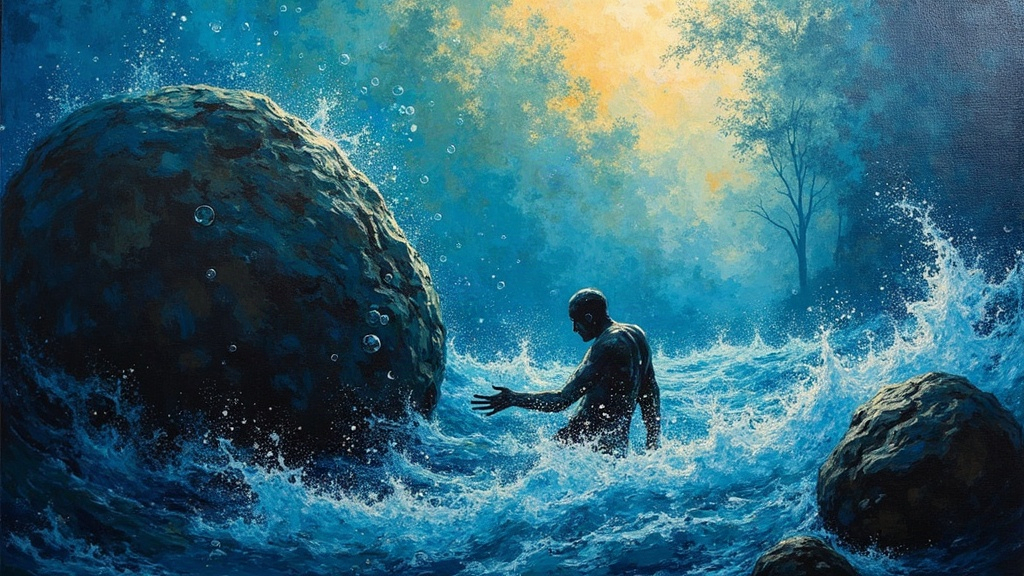
The boat flipped. Peter went under. At first, he didn't panic. He did what you're supposed to do: feet up, coming through the rapid. "I thought, oh, this is kind of fun, you know, I'm bouncing around these big waves," he recalls. Then he got pulled under. Caught in a hydraulic, stuck at the bottom of the river. Up, down, up, down.
There came a moment when the clinical assessment became unavoidable. He remembers thinking: "You're drowning, you're dying, this is it, this is the end." And then, with the same detached curiosity he'd brought to a thousand autopsies: "Shouldn't I be more upset about this? This is actually very calming."
He thought about the drowning victims he'd examined. He thought: "Well, this is a lot what you read about in books, that this is supposed to be a very peaceful way to die." And then: "What the heck is taking so long?"
When Everything Stopped
At that point, everything stopped.
Peter was next to a huge boulder under the water. The bubbles, which had been rising in the chaotic turbulence of the hydraulic, froze. He moved his hand through them and "they all just sort of moved around my hand in this very kind of weird way."
Then there was light. He struggles with the description. "I used to think very cliche, like a sunset or sunrise," he says, "but those, the only, it wasn't like that, but these are the only words I have in English language to explain something that's outside of normal human experience. I don't have the words for these."
His awareness expanded. He describes being "able to see everything around me 360 degrees," though he clarifies it wasn't seeing exactly, more like "experiencing it more than seeing it."
He knew things he couldn't possibly know from his position underwater. He knew his wife had been pulled out of the river by a yellow kayak. He knew which guide had rescued her. He knew his son was safe in another boat. He knew the boat behind him was coming to get him.
And he knew something he had no way of knowing: a family member was going through a severe personal crisis that Peter hadn't been told about. In that moment underwater, he knew about it. And he knew it was going to be okay.
They Don't Need You
There was a voice. It said: "They're going to be okay."
Peter still gets emotional describing this part. Not because it's upsetting. "Because I'm in that moment of that beauty," he explains. "It was just so beyond experience."
An overwhelming feeling of love. The voice again: "They don't need you. You're going to be fine."
The message kept repeating: "They're going to be okay. They don't need you. You're done. Good job."
For a man who had spent his career proving that consciousness was nothing but neurons and chemistry, who had argued there was no soul to be found in the dissected brain, this should have been impossible. He was drowning. His brain should have been shutting down in predictable, documentable ways. Instead, he was experiencing something he describes as more real than ordinary reality, gaining information he couldn't access, feeling a love that had no neurological explanation.
But even in that moment, the scientist in him fought back. A voice in the back of his head was shouting: "You're just hypoxic! You're just hypoxic! Hold your breath! You have to beat your record! You have to beat your record!"
Those hours in elementary school, holding his breath, watching the clock. Someday I'm going to need this.
The Sucking Sound
The light vanished. "There was a giant sucking sound and I slammed up against the rock and popped out of the water."
When he surfaced, the boat behind him was almost there, but he couldn't see properly. His vision "was like a View-Master, one of those old View-Masters. I could see and it was gone, see and it was gone. I couldn't see motion."
The guide put out a paddle. Peter remembers "reaching up and being, you know, in moments of blackout, thinking if I don't grab this paddle I am done."
That's the last thing he remembers before finding himself in the boat, unable to breathe. They were in the middle of the rainforest. The only way out was "28 miles of river."
The doctor took over. ABCs: airway, breathing, circulation. He was the only physician for hours. He knew the dangers: water in the lungs can cause delayed inflammatory reactions that kill you 24 to 48 hours later. It's called near-drowning syndrome. But he'd experienced something else: laryngeal spasm, the voice box closing reflexively when irritated by water. Dry drowning. He remembers "being in the boat trying to breathe and thinking, that's really great, Cummings, you survived it, you got in the boat, you die in the boat, that, you know, typical."
He forced himself to calm down, knowing the spasm was a reflex he couldn't control. Small breaths came. Eventually, normal breathing. They continued down the river like nothing had happened.
Eight Missing Minutes
That night, back where they were staying, Peter checked his Apple Watch. He was obsessive about his heart rate data: sleeping heart rate, resting heart rate, constant monitoring. What he found stopped him: "I had eight minutes of unrecorded heart rate in that time period."
He knows the caveats. It's an electronic device. The watch takes readings at intervals, not continuously. But in all the time he'd owned it, this had never happened. It never happened again. It didn't happen the rest of the time they were on the river.
"At least in those eight minutes," he says, "I had a period of time where I had no registered heart rate."
At that point, something shifted. "I started to think something, something happened."
The Blue Morpho
The next day, back on the river, still shaken, Finn called out: "Look at that butterfly on the boat." Peter looked over. "I said, Finn, that's not a butterfly, that's a bird. He said, no, it's a butterfly. It was so big."
A blue morpho butterfly. Peter knew nothing about them at the time. But it followed them the entire 28 miles down the river. Everyone saw it. The next day, rappelling down 150-foot waterfalls (in the waterfalls, not beside them, this was a Survivor vacation), there was the blue morpho, staying near Finn the whole way.
They called it "the angel Grand," after Peter's mother, who had died years before. He didn't learn until much later that in many traditions, the blue morpho is considered a messenger from the other side, a sign from deceased loved ones. But in those days after the drowning, it felt like a presence, a confirmation of something he couldn't yet name.
The Problem with Time
Back home, back to work, Peter started noticing something wrong. He couldn't judge time anymore. Couldn't estimate it. You know how you get lost in something and forget how long you've been doing it? That became "every moment of my day."
On vacation, it hadn't mattered. But back at work, with a heavy lecture schedule, labs, places to be, trains to catch, it became a serious problem. He was late for everything. He'd run into someone in the hall on the way to teach a class, start talking, and "30 minutes would go by."
Something else was happening too. He became "very uncomfortable with my career pursuit. Those things weren't important to me anymore." He'd written a couple of (admittedly bad, he says) horror novels. "I was the best character I ever created because I was this piece of paper and I couldn't identify with that anymore."
The intense Boston academic environment made him physically ill. He couldn't be there. They moved to Maine, to the woods, back where they were from.
The after-effects were difficult. Peter thought he'd suffered a hypoxic brain injury. The time perception problem has a name: dyschronometria. He has "difficulty, many ways to cope with it now, it doesn't affect my life, but that was really the catalyst for me to figure out what happened."
The Death Investigation
What does a forensic pathologist do when something inexplicable happens to him? He investigates. Peter calls it "doing my own death investigation of my own."
He found Jeffrey Long's research on near-death experiences. He found a world of serious, rigorous study he'd had no idea existed. But the turning point came when he read Yvonne Kason's paper, "Six Challenges Faced by Near-Death Experiencers."
That paper was "probably the most profound thing I've ever read in my life." Every single challenge: yes, yes, yes. Seventy-five percent of people who have these experiences struggle to integrate them. Peter had thought, based on movies, that everyone came back loving God and quoting scripture and being happy. "It was the opposite for me," he says. "I had a really hard time reconciling that."
When he tried to tell people about it, the response was always the same: "Oh, that sounds really really horrible, it's good thing you're still here, let's get a beer." It wasn't that he needed them to understand. "I just needed you to hear it because I needed to process it."
He's still processing. Three and a half years out, he calls himself a newbie. "I'm still trying to figure this all out. I'm no great expert or pundit on it. I'm still struggling."
But something fundamental has shifted.
The Gift of Being Here
The time perception problem, the dyschronometria that derailed his career and forced him to rebuild his life, taught Peter something he couldn't have learned any other way.
We put "great importance on the past and on the future," he says. "We focus so much on those two things, that's where our importance is. But the value is here, right now."
Getting out of the boundaries of time allowed him to put the importance where the value actually is: "In where I am right now, the people I'm with right now."
He's come to see death differently: "The gift of death is teaching the ability to let go. And to be alive. What's the point of music? Point of music is to listen. What's the point of life? The point of life is to live."
That understanding has changed how he thinks about his former career. As a forensic pathologist, he knocked on doors to tell people their loved ones were dead. He brought people to the morgue to identify bodies. He sat with families in horrible circumstances. The number one question was always: "Did they suffer?"
As a physician, you say no, of course not, it was sudden, trying to comfort them. But Peter "always felt like a liar because I don't know, right? Now I know."
He wishes he could talk to those families again. "Look, this is a beautiful, and even under these horrible circumstances, the horrible circumstance is a second. The process after that is incredible. There's nothing to worry."
He's developed a kind of mantra: "No amount of worry will transform your future. No amount of grief is going to transform you or fix your past. And you just have to be where you are right now and just love that."
What the River Taught a Brain Scientist
Peter Cummings spent decades proving consciousness was nothing but brain chemistry. He could show you exactly where in the tissue, which neurotransmitters, which regions light up on scans. He'd seen thousands of brains go silent, watched the chemistry of death play out in predictable cascades.
Then he drowned in a Costa Rican river and experienced something that shouldn't exist according to everything he'd been taught and everything he'd taught others. He gained information he couldn't access. He felt a love that has no chemical explanation. He heard a voice that told him truths he later verified. And for eight minutes, his heart may have stopped while his awareness expanded to encompass everything around him.
The experience didn't make him religious. He doesn't quote scripture. He's still a scientist, still thinks critically, still values evidence. But the evidence changed. He became evidence. His own case file.
What strikes me about Peter's account is how much it cost him. This wasn't a blissful transformation. It destroyed his career, alienated him from colleagues, gave him a neurological condition that made normal life difficult. He didn't want this. He was a successful academic with a clear path forward, and the river took all of that away.
But it gave him something else. It gave him the direct, unshakeable knowledge that consciousness doesn't need a brain to exist, that death is a transition and not an ending, that we're held in something vast and loving even when we're trapped at the bottom of a river running out of air.
The detail about holding his breath in elementary school, training for decades for a moment he couldn't have predicted, suggests something I've seen in hundreds of accounts: we prepare for these transitions in ways we don't consciously understand. The fear of drowning that haunted Peter his whole life wasn't neurosis. It was prescience. And the voice that told him to hold his breath, to beat his record one more time, brought him back.
He came back changed, damaged in some ways, but with a gift he's still learning to unwrap: the ability to be fully present, to let go of past and future, to recognize that the point of life is to live it right now, with the people you love, in this moment that's all we ever really have.
Physicians, Peter argues, have made death too sterile, hidden it behind curtains, medicalized it until we can't see the transformation anymore. We pathologize it, prevent it, shield ourselves from it. Funerals happen quickly, bodies disappear, we rush back to life without experiencing what death actually is.
But Peter experienced it. He went through the door and came back. And what he found there wasn't the end of consciousness but its expansion, not annihilation but overwhelming love, not darkness but a light he still doesn't have words for.
The blue morpho followed them for 28 miles. His mother, perhaps, or just the universe saying: yes, this happened, this was real, you're not alone in this. The butterfly stayed near his son, the next generation, the future Peter was told he was done with but chose to return to anyway.
Because that's the other thing about his account: the voice said they don't need you, you're done, good job. He could have let go. But something in him, some deep instinct or choice or love, made him hold his breath one more time, beat his record one more time, fight his way back to the surface and grab that paddle.
He's still here. Still struggling with time, still rebuilding his sense of purpose, still processing an experience that shattered his worldview and gave him a new one he's learning to inhabit. He's not a pundit or an expert. He's just a man who drowned and came back different, trying to live in the present, trying to love what's here, trying to share what he learned at the bottom of that river.
They're going to be okay. You're going to be okay. We're all going to be okay. That's what the voice told him. That's what he wants those grieving families to know. That's what the evidence of his own impossible experience revealed.
Consciousness doesn't end when the brain stops. Love is real and vast and waiting. Death is a transformation, not a termination. And the gift of knowing this is learning to be fully alive right now, in this moment, with nothing to fear and everything to love.
Was this article helpful?