Hospice Nurse David Parker's Sons Return From Death With Urgent Message
After a year of darkness following his sons' deaths, sparkling lights appeared with voices that changed everything he thought he knew about grief
David Parker sat alone in total darkness, paint covering every window of his house. A year had passed since the drunk driver killed his two boys in their own front yard. Three months before that, their mother had died of cancer. His best friend, gone too. Everyone he loved, vanished. He'd been a nurse for a decade, had cared for the dying, understood loss professionally. But this was different. The silence in the house screamed. Then one morning at 9:00, sparkling lights appeared in the corner of the room. From them came two stern voices, young and executive, scolding him. His sons had returned, and they weren't there to comfort him.
The Weight of Everything
David Parker had probably been a nurse for about ten years when his world began to collapse. His wife was dying of cancer. They had two beautiful little boys, seven and nine years old. As she failed all treatment, David cared for her at home. Then his best friend developed a terminal disease, and David moved him into the house too.
He worked three 12-hour shifts, had someone watch his wife and friend while he was gone, then spent his four days off caring for everyone. "My friend died, and then the boy's mother died," David recalls. "She had cancer and it was just me then as a single dad with two young boys and working and we just got through it."
They got through it. Past tense. Because what came next would shatter even that fragile equilibrium.
The Moment Everything Stopped
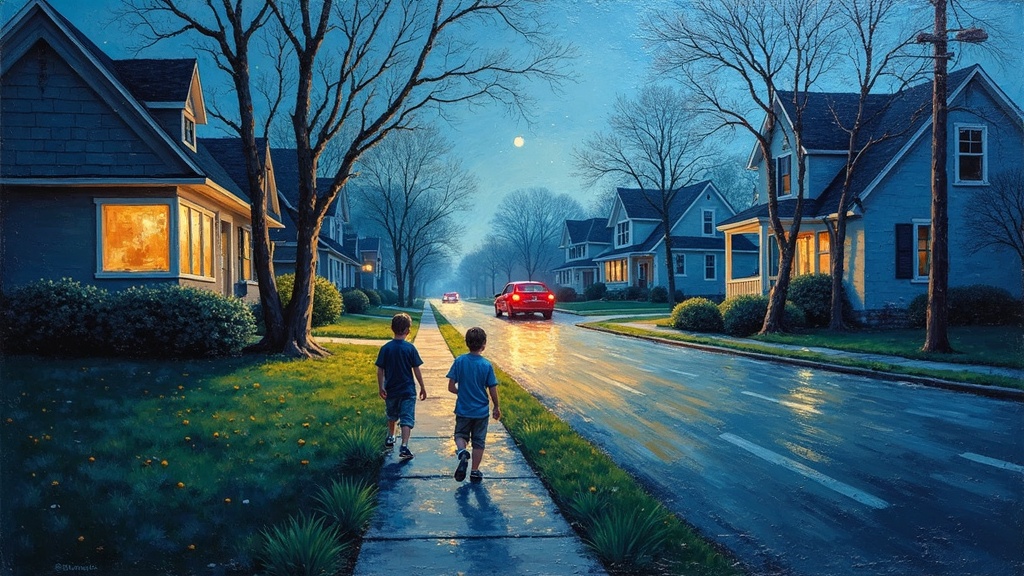
One day David was in the house. The boys were playing in the front yard. He heard "this horrible noise and crashing and screaming," and went outside to see what was happening. There was a car in the yard. Neighbors were running over, screaming and yelling. Red everywhere.
"I'm a nurse," David says. "I just withdrew totally from what happened in that situation. I just stood there, you know, what's going on? Why is there a car in the yard?" The neighbors were trying to pull something out from underneath the car. An inebriated man was walking around in a daze.
"The red that I saw was the blood of my sons," David explains. A drunk driver had lost control and driven right through their front yard. The kids were playing in their own yard, and he ran them over. Killed them both.
"I froze. I couldn't do anything. I was absolutely useless," David remembers. The neighbors took over completely. They pulled the bodies out from under the wheels. Called for help. David just stood there and cried. The boys were dead.
Their mother had died three months earlier. Now this. The in-laws came in and did all the funeral arrangements. "I just was absolutely useless," David says. He couldn't go back to work. His boss told him to take as much time as he needed. He never went to the funeral. He's never been to their grave. This was 1989, 35 years ago.
Painting Out the World
"I just stayed in the house. I couldn't do anything. I was absolutely useless," David says. Despite all his spiritual experiences up to that point, despite knowing in some part of himself that his sons had gone on and everything would be fine, the reality was unbearable. "It was seven and nine year olds screaming and laughing and everything throughout the day, and then in one hour at once the house was so silent it was like screaming in silence."
Everyone was dead. His friend, the mother, the kids. He was alone.
Wonderful friends came over, brought food, took care of him, let him vegetate. David sat in the house for a solid year without going to work. He'd look out the window occasionally and see cars drive by, people walking their dogs. "I'd think, how are you guys having a life when my world stopped?" he recalls. "There's absolutely no life left in my life. How are you guys doing this?"
He had gallons of paint. He painted over the windows, completely painted them out. Those great big picture windows, he covered them entirely. Painted out the whole world. Total darkness. He sat in total darkness for a year.
His friends never tried to get him to change or straighten up. They'd just come over, bring food. He'd order pizza. He had a TV with three channels and he watched that. "I just sat in the house," David says. "I just froze."
Sparkling Lights in the Corner
Then one day, early in the morning around 9:00, David was sitting in total darkness watching TV. Up in the corner of the room, "it was like sparkles," he describes. Like those silver sparklers you light on the Fourth of July, little lights. A couple at first, then a ton, then loads of them.
The sparkling lights formed an oblong shape, maybe four feet wide and one foot tall, glittering, sparkling white diamonds of light. David's first thought was that it was an electrical fire. He stared at it, thinking he should probably call the fire department.
Then something happened that would change everything.
"Out of that bar of sparkles and light came two voices," David says. They were young executive men, maybe 27 or 28 years old. Both had distinct voices, very young. And they were stern. Very, very stern.
"They started telling me off," David recalls. "They said, 'Listen, we've had enough of you. We've got so much work to do, so much important work. We have so many people relying on us, so much important endeavors that has been going on for a long time, and people are relying on us to get our jobs done. But we can't because of you.'"
When one would stop, the other voice would take over. The only nice thing that was ever said was, "We appreciate what you did for us," David remembers.
Instinctively, he knew. "It was my two boys. My two boys died at age of seven and nine, but now a year later they sounded like very intelligent, well-educated young executives," David says.
They kept telling him off. You've got to stop this. We're not going to put up with this one more minute. It's stopping now. You can't keep holding on to us. We've got to go. "This is your only warning. This is the only time we're going to tell you. Let go. Let go now," they said.
"They were just telling me off. It was like a bad police officer pulling you over and letting you have it," David recalls. He found himself responding, "Yes, I'm sorry. I didn't realize I was doing anything bad. I miss you so much. I can't tell you how bad I hurt that you're no longer here."
They didn't respond with comfort. "It wasn't like, 'Oh Daddy, we miss you, we love you.' They just told me off, one after the other," David says. It went on for maybe three or four minutes, though it seemed much longer. "Yes sir, I'm sorry. Yes, I'll stop. Yes, yes, I'll let you go."
Then the sparkling got smaller and smaller and smaller, tiny and tiny and tinier, and then finally it was just a couple sparks. Then David was back in the darkness again.
"It was my boys. My boys came back and told me off," he says.
The Revelation About Mourning
"I didn't realize I was mourning them so much," David reflects. "And I didn't realize that mourning them, not only was holding me back and holding me in total darkness inside, I was evidently holding them in darkness too. I was holding them back from the life and the spirit experiences that they're supposed to be having at this time."
This hit him like lightning. "Missing someone's healthy. That's okay. But mourning someone is lethal," David says. "It's lethal for me and it was lethal for my boys."
"I had no idea that my attachment not only limited my experience but was limiting their experiences too," he explains.
He remembers one night in a dream, it came to him that he'd "turned myself into a living headstone for my two sons. When I buried them, I buried me too. And after this experience, I turned the headstone into stepping stones and I was able to move on."

Scraping Off the Paint
That day, David's attitude "changed 160 degrees," he says. He called up his old job. His boss had moved on, but everybody knew him. He said he needed to come back to work. They told him to come in and put in an application.
He had to call somebody to jump his car because he hadn't started it in a year. He got cleaned up, did his hair, shaved, got in the car and drove to work and put in an application. They hired him right then and there. He started the next day.
"After staying in the house for a solid year in total darkness, I mean it really hurts your eyes going out in the light after that," David recalls. He started back in orientation. It was that quick and that sudden of a healing.
"When my boys touched in with me, what a glorious thing that was," David says. "When they freed me, they freed themselves. When I freed me, I freed them. We freed each other."
He went back to work, and soon returned to hospice care. That was going to be his dedication after this. He'd been a very technical nurse before. Now he wanted to work with dying people. He went to work in an AIDS facility.
But he still had to deal with all that paint on the windows. Friends came over and offered to help scrape it off. "I said no, this is something I need to do," David recalls. It took months. Little bit, little bit, little bit. Scraping off all these windows full of paint.
"The more I scraped off, the more the light came in," David says.
"The more I scraped the paint off and the more sun would be coming through, the light's always there," David realized. "It's always there. It never turns off. It never turns away from you. You can shut your eyes, you can try to paint over it, you can turn your back against it, you can spray paint it, you can pull curtains, you can say no, no, no, it doesn't exist. It's there. It's there whether you accept it or not."
"And it's there for you. It's just waiting for you to again remove those blocks that separate you from it," David says.
Prior to this, he thinks he'd had his blocks pretty well removed because of his many spiritual experiences. "I tumbled on this one. Mourning, mourning is lethal. And again, missing is healthy, mourning is lethal," David emphasizes.
He had to relearn the lesson: "To never turn away from the light again, no matter what else. It's the most important thing that can happen to you in your life and in your next life, wherever it is you are," David says.
He scraped and scraped and scraped and finally opened up all the windows. "I have never ever separated myself from the light again," David declares. "And what a wonderful healing that was."
What His Sons Taught Him
"I'm so blessed that I got to see my boys," David says. "I know they're fine. They're doing something." He's never seen them again. He never tried to call them back. "I've learned after that I don't want to get told off like that again."
"I know they're happy and they're doing stuff and they're having an adventure and they've got a purpose," David says. "You don't just float around playing harps up there. There's progress and growing and unfoldment, constant."
"Oh, what a marvelous experience that was. I am so grateful," David reflects.
Later, David had another dream that taught him something profound about how we see others. In the dream, he saw a coworker who was mean to people, cussing somebody out on a sidewalk. Then suddenly in the dream, the mean person was in the gutter while the person he'd been cussing was still on the sidewalk.
The feeling that came to David was this: "Spirit, our soul, we as soul can only look one way, and that's up. We can only look up. We can only look to that divine source. It's an illusion to think you can look down," David explains.
"When he looks down on people, he's actually just below them. He has now placed himself below them, because spirit can only look up," David realized.
From that moment on, David has watched "every single word and thought and feeling" he has. If something negative comes through, he throws it off, makes a little joke about it, laughs it off.
"See people as high as you possibly can in spirit, as their true form, as little sparks of God, like the little twinkly things that I saw when my boys were on," David advises. "Whenever you see anybody or everybody as high as possible, you're just like that much below them. You're up there too. And if you see people down as low and undeserving or whatever, you're just that much below them. You've placed yourself. It's your choice."
"Everything, everything in the universe is between you and God. That's the connection we have," David reflects. "And that's just been life-changing. What a simple little thing that is. I mean, it's profound, but it's also very, very simple. I think the universe keeps things incredibly simple."
"You can say the truth of the universe probably in just a couple sentences, not books and books and books," David believes. "I think the universe just keeps it very simple. You know, love each other, look up, hold to the hand to your friend. When someone stumbles, grab their hand and lift them up. What simple little things. That's all there is."
From Loss to Service
"I couldn't be there to protect them. I couldn't hold them or hold their hands when they took their last breath," David says of his sons. "But as 17 years as a hospice nurse and 30 years or 20 years as an emergency room nurse, and then I spent five years as a burn nurse, I could take care of those people. I could hold their hands when they took their last breath or their mothers or fathers or their children or whatever."
"I was blessed with the opportunity to be able to support people, spirit, moving on to the next level, and then how it affected all their loved ones that were around them," David explains. "It's been an absolutely blessing. I am so glad I became a nurse."
David has shared many other profound experiences throughout his nursing career. In his other interviews, he describes encounters with patients at the moment of death, visions of the afterlife, and the profound peace he's witnessed in those transitioning. His account of traveling to the afterlife offers additional insights into what awaits us beyond this life.
Recently, David himself faced death when he had a stroke six months ago. He was completely paralyzed, couldn't move or speak, was curled up in total paralysis. The doctors talked about putting him on hospice. But even though he was in a lot of pain and completely paralyzed, "I was in so much peace. I felt spirit. I felt like I was cuddled and nurtured and rocked and held and kissed and loved," David recalls.
"This is terrible, but I had a great time with my stroke. I really enjoyed it," David admits.
Using meditation techniques he'd practiced for years, David reduced his consciousness down to a tiny speck and went to the cellular level in his brain. He found the clot. Instead of seeing it as an enemy, he gave it eyes and a nose and a mouth and hands, made it like a little puppet, and talked to it.
"I asked it as if it were a friend. I said, 'Yeah, you know, you're interfering in my body. I'm totally paralyzed. Can you work with me and let's resolve this?'" David recalls. He imagined the clot talking back, saying, "Hey Dave, yeah, sorry about that. Let's work on this."
In his meditations while lying in ICU, he and the clot "lodged it cell by cell, one piece by one piece, and dissolved it and moved it into the blood flow" and disseminated the clot down to absolutely nothing.
He was out of the hospital in nine days. Went home with home health, had speech therapy for a while. They fired him after six weeks because he was doing so much better. The clot's completely gone. Other than a little bit of balance issue, he's pretty much back to normal.
"Instead of working in fear and reacting, I worked in friendship with the clot, and we worked together and brought everything back to normality," David explains. "I really think working with a spiritual flow and not being in panic mode but being in love mode and making friends with the disease rather than to see it as the enemy, here I am. It worked."
"Lift it up, lift it up. You're just below it. See everything as high as you can because you're just below it," David says. "I'm using that again and again and again in my life, and I have now for a quarter of a century."
What This Tells Us About the Other Side
David's experience offers something rarely discussed in near-death literature: direct evidence that our grief affects those who've passed. His sons didn't return as seven and nine year olds. They returned sounding like young executives in their late twenties, with important work to do, with people depending on them. A year in our time had been enough for them to mature dramatically in consciousness.
This matches a pattern we see across thousands of NDE accounts. Time operates differently on the other side. Consciousness continues to grow and develop. The dead aren't frozen in the state we last saw them. They're moving forward, evolving, engaged in meaningful work.
But here's what makes David's account so significant: his intense mourning was actually holding them back from that work. Not his love. Not his missing them. His mourning, the kind that turns you into a living headstone, that paints out the world, that refuses to let go.
This distinction between missing and mourning matters deeply. Missing someone honors the relationship. It acknowledges what was real and beautiful. Mourning, as David experienced it, becomes a kind of spiritual anchor, weighing down both the living and the dead.
The sparkling lights that appeared in David's darkened room, those diamond-like sparkles forming an oblong shape, this is consistent with how consciousness often appears to experiencers. Not as solid forms but as light, energy, vibration. His sons had shed their seven and nine year old bodies. What returned was their essential consciousness, their souls, and they could communicate directly, mind to mind, without the limitations of physical speech.
Their sternness, their insistence, their lack of sentimental comfort, this too tells us something important. Love on the other side isn't always soft and gentle. Sometimes it's fierce. Sometimes it tells us what we need to hear, not what we want to hear. David's sons loved him enough to come back and shake him out of his darkness. That's real love.
And the immediate transformation, the sudden healing, the ability to return to work the very next day after a year of total isolation, this demonstrates the power of spiritual intervention. When we finally let go, when we finally remove the blocks we've placed between ourselves and the light, healing can happen instantaneously.
David's realization about the light, that it's always there whether we accept it or not, that we can paint over it but never extinguish it, this is one of the most hopeful messages that emerges from NDE research. The light doesn't abandon us when we turn away. It waits. It's patient. It's there the moment we're ready to scrape off the paint.
For those of us who've lost someone we love, David's story offers both challenge and comfort. The challenge: our grief can become toxic if we let it consume us entirely. The comfort: our loved ones are fine. More than fine. They're growing, working, engaged in important endeavors. They want us to live fully, not to bury ourselves with them.
And perhaps most beautifully, David's insight that spirit can only look up, that when we see anyone as beneath us we've actually placed ourselves below them, this reframes our entire relationship with others. Everyone we meet, no matter how difficult or broken they seem, is a spark of the divine. When we see them that way, we rise. When we look down on them, we fall.
David has spent decades since this experience helping people transition from this life to the next. His hospice work has given him countless opportunities to witness the moment of death, to see the peace that comes, to support both the dying and their families. He knows, from direct experience repeated thousands of times, how peaceful and wonderful it is over there.
That knowledge, purchased at the highest price imaginable, has become his gift to others. And now, having faced his own stroke and recovery, having made friends with the clot in his brain and dissolved it through meditation and spiritual practice, he continues to demonstrate that consciousness is far more powerful than we typically imagine.
The light is always there. It never turns away. We can shut our eyes, we can paint over the windows, we can sit in darkness for a year. But the light waits. And when we're finally ready to scrape off the paint, it floods in, brilliant and healing and eternal.
Was this article helpful?