Crystal McVea's NDE: The Question She Thought She'd Ask God
A teacher who survived childhood abuse died at 33 and discovered God's answer wasn't what she expected
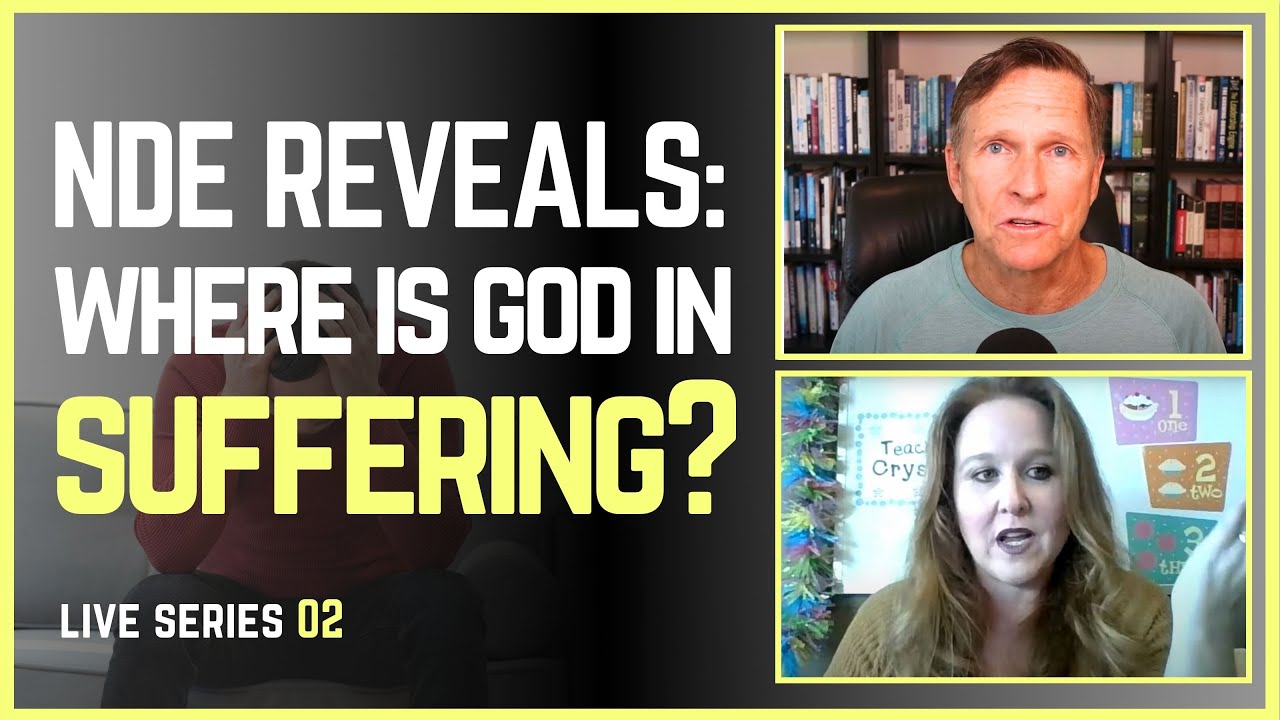
Crystal McVea had rehearsed the question for years. If God was real, if she ever got the chance, she'd ask him point-blank: What kind of God are you? What kind of God watches a three-year-old endure sexual abuse for nine years and does nothing? She carried that question like a stone in her chest through four baptisms in three denominations, through a teenage pregnancy, through an abortion she told no one about for two decades. The question grew heavier with every unanswered prayer, every moment she felt alone in the dark. Then, at 33, her heart stopped in an Oklahoma hospital room. She opened her eyes in a tunnel of living light, angels to her left, the presence of God to her right. She fell to her knees, then to her face, and opened her mouth to finally ask. What came out instead shocked her more than anything she'd experienced in heaven.
The Girl Who Kept Getting Baptized
Crystal grew up in a small town in southwest Oklahoma where the question wasn't whether you went to church but which church you attended. At eight years old, she heard the altar call and was down at the front before the pastor could finish. The words that caught her attention were simple: "If you accept Jesus, he will save you."
What nobody knew, what nobody would know until she was well into her thirties, was what she needed saving from. The sexual abuse had started when she was three or four. By eight, it was still continuing. She went into the baptismal water that night and came out feeling clean, because that's what God does, she thought. He makes us clean.
But the world has a way of bringing the dirt back.
By the age of twelve, Crystal had been baptized four times in three different denominations. She was running the gamut, trying to find the one that would work. When the abuse continued past her twelfth birthday, she faced a choice that would define the next two decades of her life. Maybe God wasn't real. Or worse, maybe he was real and just didn't love her.
The second possibility terrified her more than the first.

The Path of Someone Who Feels Worthless
"When you feel worthless, you act as if you have no worth," Crystal says now. She'd been taught at an early age that her body wasn't something to be treasured, that she wasn't something to be treasured. By seventeen, she was pregnant with her first child. At nineteen, pregnant again and terrified, she heard a quiet voice telling her the only solution was an abortion clinic.
She can still see the scene. Walking into the clinic, looking across the street at people holding signs. What she needed that day more than anything was for somebody to come and hold her. She'd never felt more alone. When she left that afternoon, she remembers thinking, "Well, you've done it now. Like if he's real, if he's real, he would never love someone like you."
That's how she lived her twenties. Married and divorced by 23, two precious babies, and a failing belief that God was good or loving. When preachers talked about God as a loving father, it didn't compute. Her parents were divorced. Her father was mostly absent. Her stepfather struggled with drugs and alcohol and the abuse that comes from unhealed pain. A loving father wasn't in her vocabulary.
At 28, she married the first Christian man she'd ever dated. That's when something started to shift.
The Question She Carried
"I wanted to know what kind of God are you," Crystal says. What kind of God would allow a three-year-old to go through what she went through? One in four girls are sexually assaulted by the age of eighteen. "If you're so loving, where were you?"
The question became sharper when she became a mother herself. She knew what it felt like to have a child, to be willing to lay down your life for them. The lengths you'd go to protect them. So where was God?
She and her husband Virgil tried to have children through IVF. Crystal made deals with God, setting up hurdles for him to prove himself. Okay, I'll know you're real if we get pregnant. They got pregnant. I'll know you're real if it's twins. It was twins. I'll know you're real if it's a boy and a girl. Boy and girl. She kept raising the bar. One with blue eyes, one with green, even though Virgil has dark brown eyes and it's recessive in males.
The twins were born four months early, weighing two pounds each. It was twelve days before Crystal and Virgil could hold them. They both quit praying on the same day. Virgil's prayer ended with "Father, your will be done." Crystal's ended with "I will hate you for the rest of my life if anything happens to my children."
When she finally held Micah that morning, he opened his eyes for just a second. Blue. That evening, Willow opened hers. Green.
"So God answered your prayer," she says, but even then, even with photographic proof she keeps on her computer, she let herself believe it was coincidental. She had God right there and let him slip through her fingers.
The question remained.
The Day Everything Stopped
Six months after bringing the twins home, when they were ten months old, Crystal went in for a routine endoscopy to check on some breathing issues. She woke up with acute pancreatitis. Everything that could go wrong in the procedure went wrong. They hospitalized her, said she'd be there three or four days on a pain pump, then go home.
Two days in, she woke with a certainty she couldn't explain. She called her mom and said, "Please come be with me. I'm dying." Her mom told her to stop being so dramatic.
A few hours after her mom arrived, Crystal's body couldn't filter the pain medication anymore. She went into respiratory arrest and coded.
What happened next, she remembers more vividly than anything in her life.
She opened her eyes and saw her mom sitting at the foot of the bed, back turned, reading a magazine. She knew instantly her heart had stopped. She knew she wasn't breathing. She'd been terrified of death her entire life, her biggest fear, always wondering how it would happen, when, if it would hurt.
"Instantly this peace overwhelmed me, comforted me and there was no fear," she says. With the last little breath in her lungs, she told her mom she loved her. Then she closed her eyes.
And instantly opened them standing in heaven.
The Tunnel of Living Light
Time was different there. Everything happened simultaneously, but on earth we have to tell things in sequence. She experienced no time, no rush. All knowledge flooded into her instantly. She knew where she was. She knew who she was, still Crystal, the same Crystal dying in that hospital room while doctors performed CPR, and yet the most perfect version of herself, standing in light with no negativity attached.
The Apostle Paul wrote about this. "Now we see in a mirror dimly, but then we will see face to face. Then we will fully know just as we are fully known." Crystal experienced exactly that.
She describes standing in a tunnel, but not darkness. The entire tunnel was made of the most gorgeous light she could ever describe, and not just light you could see but light that communicated, light she could feel, light she was connected with. The tunnel itself seemed alive.
Two angels stood in front of her and to her left. They didn't look like the angels in paintings, no big wings and halos. She could see their silhouettes, humanlike, one taller than the other, but what she saw was like looking at a light bulb, the outline visible but the interior obscured by radiance pouring off them.
Light was coming out of them. This light source running through her and around her and radiating off the floors, off the angels, was God himself.
How did she know they were angels? "Because I knew everything," she says. She had no questions. She knew she'd known them, not on earth but for as long as she'd existed. Guardian angels, she calls them, because they were hers. Not yours. You have your own. They'd been with her through her entire journey, assigned like mentors in a class, following and sticking with her. She just hadn't known they were there.
They were excited that she could finally see them and hear them. She remembers loving them so much, these beings who had to be her very best friends, who loved her and knew her better than anybody on earth. They began to talk, but not with words. All through feelings and thoughts. She stood there rambling a mile a minute, trying to get everything out. "You think I talk a lot as a human? You should have seen me when I didn't have to use words."
The communication was vastly different from anything she'd imagined. It was like having a hundred senses instead of five, a hundred different ways to interact with reality. And she knew, with absolute certainty, that this was actually her reality. Her earthly life was the dream state. Heaven was home.
Falling to Her Face
While talking with the angels, she became aware of a presence to her right. It had been there all along, but her awareness just came. She turned to face this presence.
Immediately her spirit recognized him. "I didn't meet God, I recognized him." She was standing in front of the entity that created her.
She describes him as light, but there's no word for the kind of light, nothing like any light we've seen here.
She fell straight to her knees. This is pivotal, she says, because she raised her hands. She'd been raised mostly Baptist and Methodist, and they didn't raise hands in church. She'd never praised like that. In fact, she was the person who, when they played another song, would think, "Okay, another song." She wasn't that type.
But she couldn't even stay on her knees. She went straight down to her face. Out of reverence. Out of love. She started crying, and he wrapped her in tangible light, tangible love she could feel.
She went back to that day, walking out of the abortion clinic at nineteen. If God was real, she'd had questions. What kind of God are you? Why are you so punishing, so vengeful? Where are you? She'd become a mother of four. How could he say he loved her and stand by while horrible atrocities were committed to an innocent child?
As she raised her hands and opened her mouth, what came out was: "Why didn't I do more for you?"
She's glad God allowed her to remember that. In that moment, with all knowledge flooded into her spirit, the only question she had for him was one of regret. Why didn't I do more for you?
The Answer She Didn't Expect
It's confusing until you understand what happened. All the questions she'd held inside had already been answered the instant she arrived in spirit form. She had no questions. You could have asked her how God was created and she might have been able to tell you.
God didn't say anything, but they were talking the entire time, that communication without words. She was in awe of him. She reached her hand out because she couldn't get close enough, and yet he was all around her, enveloping her like a cocoon, a blanket.
As she tried to get closer, she said, "I could worship you for all of eternity". This from the woman who got antsy after four songs in church. But she couldn't stay on her feet, couldn't stay on her knees. She'd never experienced such love, such goodness.
It's not like God is an egomaniac demanding worship. It's more like being so overwhelmed with joy and love that you don't know what to do with it except shout. That's what worship really is.
As she lay there worshiping, she looked down the tunnel and saw that at the very end it became very bright. She knew that was the entrance to heaven. She didn't see big gates, but she knew. God said once they got there, she couldn't come back.
He showed her, in that moment, all four of her children. Thirteen, eleven, and the twins at ten months old. She knew she wasn't truly leaving them. She was leaving them physically, but she was going to experience every moment of their lives with them, almost more so in a way. She wasn't going to miss a thing. And she was going to see them again.
People ask how she knew they'd go to heaven. "Because God told me," she says. "I don't know what else to say." Both older kids had a relationship with the Lord. The babies were babies. All she knows is God told her they'd all be together again.
God said, "You can go back and be their mom or you can continue with me". Crystal looked at her kids. She looked at him. "I want to go with you," she said.
That was the first time in her entire life she truly chose God above all else.
When she came back and told her older kids this story, they were shocked. "Wait, what? You chose not to come back?" She's had to explain: the love we have for God surpasses the love for children, grandchildren, anyone. Can you imagine loving something more than your own child? All the love we have is derivative. We have no love of our own. Love comes from God. We're just tasting a little of what real love is.
The Little Girl Playing in the Light
The vision of her children vanished. They continued toward the entry point, God walking on her right, angels to her left. The entire time, God and Crystal talked. About everything. She doesn't remember what, but they never stopped.
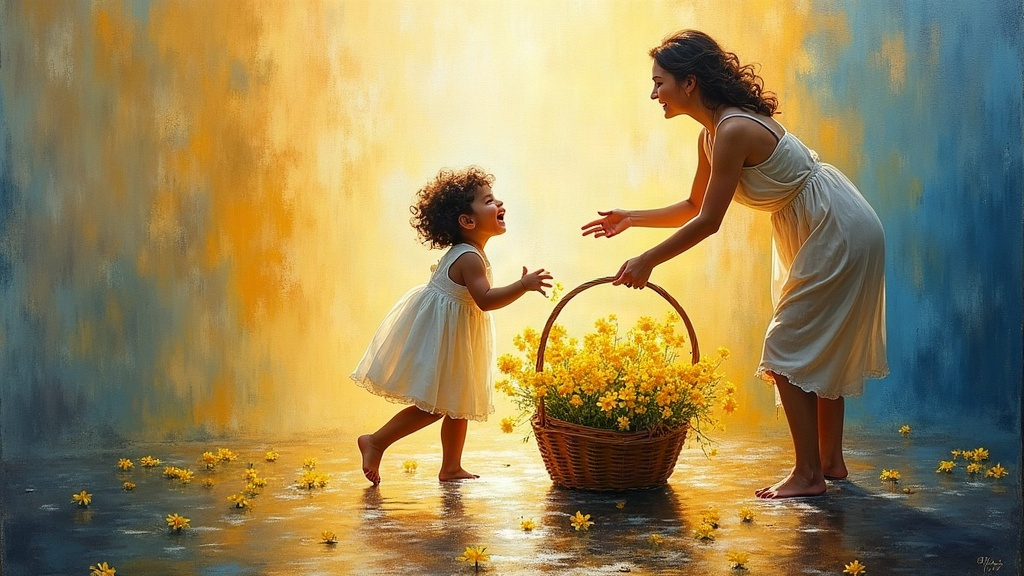
As they got closer, she noticed a little girl up ahead, so different from anything she'd seen in this realm. Fully human. Three or four years old. She wore a white frilly dress with little yellow flowers, and the yellow from the flowers would prism with his light all around. She had a little basket and would dip it into the light, then dump it out, and the light would cascade like water.
The girl would throw her head back and laugh, this beautiful laugh, and Crystal knew instantly: she's mine. She started trying to get to her as fast as she could, watching her play and smile.
Something started happening to Crystal's spirit. It was almost as if her spirit was being blown up like a balloon, but with love. She'd never felt love like this. As she got close, she remembers saying out loud, "I'm going to explode," because she couldn't take one more bit of love for this child. She was okay with exploding into a million pieces because she couldn't take her eyes off her.
Right before she scooped the girl up, it was like God removed the glasses she was wearing, the way she was viewing the child. She stopped. Looked back down.
She recognized her immediately.
She recognized her as herself.
Seeing Through His Eyes
In an instant, God explained everything. "I have tried to tell you this your entire life. I have tried to show you your entire life." It was one thing for God to say I love you. But he allowed her to view herself through his eyes.
At three and four, when the sexual abuse began, when the evil came in, all through those years until she was twelve, when she'd call out to him and say "Where are you?" and ask the main question, "If you loved me so much, why would you let that happen?"
What he showed her in that moment was that he does not interfere with the free will he has given humans. That he was with her when she called out. Every moment of her life, he never left. When she was in that dark room every Thursday night, he was there.
She'd felt alone her entire life. But this God, who could have not even looked upon what was happening to her, not only looked upon it but sat with her so that when she went through earthly pain at the hands of another human, she did not do so alone.
He explained how he gave humans the gift of free will. If he interferes to help one person, he's also interfering in another human's free will. Free will isn't just for doing good things. We do terrible things because of our free will. If he interferes with that free will, we become nothing more than puppets.
She was not hurt at the hands of an unloving God. She was hurt at the hands of a human acting through their own free will, going against God's will.
Free will and God's will, our ways and his ways, they're so different. When God showed her that the plan for her children's lives was perfect, his perfection doesn't mean we won't have sorrow and hurt and tribulations. His perfection is that in the end, no matter what, he takes it all and uses it for good, for his glory. That's something we'll never understand until we're standing with him again in eternity.
But Crystal saw it. She experienced it through the life of her four children.
The Healing That Therapy Couldn't Give
In that moment, God freed her from a lifetime of shame. Victims of childhood sexual abuse take it on. It becomes part of their identity, a darkness, a voice constantly saying you're worthless, you deserved it, you're bad, something's wrong with you.
What God did in that moment was something therapy had never been able to do. He healed her. He freed her from the inside out.
Bad things can still happen in her life, but what they cannot do any longer is take away the belief and knowledge that God is a loving God, a loving father. That was what she wrestled with her entire life. If you're such a good loving father, how can you, where are you?
He showed her: I'm with you.
That healed her sense of identity, the shame that went with the abuse. She realized it was not his will.
Jesus taught us to pray, "Your will be done on earth as it is in heaven." Meaning his will is not done on earth. Not unless we choose to be the conduits through which it can be done. He gives us free will so we can love God. You can't love without free will. You can't force love.
Growing up, Crystal loved Jesus. God scared her to death. She viewed him as angry, vengeful, judgmental. Without free will, she wouldn't have been able to choose him on her own account.
How do we recognize or choose God without darkness to contrast it? You can't freely choose to love someone if you can't also freely choose not to.
In that moment, Crystal remembers, somebody later said to her, "I just knew God brought you to heaven to meet your child". As much as she can't wait to hold that child and tell them how loved they are, she looks at people and says, "No, God brought me to heaven to meet his. I had no idea I was his. That I belong to him."
That's something we have to hold onto. Ten years later, life goes on. Having this experience doesn't make life perfect. Two years ago, when her husband Virgil, an army veteran suffering from PTSD, tried to take his own life, Crystal called out to God again, saying where are you?
She knows he's there. She knows he's good. And she still wrestles.
Knowing about it doesn't make our lives perfect.
What Changed
Crystal came back different.
Right before she died, they were in the middle of a lawsuit over a business deal gone wrong, a significant debt left for them to pay. When she came out of her experience, the first thing she told Virgil was to drop the lawsuit, they'd pay the debt. Virgil says that's when he knew she was telling the truth, because Crystal had been a very selfish human being.
She harbored no hatred in her heart for the people who'd hurt her. In fact, she began to pray for them. She can't fathom even her worst enemy, the person who hurt her most, not experiencing the eternity of God. That's how life-changing he is.
She realizes he is what's missing. He is love. She never understood that until she met him, until she stood there. "I've never touched love. I felt love, but on this earth, I've never touched it, but with him, I touched the face of love."
She can't imagine one person not getting to experience that.
What This Story Reveals
Crystal McVea's experience is one of the most profound answers to the problem of suffering I've encountered in more than 5,000 accounts. Not because it solves the intellectual puzzle, we're still living in a world where God's will is not fully done, but because it shows us something we can't see from here: the view from the other side.
The detail that strikes me most is how her question changed. She spent decades rehearsing what she'd ask God if she ever got the chance. The question was loaded, justified, born from real pain. What kind of God are you? Where were you?
But when she stood in his presence, with all knowledge flooding her spirit, the only question that came out was one of regret. Why didn't I do more for you?
This isn't spiritual bypassing or toxic positivity. This is what happens when you see the whole picture, when you understand not just with your mind but with your entire being that this life is the classroom and love is both the curriculum and the teacher. From that vantage point, the question shifts from "Why did you let this happen to me?" to "How can I bring more of your love into this broken world?"
The other detail that haunts me is God sitting with her in that dark room every Thursday night. He didn't stop the abuse, he explains, because to do so would be to override human free will, and without free will, love isn't possible. But he didn't leave her alone in it either. He was there. Every moment.
This is the paradox at the heart of existence: God gives us the terrible gift of freedom, the freedom to choose love or to choose harm, and then he enters into the suffering that freedom creates. He doesn't watch from a distance. He sits with us in the dark.
Crystal's experience of seeing herself as a little girl, of feeling God's love for her through his eyes, is one of the most commonly reported features of the life review process in NDEs. Experiencers describe not just seeing their lives but feeling how their actions affected others and, crucially, experiencing how much they are loved. The shame that survivors of abuse carry, the internalized belief that they deserved it or caused it, dissolves in the presence of that love.
What this suggests about the nature of reality is staggering. We are not our wounds. We are not our worst moments or our deepest shame. We are, as Crystal discovered, the version of ourselves that God created before time, the self that exists in his mind, the self we'll fully become when we're home.
This life, with all its pain and beauty, is the dream state. Heaven is the reality. We're eternal beings having a temporary human experience, learning what it means to choose love when love isn't forced, when darkness is possible, when we're free.
And when we finally cross that threshold, when we stand in the presence of the One who made us, the question won't be "Why did you allow my suffering?" It will be "Why didn't I love more?"
That's not a guilt trip. It's an invitation. An invitation to live now, in this broken beautiful world, as conduits of the love we'll one day know fully. To be, as Crystal puts it, the people who bring God's love and goodness to combat evil.
Because this isn't it. This is just our beginning. The best is yet to come.
Was this article helpful?