Brian Hoyland Died for 10 Minutes and Met Jesus: What He Learned
A military veteran's clinical death revealed three urgent instructions from Jesus, and why suffering might be the greatest gift we're given.
Brian Hoyland knew he was dying. Seven hours in the ER, his heart failing from years of autoimmune disease triggered by toxic military exposure. The pain had become unbearable. He closed his eyes and told God to take him. He couldn't endure another second. Then he felt it: a strong shake, a pop, a surge of pain so intense it eclipsed everything that came before, and then nothing. The pain vanished. The chaos of the hospital room ceased. He was standing in a dark tunnel, and the atmosphere was flooded with love and joy so profound he could barely comprehend it. But the darkness in front of him was beckoning, pulling him forward, and something about it felt wrong.

The Soldier Who Wouldn't Stay Down
[Brian describes](/video/SSlwG2sTO_o?t=31" class="text-blue-600 dark:text-blue-400 hover:underline">Brian Hoyland how he went into "a very serious level of heart failure" and spent seven hours in the ER "fighting for my life." They moved him to the ICU. His heart went into sustained ventricular tachycardia, a dangerously high heart rate. And then he felt it: the certainty that he was about to die.
"I started to feel that I was going to die," he says. "I knew it was going to come and I was praying this whole time but I closed my eyes and I told God please just take me I can't take this pain anymore it's too much."
This wasn't surrender in the usual sense. Brian wasn't someone who gave up easily. But the pain had beaten him. He'd been broken so badly that he just wanted it to end.
And then it did.

The Shake, The Pop, The Exit
Brian describes what happened next with a precision that's startling: "I felt a strong shake and a pop in my body there was a surge of pain but it was so quick and it was so it was over and just a moment that it it didn't even register as as bad as all the pain that I had felt even though it was worse but it was gone."
In that instant, his soul exited his body. He was in a dark tunnel. The noise and chaos of the hospital room vanished. And then the love hit him.
"I felt this love and this Joy just coming over me," he recalls. "It was it was almost as if the whole atmosphere was filled with this love and this Joy."
But he was staring into a Dark Void, immense and beckoning. It looked like outer space without stars, without planets, without light. Just pitch black. And yet he could see into it. The void was pulling him, compelling him to enter, promising that the love and joy he was feeling would continue if he just stepped forward.
But something felt wrong.
Brian explains that the void "was beckoning to me it was It was kind of compelling me to to come into it you know I was experiencing this love and joy and it was telling me that this is what it's like here just to be here and just feel this love and joy and nothing else and all is well but it it wasn't where the love and joy was emanating from and this was very clear so I I knew that this was this was something that was trying to lure me in not not for my benefit but maliciously."
He looked at the void and thought: this can't be it. Not without Jesus. He'd felt Jesus with him the entire time he was dying. Jesus hadn't abandoned him. This void wasn't right.
And that's when he realized there was a light behind him.
The Light That Sees Everything
Brian had been seeing the light the entire time. That's why he could see into the darkness. The light was illuminating everything. When he turned toward it, something extraordinary happened: he didn't lose sight of the void. He could see in 360 degrees.
"I didn't actually need to turn towards the light because when I did turn that light I was facing right at it but I never lost a vision of that Dark Void," he says. "So I was able to see in 360 degrees and at the same time I didn't have to look at one and then stop looking at the other I could still see it but whatever I was focusing on because now I'm focusing on that light that took the predominance of my my focus."
The light was extremely far away. He couldn't calculate the distance. But as soon as he said he wanted to be with it, he was there. Instantly. No sense of movement, no wind, no inertia. He just arrived.
Brian describes remembering "every single step I took" even though there was no linear sense of time. Everything was happening quickly and yet drawn out. There was no way to measure duration.
Standing before the light, he was overwhelmed. It was "so beautiful and so resplendent," he recalls. The light didn't hurt his eyes. It was different from any light imaginable. And it was permeating into him. "This this light was love itself and it was permeating into my soul," he says.
His intellect had "gone through the roof." He knew things he'd never known in life, memories of history he'd never experienced, every detail of his own life present and clear. He was like "some sort of a super computer that can process many things at once," he explains. No confusion. Just pure, expanded awareness.
He tried to find the edges of the light, looking left, right, up, down. He couldn't. His vision kept expanding, and the light kept growing. He watched "at the end of my vision I could watch it as it was continually growing and I could not find the end of this light no matter how long I took to do this I don't think I would have ever found the end of it it was immense."
The light gave him the understanding that it was infinite. That it would last forever.
And then he knew: "I knew it was God," he says.
As soon as he made that recognition, God said: "You can come in."
Brian didn't hesitate. He jumped right in. He couldn't contain himself. He wanted to be with God so badly.
Inside the Love
Inside the light, God's love rushed into him "like a river," Brian describes. "It was so powerful and so strong but my my soul was open to it there was no resistance I didn't put up any kind of barriers I didn't do anything to resist that influx of that love."
It felt like taking a warm blanket out of the dryer on a cold day and wrapping it around yourself. Warm, safe, secure. That's how God's love felt.
Walking through the love, Brian began to understand something profound about God's nature. He realized that "God has one thought but contained in that entire thought is everything all of the knowledge of of mankind all of the history all of our ideas all of my my memories yours everyone's everything was contained in that one thought and that thought is Jesus Christ."
As soon as he realized that, he said: "I want to see Jesus."
The light opened. He was looking into a great room filled with countless beings. These beings had "the shape of a human torso but they were shining with this this Brilliance this just love." He could see the front and back of every being at once, without losing sight of any of them.
In the middle of all these beings was one whose light was brighter, more significant than the rest. The love was emanating from this light. Brian knew it was Jesus.
He describes the love flowing from Jesus like a river, and himself as a straw: "You know when you're drinking from a cup... the fluid is inside the straw going into my mouth from the cup it never is empty the straw is always full but it continually comes and it's new it's fresh that's what I felt like what Jesus is Love is that it was clearly clearly infinite and we were going to be continually filled like a straw constantly drinking in that love."
For all eternity, we'll experience that love "new and fresh and exciting," he says, "because his his love is infinite there's so many dimensions to it that we're going to be able to experience in new ways throughout all of eternity."
Then Brian said: "Jesus I want to see your face."
As soon as he said it, Jesus's face appeared. All the beings turned to their human forms. But Brian was hyperfocused on Jesus. Everything else was "just in the periphery." He probably saw family members who'd passed, he has feelings he saw certain people, but he can't say for sure. He was too focused on Jesus.
Jesus's face was "complete Mercy," Brian recalls. "It was love you know here I was standing before him as a great sinner I had sinned so much in my life and granted I was apologizing you know I was full of Contrition prior to death and many of my sins I had been very sorry for for most of my life but as he was staring at me I wasn't able to to lay down the memory of his of his face."
Brian couldn't retain the image of Jesus's face. It was like watching an animation, taking in new images constantly but unable to compare them to the memory he'd just seen. He doesn't know why God didn't let him bring that back, but he doesn't care. "I just loved him and we're all gonna love him because he is so perfect."
The Life Review: Mercy, Not Condemnation
Jesus's mercy gave Brian forgiveness. They began discussing his sins in depth. They looked at "my good things my whole life it was it was a review of everything that I have done in my life and all these beings were there and they got to see it so everybody in heaven was was able to see."
Brian wasn't embarrassed that everyone could see. He already knew they'd seen everything he'd done anyway. But he was ashamed of his sins, in a way that was "more healthy than it ever could have been in life," he explains. Jesus was healing the wounds Brian had inflicted on himself.
"The shame was more of of a detestation of my sins," Brian says. "I I realized how how bad they were because I could see what I had done to him during his passion I could see how they affected other people he was letting me see the the Ripple effects of my sins."
Jesus showed him how his sins hurt Jesus himself, hurt others, and inflicted deep wounds on Brian's own soul. Most of the things he'd done, he was already sorry for. But it was "the things that I could have done and didn't," Brian recalls, "or the justifications that I had like somebody did this to me and I well I have the right to get them back now from a human standpoint I did there were some really atrocious things that happened to me but being my nature I I didn't allow people to walk on me and so I would I'd give it back to him and often to a degree that was not just but I would I would justify myself in it."
Those justifications really hurt him, because he could see how they affected Jesus. He'd thought he was right.
During the review, Brian also realized that time didn't work the way it does on Earth. Everything was happening "on what you would say maybe like a a pen dot you know you take a pen and you write a little dot on the on the paper imagine all of time happening in there it's like all at once and never escapes from that because it's continually there so with time not ever ending it's all present immediately at the same time."
A memory surfaced: his great-grandmother's death when he was six years old. He remembered driving home that night, upset, not wanting to tell his parents. He got on his knees and prayed, "the first time I remember being on my knees," a long prayer for a little kid. He felt God touch him, confirming the prayer would be answered. He went to sleep and never thought about it again.
Until that moment in heaven.
Brian asked Jesus: "Did this really happen did you did you answer that prayer and he confirmed that he had."
That confirmation was profound. But what came next was even more so.
The Question That Changed Everything
Jesus asked Brian: "Why would you want to go back?"
It wasn't a simple question. It was about purpose. "What would be my purpose for going back," Brian explains, "you know not not just to go back to enjoy life and and the things that come with it."
Brian tried to come up with reasons. His family. His job. All the wonderful things he could do. Everything he came up with was empty. "It wasn't because they weren't good it was it was because I I was again still not realizing the proper order of things in the proper order is putting God first."
That's when it hit him. He was feeling Jesus's love rushing into him. He wanted to give that love back.
"I've never experienced that kind of love in my entire life," Brian says. "You can imagine the most disgusting thing in the world that something that's so foul to you you would endure that for all of eternity or at least I would have I would have endured that for all of eternity just to feel his love."
That's how Jesus feels about us, Brian realized. "He loves us so much that that his his love makes us feel like we could do anything and if you can learn to grab into that your life is going to be wonderful."
Because of Jesus's love, Brian wanted to go back and share it with others. He knew "there was nothing that that could could have been more important to God than to have as many people in heaven with him."
He told Jesus: "I want I want to go back and and give your love out I wanted to go back to love others."
Jesus said: "That's that's that's what it is that's good that's the purpose."
Brian believes this purpose applies to everyone: "To love God and to love others share that love with them."
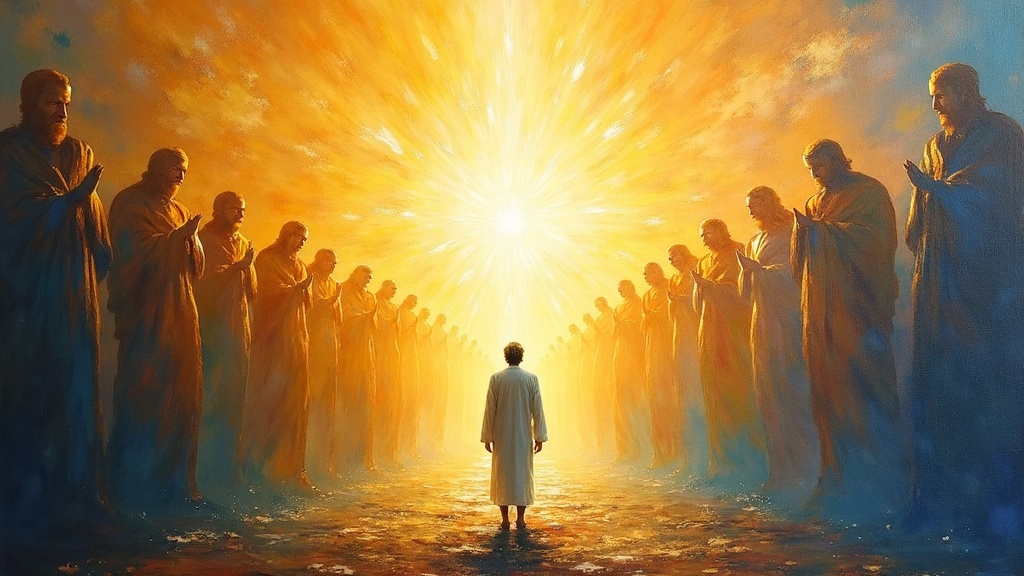
Three Instructions for Living
Before sending Brian back, Jesus gave him three specific instructions.
First: Pray more. Not just routine prayers, though those are important. Jesus wanted Brian to live out prayers through good works, through helping other people. These works wouldn't save him, Jesus had already shown him how he was saved, but "when we have his love in US we are meant to share and to to stay in communion and to do these things with his love and because of his love."
Even something as simple as picking up litter and throwing it in the garbage, Brian explains, can be a prayer if done out of love for God and others. "We don't have to to do magnificent wonderful things that get the attention of all other human beings we have to get the attention of God and it's putting God in the proper order if I pick up that piece of litter because I love God and I love other people and I want to make it a better place God's going to honor that he always honors love."
Second: Suffer joyfully. This was the hardest instruction. Brian had just died a horrific death. Now Jesus was telling him he'd have to suffer more.
But Brian realized that Jesus himself, "the king of the universe," became "the most humble and lowly of all people" so he could identify with us. Jesus had to carry his cross to save us. "How could I ever think I was going to avoid my own cross," Brian says.
Not everyone will suffer the same way. Not everyone will have a horrific death or need a heart transplant. But we all suffer. "That is the nature of life if you eat too many tacos it's not God's fault that you got a stomachache that's nature that's the way it is in life."
God will use that suffering to our advantage if we let him. The purpose of joyful suffering is "to accept the consequences of our behaviors and of Nature and just giving it back to God and saying I still love the good that is here despite the discomfort I'm experiencing now use it for good and he will."
Brian never understood the Bible verse where Paul says through his sufferings he makes complete the sufferings of Christ. How can we complete something that Perfection itself already did? "It's because of our willingness to participate our acceptance of of our experience is how we do it," Brian explains. Jesus showed us this in the Garden of Gethsemane. He was suffering immensely, and then he turned it all over. He accepted it.
Jesus told Brian he'd go back and suffer more than he had before dying. He'd have all that pain plus the additional pain of dying and whatever life extension he'd receive. Jesus told him he'd give Brian a new heart. Brian thought it would be a miraculous cure. It turned out to be a heart transplant.
At that point, Brian realized how wonderful all his prior suffering had been "because he filled it with love and had not had I not had those wounds I don't know that I could have ever experienced that love and that same degree I certainly wouldn't have been able to appreciate it by having the experience of something so horrible to be filled with something so good."
Third: Share his love. While this sounds simple, it can be difficult. People offend us. People sin. "We don't we don't ever love the sin we don't tolerate it we don't have to even ignore it and and pretend," Brian clarifies. We never judge the person. We say: "You're doing this evil thing come on come back over here and and be a good person again."
To share love means recognizing where another person is and reaching them at that level, helping them experience love in a way that gets them to the next step. "It's a very complex thing but if we go into it with just the purity of trying to share love even if we make mistakes God will make that good," Brian says. "He's the one who's going to grow that seed that I plant."
The Return: Chaos and Joy
Jesus told Brian to go back. As Brian turned toward his tunnel, he no longer saw Jesus. "That was the only time I wasn't able to see you know everything in heaven." He walked through the light, and the light opened up. He saw his tunnel. He thinks he saw other tunnels in the periphery, but he was focused on his own.
At the end of his tunnel wasn't the Dark Void anymore. It was his hospital room. He could see his body lying there. He could see through his eyes but also see the back of his head. He could see everything. About 20 people were gathered around, running tasks, getting equipment. It was chaotic.
He was going back to that chaos knowing the pain would hit him immediately. But he had "this this joy that it just couldn't couldn't be shaken."
He snapped back into his body. It was natural. He didn't need anyone to explain how to do it. As soon as he was back, it felt like the tunnel closed, like a barrier went up. But it was because of "all the distractions of Life rushing back into me at once the chaos of the room the the worries the fears the pain I mean the pain was immense."
Yet Brian knew "that that that tunnel was still wide open it was those distractions that we all experience in life those are what prevent us from having complete communion with God."
He popped his eyes open. He tried to get up but was strapped down because they'd been shocking him. He had masks on, equipment on his head to keep his brain cool and monitor brain activity. He'd been dead for 10 minutes. No heartbeat. No brain activity. Everything completely dead.
As soon as he got back, he didn't seem to have any brain damage, "which you would would usually suspect at that at that kind of a length of time of being dead."
He looked up at the doctor and asked: "Did I just die?"
The doctor couldn't hear him through the mask. He came down closer. He had "this look on his face like he was just about to call call and call it a day that I was dead and he was gonna call the time and say that the patient is dead because they had taken this Lucas machine off me which also by the way broke a couple ribs so I mean the pain really was more severe."
Brian asked again: "Did I just die?"
The doctor said: "Yeah you just died."
Brian wanted that medical confirmation. As a psychotherapist, he'd never believed in near-death experiences. He thought they were neurochemical, just a rush of chemicals in the brain causing memories. But he'd never lost conscious thought from the moment before he died, throughout his entire time in heaven, and back into his body. His physical brain was dead, yet he was in heaven laying down new memory. "That's impossible particularly the the the things that I was able to do are beyond what any other human being has ever even imagined."
There's no way his brain could have come up with something on its own while dead and not functioning. "It's just it's it's an impossibility."
All his understanding and training was turned upside down. He remembers thinking about his professors: "Boy they really got it wrong this is this is absolutely turning everything on its head."
The Miracle Heart
The doctors worked on Brian. They did surgeries. They put in a new defibrillator. For two years, he lived with a heart that shouldn't have worked.
When they took it out during the heart transplant, they cut it open and did a biopsy. They showed him all the pieces. Five or six different places were so encrusted with scar damage that the smooth muscle could no longer contract. "Without this piece and without this piece or with this one any one of those your heart couldn't function," they told him. The heart was sending bad rhythms. It shouldn't have been able to work.
They said it was a medical miracle. But Brian knows better. "It was a god Miracle God decided to intervene in my life and he pulled me back from the cusp of whether I was going and has given me another chance."
What This Means for All of Us
When Brian was looking at Jesus's face, it was Mercy. "He wasn't condemning me for my sins he was saving me from him and it was because I loved him I chose him in that Dark Void I made the conscious choice to turn and look at him and I said I wanted to be with him and I said I wanted to be with that light and I said I wanted to see Jesus."
These choices couldn't have come from anywhere else "other than that love just impelling me it was from inside it was my soul saying this is where I belonged I knew it my intelligence was far greater than I could ever have imagined but it was all because of that connection with Jesus and he was freely giving it."
That's the beauty of God's mercy, Brian says. "His Mercy comes without strings the only thing we need to do is ask for it the only thing we need to do is give him love that's all that he wants."
Brian wrote a book about his experience under the pseudonym T.S. Dismas. He chose a pseudonym because he didn't feel "that I should take credit for this story as it happened to me not because of me I haven't because of our Lord."
You can also hear Brian tell his story in other interviews where he discusses the nature of prayer and his detailed observations about the afterlife.
A Perspective on Suffering and Love
Brian's account is one of the most theologically rich NDEs in the modern literature. What sets it apart isn't just the duration of his clinical death (10 minutes with no heartbeat or brain activity) or the vividness of his recall. It's the three instructions Jesus gave him, and particularly the second one: suffer joyfully.
This is not a message we want to hear. We spend our lives trying to avoid suffering. We medicate it, distract ourselves from it, numb it with entertainment and substances and endless scrolling. The idea that suffering might be purposeful, that it might be the very mechanism through which we become capable of receiving and transmitting divine love, runs counter to everything our culture teaches us.
But Brian's insight about the straw is worth sitting with. He describes Jesus's love as infinite, flowing into us like liquid through a straw. The straw is always full, but the love is always new, always fresh. We're not containers that get filled and then stop. We're conduits. The love flows through us and back out into the world, never to be lost, always to be replenished.
If that's true, and if suffering is what opens us to receive that love more fully, then suffering isn't punishment or meaninglessness. It's preparation. It's the widening of the channel. Brian couldn't have appreciated the magnitude of God's love without first experiencing the magnitude of his pain. The wound became the entry point.
This aligns with one of the most consistent patterns in NDE research: experiencers return with a radically altered relationship to suffering. They don't become masochists. They don't seek out pain. But they stop fearing it in the same way. They understand it as temporary, purposeful, and ultimately redeemable.
Brian's encounter with the Dark Void is also significant. He describes it as malicious, as trying to lure him in with false promises of peace. This is one of the rare NDE accounts that includes a description of something deceptive on the other side. Most experiencers report only love and light. But Brian's military training and psychological background may have given him the discernment to recognize the difference between authentic divine love and something that was mimicking it.
The fact that he turned away from the void and toward the light because he wanted Jesus specifically, not just peace or relief, suggests that our deepest desires matter. What we long for shapes where we go. If we long for God, for truth, for love that doesn't manipulate or deceive, that longing pulls us in the right direction even when we're disoriented and in pain.
Finally, Brian's life review is a model of what judgment might actually look like. Jesus didn't condemn him. Jesus showed him the truth: the ripple effects of his sins, the wounds he'd inflicted on himself and others, and the ways he'd justified harm because he felt he had the right to retaliate. The shame Brian felt wasn't toxic. It was clarifying. It was the natural response of a soul seeing itself clearly for the first time and recognizing how far it had strayed from love.
But the shame was paired with mercy. Jesus was healing those wounds as he revealed them. The life review wasn't about punishment. It was about restoration. Brian left heaven knowing exactly what he'd done wrong and exactly how loved he was anyway.
That's the message he came back to share: God's mercy comes without strings. The only thing we need to do is ask for it. The only thing we need to do is give him love. That's all he wants.
And if a man who died for 10 minutes with a heart that shouldn't have worked for two more years can come back and tell us that, maybe we should listen.
Was this article helpful?