Amber Kavanaugh's Stroke NDE: The Garden Where She Chose to Return
A 40-year-old woman dies during a Christmas helicopter flight and spends what feels like 50 years in a garden on the other side, deciding whether to stay or return to a paralyzed body
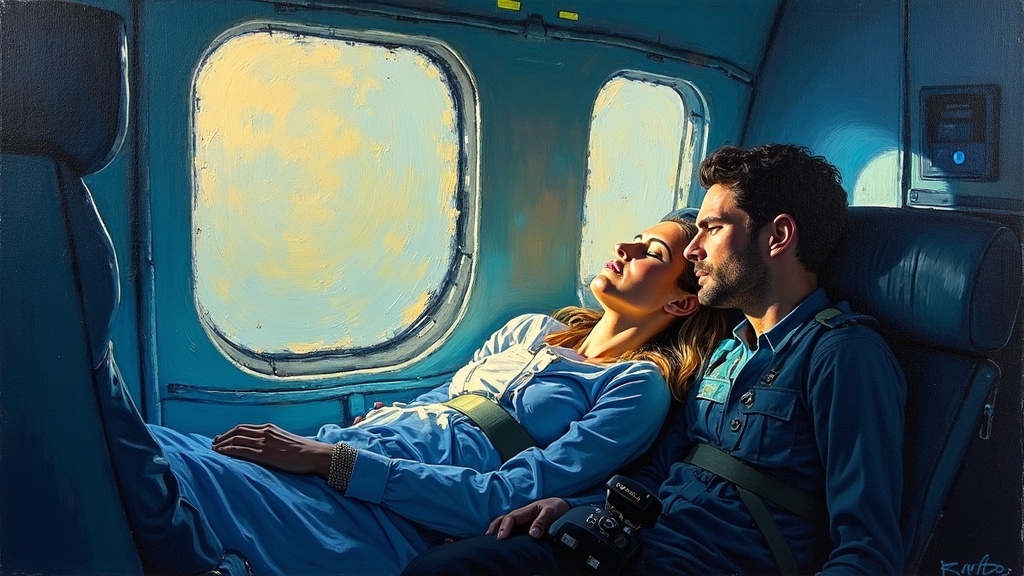
The sun came through the helicopter window at exactly the wrong moment, or maybe the right one. Amber Kavanaugh was strapped down, barely clinging to life after a massive stroke had destroyed two-thirds of the left side of her brain. Her husband sat beside her. The paramedics had let him come because they didn't want her to die alone. She was 40 years old. It was December 23rd, 2021. Her kids had already said goodbye. When the sunlight hit her face, she closed her eyes in the helicopter and opened them in a garden unlike anything she'd ever seen. The grass felt different under her feet. Everything glowed. She knew, without anyone telling her, that she was there to make a decision, and nobody was going to make it for her.
The Headache That Wasn't a Headache
Two days before Christmas, Amber Kavanaugh: "All of a sudden out of nowhere I did tend to get headaches like tension headaches weird sensation and then a super bad headache like it couldn't open my eyes type of headache."
She told her family she didn't feel well. She was supposed to cook Christmas dinner for 30 people in two days. She went to bed early, around 9 p.m. By 10:30, the pain was so severe she couldn't see straight. She texted her husband from the bedroom, asking for Tylenol and Advil. He brought them. She took them. Then, she thinks, she fell into unconsciousness.
What Amber didn't know was that her left carotid artery was dissecting. The artery was tearing itself apart, and as she later learned, "when your carotid dissects it actually I guess is painful and causes a super bad headache." While her family went through their normal bedtime routines, Amber's brain was being starved of oxygen. The dissection triggered a massive MCA ischemic stroke, and because she didn't wake up, it went all the way through her MCA2 region. The stroke completed. The tissue died. Then a secondary frontal lobe stroke began.
She woke up around 4:30 in the morning thinking she was dreaming.
The Fall and the Silence
Amber's bed sits high off the ground. The stroke had paralyzed her entire right side, but her brain didn't tell her that. She remembers: "Your brain doesn't tell you you're paralyzed I just didn't understand how why I couldn't move I couldn't do anything." She pushed herself up with her left side, stood, and when she put weight on her legs, her right side gave out. She crumbled to the floor.
She still didn't think "stroke." She thought she needed to get to the living room, to get her husband, but she couldn't talk. She couldn't scream. She couldn't make a noise. She tried to army-crawl across the floor. She couldn't. There was a wall right there. She doesn't know how long she tried. It seemed like a long time. Probably a couple of minutes. Finally, she banged on the wall five times, as hard as she could.
Her husband had been startled when she fell out of bed, but when he didn't hear anything else, he went back to sleep. The banging woke him. It also woke Amber's mother, who lives in the basement suite. Her husband came into the room and tried to pick her up. He asked: "What are you doing on the floor?" He tried to lift her under her arms. It's very hard to lift dead weight. He put her down, turned on the light, walked around, looked at her face, and said, "I think you're having an effing stroke."
The Nurse Who Saw
The paramedics brought Amber to the hospital. She was still completely conscious. They wheeled her into triage. She describes the scene: "They were talking and chatting and laughing all the paramedics not looking at me not anything and there was a nurse facing a different way checking in patients to the ER and he turned around and he looked at me and he said what are you guys doing she's clearly having a stroke what are you doing."
He picked up the phone and called a stroke code. Everything went super fast after that. She was in the CT scanner within minutes. They saw the carotid dissection. They saw the massive stroke. Amber was still in her body, but disconnected, floating slightly outside herself. She could hear them talking about what they could do, what they couldn't do, how extensive the damage was, how it might just be permanent.
They decided to give her TPA, clot-busting medication that works 50% of the time and also has a very high instant death rate. With TPA, you usually see improvement quickly. Nothing came back. Amber didn't start moving. She had no reaction to pain stimulus. She couldn't hold up her arm. The medication didn't work.
There was only one other option: brain surgery. But they didn't do that surgery at this hospital. They needed to life-flight her to another facility. There was a storm coming. The helicopter didn't want to fly. By this point, Amber's kids had arrived. The doctors and nurses had told them to come say goodbye, because more than likely their mother would not make it to the next hospital.
The charge nurse got on the phone and started screaming. Amber remembers her words: "I'm not gonna watch these kids watch their mom die on Christmas you are going to come it's like a 15-minute helicopter ride so you need to come." Finally, the helicopter agreed.
The Goodbyes
Amber was barely conscious. She remembers people saying goodbye. She remembers her kids. She remembers a couple of family members. People had been waking up, calling her sisters, calling other relatives. They were coming to say goodbye because she wasn't probably going to make it. The doctors were very clear. The damage was too extensive.
They strapped her into the Life Flight restraints. It was a beautiful day. The sun was out. It was early in the morning, maybe 9 o'clock. Amber remembers being pushed towards the helicopter, going in, and her husband being allowed to come with her. Normally nobody's allowed, but they didn't want her to die alone.
The helicopter took off. When they got up to a certain height, "the sun came in the window and hit my face as soon as the sun hit my face that was it I was on the other side."
The Garden
Amber's body was still clinging to life. She could see it. She could see her husband. But she didn't have a lot of attachment to her body anymore. She describes the transition: "It was like I closed my eyes and opened them and I was in this beautiful garden the grass in the water was not like nothing I've ever felt in my entire life."
She thinks she wasted more time feeling her feet in the grass than actually making the decision she was there to make. Because she knew, without a shadow of a doubt, that she was there to make a decision, and nobody was going to make it for her.
Amber thinks her experience was a little different than a lot of people's NDEs, because she didn't feel super pushed either way. Everything in the garden glowed with what she calls "essentially the light of God." There's just love that radiates from everything. She wasn't alone. Her guides, the beings she'd gotten to know very well since accepting her spiritual gifts, were there. They were sitting on a bench. She would sit with them for a bit, then get up and walk around.
Strangely, her husband was there. Her kids were there. She didn't talk to them, but her belief, even before the stroke, was that our higher selves are always on the other side, always connected to us but also connected to all the other lives we're living. She saw a couple of her animals that have passed. She saw one that hadn't passed yet, a pet that, unbeknownst to her, would die before she got out of the hospital. She saw her mother-in-law, who passed away in 2011.
To the side, there was a huge group of people. Dozens and dozens, maybe even hundreds. She looked closer: "I was like well that's weird like I I don't think I know them but then I kind of looked and concentrated and it was all of my other lives there to support me again we're all kind of one so we can look separate but we're not actually separate."

The Decision
Amber's guides told her she needed to make a decision whether or not she wanted to go back to the physical world or stay on the other side. She was very aware that this beautiful garden, although part of the other side, was kind of like an area where you can go when you're still human or attached to a human body. She knew that if she died, she would go to a different place.
In the garden, she looked like the best version of herself. She was 40 at the time, but she looked 25. She was wearing a beautiful white eyelet dress. She had no wrinkles. She had no laws, no weight, no heaviness to her. She had no pain, even though her physical body at that moment was still in the helicopter, clinging to life, with paramedics trying to keep her alive long enough to reach the next hospital for brain surgery.
Her guides told her what was going to happen with either choice. Once she got there, she knew everything. She understood everything. Every choice she had ever made in her life made sense: "Everything that I had ever regretted as a human or things that I had done to hurt people made sense there was no question there's just on all knowing that your life was planned to learn you're doing it right there's no judgment there was not one moment where I felt like any decision ever that I should regret."
Having that knowledge, having the ability to take away the human amnesia we're born with in order to survive here, made the decision so much easier. She could remove herself a little bit.
Her guides showed her what her kids' life and her husband's life would look like if she didn't go back. She still didn't feel sad, because she knew innately that they would have chosen and planned that as well. They showed her what she would do if she did go back. She would write books. She would speak to very important people about the gift we're given to learn. They showed her that 18 months after the stroke, she would be able to learn a lifetime's worth of patience to prepare her for what was coming.
But they also told her that those 18 months, especially the first six or eight, would be the hardest time she had ever lived. And Amber says: "I have not had an easy life at all full stop I've had a really difficult life but again it's kind you're kind of removed from that like okay yeah it's gonna be horrible but like everything feels so wonderful here I can handle that."
She didn't really realize what it would feel like to be completely paralyzed and not be able to talk. At the time, her body was paralyzed and she was not verbal. She wouldn't be able to eat or drink or go to the bathroom. But she still didn't feel like she had to do something one way or another. They really let her just sort of look at all options and try to figure out what would be the most comfortable for her.
There was a bit of a guiding energy of God. She didn't see God. She's clear about this: "A lot of people think God's an old white man he's definitely not God is more of an energy."
Something else was interesting. There were no words. Everything was telepathic. You just knew. As soon as you were there, that need to only hear things was gone.
Amber felt like she was there 50 years. She knows she wasn't. It was minutes. It was the time in the helicopter until she landed, got to the next hospital, and then had a grand mal seizure because her brain was swelling. Her guide said if she was going to die, she was going to have this seizure. They were going to try to resuscitate her, get her back, she'd go back and forth a little bit, and then she was going to actually die at 12:22 on December 23rd. That was her physical time frame. She was still alive. She just wasn't attached at all to her body. She was on the other side.
When she finally made the decision that she was going to come back, "nobody pressured me they just showed me my past present and future with either choice I decided to come back and in the instant I made the decision I was out of the garden and that was it and I'm like what."
The Light-Filled Waiting Room
But she didn't go back to her body. Not yet. She went to what she wants to call a light-filled waiting room, but it wasn't a waiting room. It was just this light-filled, all-encompassing area where she could watch herself. She could kind of see her family still, but her soul was back connected with her body. She got to make the decision whether or not she wanted to be in her body with the seizure, because they can be really painful. She didn't want to. So she got to stand and watch.
She could see her husband. When the seizure happened, she was in the hospital. She started seizing. Grand mal seizures look really scary. It took a long time for it to stop. She watched that happen. As soon as the seizing stopped, her body went into an almost comatose state, falling asleep really deeply. That's when she rejoined: "I was in the light filled rating room and then I wasn't and I was fully in my body and it that was it it was kind of Blackness and pain I think."
Then it was a waiting game. The doctor came in and said they'd brought her for brain surgery, but after seeing the MRI, the brain surgery wasn't going to help her. The damage was too extensive. They could maybe go in and take the blood clot from the small stroke, but there was a huge chance, 70-plus percent, that doing that would cause a stroke on the other side of her brain and she'd die anyway.
Miraculously, Amber didn't die in that first 24 hours. They moved her from the ICU. Over the next couple of days, the neurologists and doctors all said this is her, this is going to be her life, she's going to need continuous care. She had a catheter. She couldn't eat. She was being fed through her nose down a tube. She couldn't walk. She couldn't go to the bathroom. She couldn't turn over to avoid bedsores. They were very realistic that she'd probably be in the hospital for a long time, maybe move to a rehab facility to try to get something back, but more than likely this was going to be her forever.
Then, hour after hour, she started talking. On December 27th, she walked for the first time. She walked to the bathroom.
What She Wants You to Know
Amber says that going to the other side "was the most exciting time in my life because I've never felt more peaceful or more wonderful or more grounded or more belonging."
She wants people to know that we get to choose. We get to choose what we learn, and we come here to learn. On the other side, everything is love. There is nothing else. In her view and what she's seen, there's no hell, there's no punishment, there's no judgment. The only thing that happens there is love. We come here to experience everything else.
The reason we're here is to learn: "Your human self doesn't choose that's chosen before you come here and we get to choose exactly how we learn and how we experience Our Lives the learning and where we focus that learning is what makes us move forward."
It's not punishment. It's not God or your guides on the other side saying, "Oh hi here you go have this you suck have fun trying to walk through that." No. It's your guides and God and everyone you love saying: "We know you are strong enough to walk through this life we're gonna walk beside you as you learn these lessons."
If you ignore the lessons, they'll keep throwing them at you. So try to focus on what the lessons are. That's why we're here. We are here to learn.
Amber has shared more details about her experience and recovery in other interviews, including how she continues to navigate the ongoing challenges of stroke recovery while holding onto the profound peace she found in that garden.
What This Story Reveals
Amber Kavanaugh's account sits at the intersection of medical catastrophe and spiritual clarity. She suffered one of the most devastating types of stroke, a carotid dissection with a completed MCA2 infarction and secondary frontal lobe involvement. Two-thirds of the left side of her brain died. The medical team told her family she would not survive, and if she did, she would need lifelong continuous care. She was paralyzed, non-verbal, unable to eat or eliminate waste on her own.
Five days later, she walked to the bathroom.
The medical literature on stroke recovery is clear: completed MCA strokes of this magnitude do not resolve in days. Neuroplasticity is real, but it takes months or years, not hours. Amber's recovery defies the standard trajectory. The doctors who treated her had no explanation. But Amber does. She says she was shown, in that garden, that 18 months after the stroke she would have learned a lifetime's worth of patience. She was told the first six to eight months would be the hardest time she'd ever lived. She was also told she would recover enough to write books and speak to important people.
She's doing that now. You can hear more of her story in this interview about the purpose of existence and this account of her ongoing lessons.
What strikes me most about Amber's NDE is the lack of coercion. She wasn't pushed to return. She wasn't told she had unfinished business. She wasn't given a mission and sent back. She was shown two possible futures with equal clarity and equal love, and she was allowed to choose. This is rarer than you might think. Many NDEers describe being told they must return, or feeling a pull back to their bodies they can't resist. Amber stood in that garden, feeling the grass under her feet, and was given full autonomy.
The detail about her other lives showing up to support her is also significant. Amber isn't describing past-life memories in the traditional sense. She's describing simultaneous lives, all happening at once, all connected through the same higher self. This maps onto the most consistent reports from deep NDEs: time is not linear on the other side. All moments exist simultaneously. The life you're living now is one thread in a vast tapestry (sorry, I mean a vast web, a vast network) of experiences your consciousness is having across multiple dimensions and timelines.
The telepathic communication is another hallmark of profound NDEs. Words are too slow, too imprecise, too limited. On the other side, you think and the other being knows. You wonder and the answer appears. There's no gap between question and understanding. Amber describes this as an "all knowing," and it gave her the clarity to review her entire life without judgment. Every choice made sense. Every regret dissolved. Every hurt she'd caused was part of the planned curriculum.
This is what I want you to understand: Amber Kavanaugh was not shown a highlight reel of her best moments. She was shown everything, including the things she regretted as a human, the things she'd done to hurt people, and she felt no judgment. Not from her guides, not from God, not from herself. Because on the other side, she could see the purpose of every experience. She could see that her life was planned to learn, and she was doing it right.
That's the gift of the NDE. It removes the human amnesia we're born with. We come into these bodies with no memory of who we are or why we're here, because if we remembered, we couldn't fully engage with the lessons. But in the NDE, the amnesia lifts. You remember. You see the plan. You understand the curriculum. And then, if you choose to return, you come back with that knowledge intact.
Amber came back. She chose the harder path, the path of paralysis and pain and months of brutal recovery, because she was shown she would eventually be able to help others understand what she now knows: we are here to learn, we are surrounded by love, and there is nothing to fear on the other side. Her body was destroyed. Her brain was mostly dead. But her consciousness, the part of her that stood in that garden and felt the grass and made the choice, was completely intact. It always was. It always will be.
That's what every NDE points to. Consciousness is not produced by the brain. Amber's brain was catastrophically damaged, but she was more lucid, more aware, more herself than she'd ever been. She spent what felt like 50 years in a place outside of time, reviewing her past, present, and future, while her physical brain was swollen and seizing and dying. If the brain creates consciousness, this should be impossible. But it happened. It keeps happening. Thousands of people have reported the same thing.
Amber Kavanaugh walked out of that hospital five days after a stroke that should have killed her or left her in a vegetative state. She's writing books now. She's speaking to people. She's doing exactly what she was shown she would do in that garden, in that moment when the sun hit her face and she left her body behind and went home for a little while. She came back because she chose to. And she brought the message with her: we are here to learn, we are never alone, and love is the only thing that's real.
Was this article helpful?